

Acroplous was an Early Permian temnospondyl from North America. A find in Kansas established the genus. Later material from Nebraska revealed more of its skull and showed an unusual joint between the halves of the lower jaw.
Quick facts
| Group | Temnospondyls, dvinosaurians |
|---|---|
| Age | Early Permian |
| Region | North America: Kansas and Nebraska, United States |
| Type species | Acroplous vorax |
| Scientific name | Acroplous |
| Diet | Unknown |
What can the fossils tell us?
KUVP 9822 includes a partly disarticulated skull and associated bones. Later studies added material from both states.
Researchers compare the positions of openings and sutures, the lower jaw joint and the shape of the ilium.
Some palate bones carry small denticles. They do not establish what Acroplous ate.
The original find and later specimens
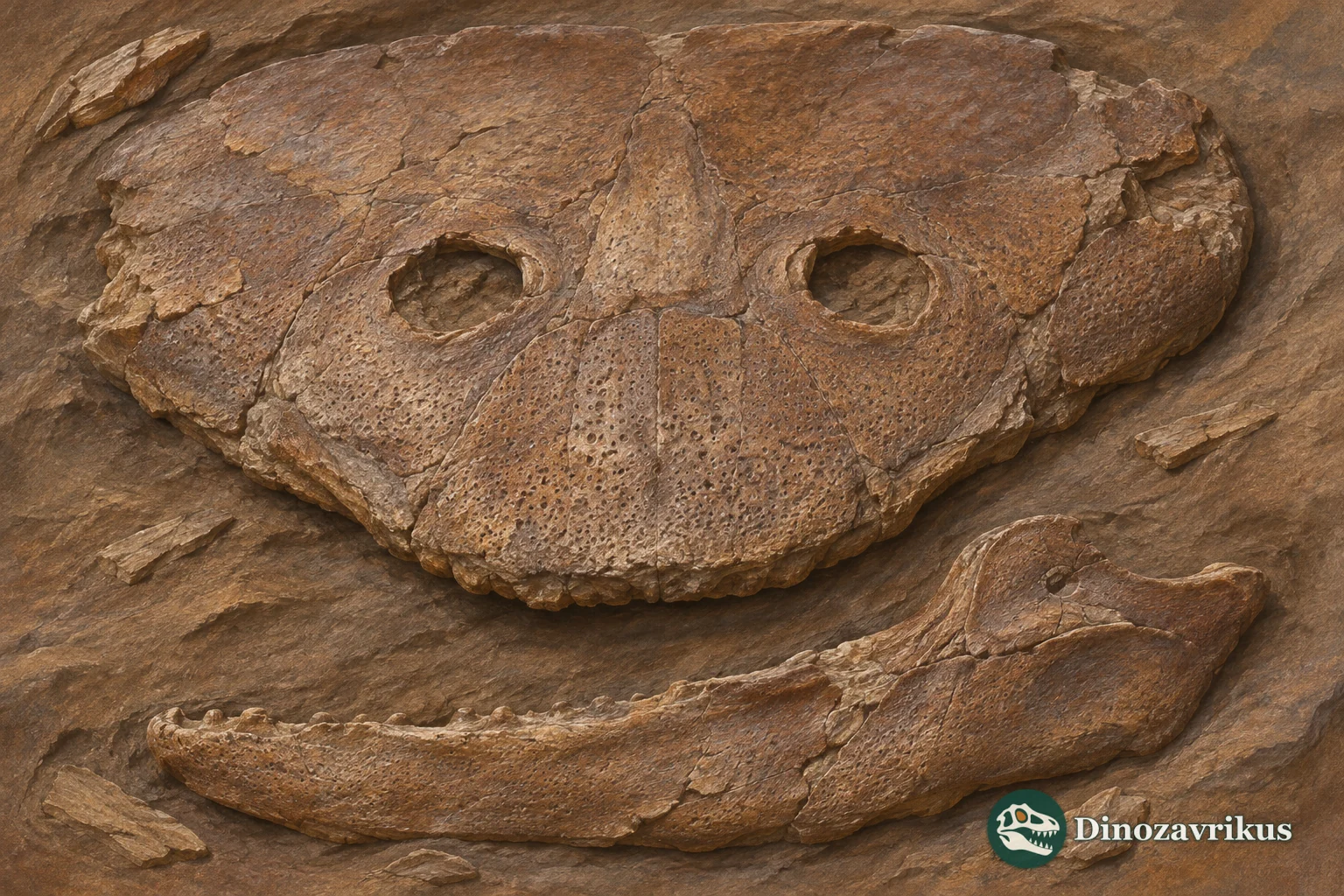
Nicholas Hotton named Acroplous vorax in 1959. The holotype, KUVP 9822, includes a skull and associated bones from the Speiser Shale of Kansas. Later specimens from Kansas gave researchers more of the skull for comparison.
What the Nebraska finds revealed
In 2008 researchers described specimens from the Eskridge Formation of Nebraska and re-examined earlier finds. The Nebraska material dates to the Asselian, the earliest part of the Permian. The additional fossils made it possible to compare anatomical features that are hard to see in the type specimen.
The skull roof has an opening at the front, between the premaxillae. The lacrimal meets the eye socket and several palate bones carry small denticles. At the front of the lower jaw the bony margins interlocked where the two halves met. The researchers also described an elongated rod-like ilium.
Relationships among dvinosaurs
Acroplous belongs to Dvinosauria, a branch of temnospondyl amphibians. It was traditionally grouped with Isodectes in Eobrachyopidae. The 2008 analysis placed Isodectes on an earlier branch, raising questions about the limits of that family.
Frequently asked questions
Where was Acroplous found?
Secure records come from Early Permian deposits in Kansas and Nebraska.
What does the type specimen preserve?
It includes a partly disarticulated skull and other bones found with it.
How did the halves of its lower jaw join?
The bony margins interlocked where the halves met at the front. This feature was described in the later study.
What did Acroplous eat?
Small denticles survive on the palate, but its exact diet remains unknown.