
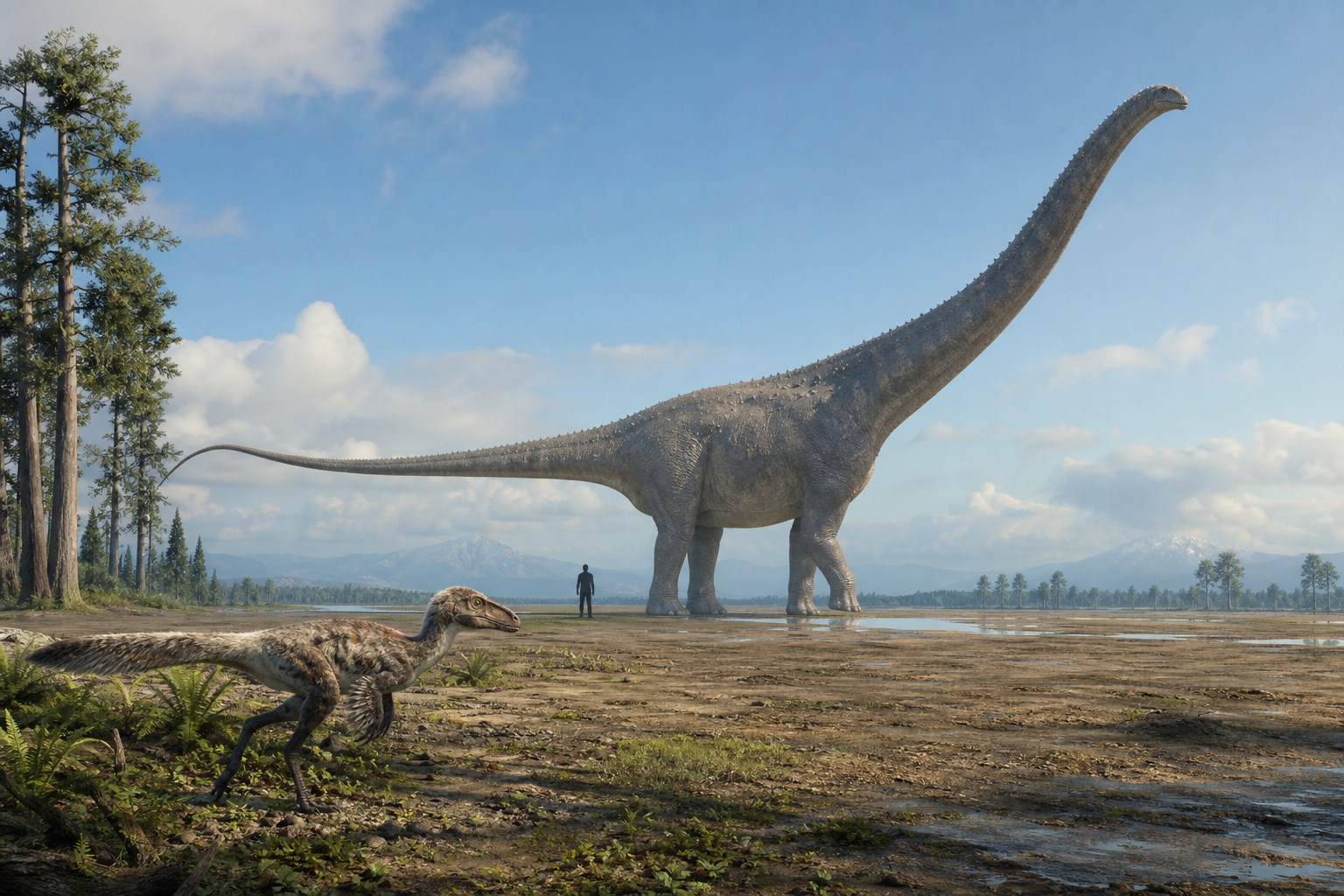
Dinosaur size is not one number. Length measures the path from snout to tail tip, height depends on posture and mass depends on reconstructed body volume. A long, lightly built animal can be longer than a compact animal that weighs far more. The calculator separates these quantities and treats each preset as a representative estimate within a wider published range.
What the calculator does – and does not do
The length comparison divides the selected value by the typical length of an adult person or a city bus. The mass comparison uses a 75-kilogram adult and a 6,000-kilogram African elephant. These are scale references, not claims that a dinosaur had the same shape, density or load distribution.
You can choose a preset or enter custom values. A Velociraptor preset shows how a two-metre animal can remain much lighter than a person because its tail makes up much of the length. The Tyrannosaurus rex preset shows a shorter total length than many sauropods but a deep, heavy torso and skull.
Length, height and mass answer different questions
Total length is usually reconstructed along the vertebral column. It depends on the number of missing vertebrae, the amount of cartilage between them and the curve assigned to the neck and tail. Standing height depends on limb posture and whether the head is held low, level or raised.
Mass asks how much three-dimensional tissue surrounded that skeleton. Two animals can share a length yet differ greatly in chest depth, pelvis width, muscle volume and air spaces. That is why “longest dinosaur” and “heaviest dinosaur” are separate questions.
From preserved bones to a complete body
A nearly complete skeleton still contains gaps. Cartilage decays, small bones are lost and a carcass may be scattered before burial. Researchers measure preserved elements, compare them with articulated relatives and state which pieces have been restored. A single enormous bone can suggest a large animal, but scaling an entire body from one element carries more uncertainty than rebuilding a skeleton from many associated parts.
Museum mounts add another layer. Early mounts sometimes bent tails too sharply or straightened necks into poses that living joints would not allow. Modern digital articulation tests joint surfaces and range of motion, but cartilage thickness and habitual posture remain reconstructed.
Estimating mass from limb bones
In land animals, the circumference of weight-bearing limb bones correlates with body mass. Equations derived from living animals can therefore estimate the mass of a dinosaur from the femur and humerus. The method is valuable because those bones respond mechanically to body weight.
The relationship has statistical scatter. A biped and a quadruped distribute load differently, and a fossil may be crushed or incomplete. The result is an estimate with an interval, not a prehistoric weighbridge reading.
Estimating mass from body volume
Volumetric methods begin with a mounted or digitally articulated skeleton. The researcher adds plausible muscles, organs, skin and other soft tissues, calculates the volume and applies tissue densities. Several “slim” and “robust” envelopes can show how much the answer changes when the chest or tail is reconstructed differently.
Air sacs and air-filled spaces in sauropod vertebrae reduce density in parts of the body. The lungs, abdomen and neck do not share one uniform density. Good models therefore divide the body into regions instead of treating it as a solid block.
Why published estimates differ
Two careful studies can produce different results because they use different specimens, skeletal poses, statistical equations or soft-tissue envelopes. The animal may also have changed shape as it matured. A range can combine those sources of variation without pretending that every value is equally likely.
A useful comparison names the specimen or at least the kind of individual, states the method and keeps units consistent. It should not compare the maximum extrapolated length of one species with the mass of a particular skeleton from another.
Small dinosaurs
Many non-avian dinosaurs were smaller than people. Anchiornis specimens were roughly 35–65 centimetres long, and estimates for small individuals can be close to a few hundred grams. Long feathers enlarged the visible outline without adding much mass.
Naming an absolute smallest dinosaur is difficult. Some specimens are juveniles, some lie close to the evolutionary origin of birds, and some species are known from too little material to establish adult size. Modern birds are living dinosaurs, so including them moves the lower boundary down to a few grams.
Medium-sized dinosaurs were common
The gap between a tiny feathered theropod and a giant sauropod contains most dinosaur body plans. Many ornithopods, early sauropodomorphs and small theropods ranged from tens of kilograms to a few tonnes. They attract fewer record headlines but reveal how dinosaurs divided food, habitat and movement across an ecosystem.
Stegosaurus could be about 7–9 metres long and roughly 3–5 tonnes. Triceratops had a broadly similar length but a deep torso and enormous skull; large individuals are often estimated at roughly 6–10 tonnes. Similar length did not mean similar mass.
Giant predators
Large adult T. rex skeletons reach about 12–13 metres and commonly yield mass estimates near 7–9 tonnes. Spinosaurus may have matched or exceeded that length, but its proportions were very different and its skeleton is reconstructed from incomplete individuals. Recent models often place it at several tonnes rather than treating old 17–18 metre extrapolations as established fact.
Giganotosaurus and Carcharodontosaurus also rivalled tyrannosaurs in length. Their largest specimens are less complete, making a permanent league table misleading. Longest reconstructed skeleton, heaviest well-sampled adult and theoretical maximum body size are three different contests.
The longest and heaviest land animals
Sauropods entered a size range no other land vertebrate has matched. Diplodocus carnegii is usually reconstructed around 24–26 metres long but only about 12–16 tonnes because its neck, trunk and tail were relatively slender. Some shorter titanosaurs were several times heavier.
Patagotitan is represented by bones from at least six similarly sized individuals. Published approaches have produced a broad span of mass estimates, with values commonly discussed in the tens of tonnes. Argentinosaurus and other contenders are less complete. “One of the largest known dinosaurs” is more defensible than declaring a winner to the nearest tonne.
Why sauropods could become gigantic
No special Mesozoic gravity is required. Long necks expanded the feeding area without moving the whole body. Rapid food intake, a large digestive system, air-filled vertebrae, efficient breathing and fast growth all changed the constraints on size. Egg laying also separated the mass of the mother from the size of a developing offspring.
No single feature created gigantism. The result came from interacting anatomy, physiology, reproduction and ecology. The dinosaur encyclopedia shows how those factors can be tested against fossils from individual species.
How tracks contribute
A trackway records an animal moving across a real surface. Footprint length and stride can estimate hip height and speed, independent of a mounted skeleton. But a track rarely identifies the maker to a genus. Soft foot pads enlarge the outline, and wet sediment changes its shape.
Tracks can test whether a proposed gait is plausible and indicate the general scale of the maker. They cannot supply mass to the nearest kilogram or prove a body-size record without compatible skeletal evidence.
Frequently asked questions
What was the largest dinosaur?
Giant sauropods such as Patagotitan and Argentinosaurus were the heaviest known dinosaurs, but incomplete skeletons and overlapping mass ranges prevent a single undisputed winner.
Why can’t scientists give an exact dinosaur weight?
No extinct non-avian dinosaur was weighed alive. Researchers infer mass from limb-bone dimensions or three-dimensional body volumes, and both methods include statistical and reconstruction uncertainty.
Were all dinosaurs larger than people?
No. Many non-avian dinosaurs were shorter or lighter than a person. Velociraptor weighed only about 15–20 kilograms, and some feathered dinosaurs weighed a few hundred grams.
Can dinosaurs be compared by length alone?
No. A long neck or tail adds length without adding the deep body volume of a heavier animal. Length, mass, height, proportions and fossil completeness must be considered separately.