

Adinotherium was a genus of extinct South American notoungulates from early Miocene Patagonia. It was one of the smaller toxodontids: published body-mass estimates range from roughly 75 to 120 kilograms. It was related to the much larger Nesodon, but differed in size, skull proportions and several features of the cheek teeth.
The history of Adinotherium shows why a list of names is not the same as a count of well-supported species. Many names were proposed in the late nineteenth century from abundant skulls and teeth. Later revisions compared type specimens, growth stages and individual variation, and combined many of those names. More Patagonian fossil mammals appear in the ancient mammal catalogue.
Quick facts
| Scientific name | Adinotherium Ameghino, 1887 |
|---|---|
| Group | Notoungulata; Toxodontidae, Nesodontinae |
| Most studied species | A. ovinum (Owen, 1853) |
| Age | Early Miocene Santa Cruz Formation, Patagonia |
| Material | Skulls, jaws, teeth and postcranial bones |
| Estimated mass | Published estimates range from about 75 to 120 kg |
| Key caution | Species lists differ among taxonomic revisions |
What can the fossils tell us?
Adinotherium was smaller and more gracile than Nesodon, with a combination of skull proportions and cheek-tooth characters. Variation has been assessed across a sample rather than a single ideal skull.
Cassini, Flores and Vizcaíno compared 17 cranial variables in 23 Adinotherium ovinum specimens. Positive allometry in parts of the face suggests changes in the chewing system during growth, but does not prove a narrow dietary specialization.
Hernández Del Pino reviewed more than seventy names applied to Santa Cruz toxodontids. The revision treated names including Adinotherium splendidum, A. rotundidens and A. corriguenense as synonyms of A. ovinum and recognized one valid species in the formation; other summaries retain some names.
Comparative morphometric analyses characterize Adinotherium as a medium-sized herbivore that could feed on grasses and leaves as availability changed. Vegetation and climate are reconstructed for specific formation intervals, not directly from an individual skull.
Discovery and naming
Florentino Ameghino named Adinotherium in 1887 in a work on mammals collected by his brother Carlos in Patagonia. The collections became the basis for descriptions of many South American fossil mammals, but the rapid introduction of new names created taxonomic confusion. Later researchers returned to original descriptions, illustrations and surviving type material to test which characters actually separated taxa.
The name is usually translated as “fearful beast.” It is a historical label, not a description of predatory or dangerous behaviour. Adinotherium was a plant-eating notoungulate, not a predator.
Type species and changing names
Taxonomic sources do not always list the same type species. A 2019 review of the Santa Cruz Formation fauna along the Río Santa Cruz names A. magister Ameghino, 1887 as the type species and lists other species historically recognized in the formation. Santiago Hernández Del Pino's 2018 dissertation treats A. ovinum as the only valid species of Adinotherium in the Santa Cruz deposits. The name that anchors a genus and the currently accepted species content are related but distinct questions.
Richard Owen described the best-studied species in 1853 as Nesodon ovinus; it was later combined as Adinotherium ovinum. The 2018 revision proposed that several names by Ameghino and Mercerat are synonyms of A. ovinum, including A. splendidum, A. rotundidens, A. corriguenense, Atryptherium bifurcatum and Acrotherium stygium. These are not spelling variants; they are names that the revision combined after comparing diagnoses and specimens.
The same dissertation retained several poorly testable names as nomina dubia, or doubtful names that cannot be confidently assigned to a diagnosable species. A 2019 fauna review lists several Adinotherium species and retains some older names. The difference should be reported as a difference between taxonomic treatments rather than hidden behind a single supposedly final checklist.
Skull, teeth and skeleton
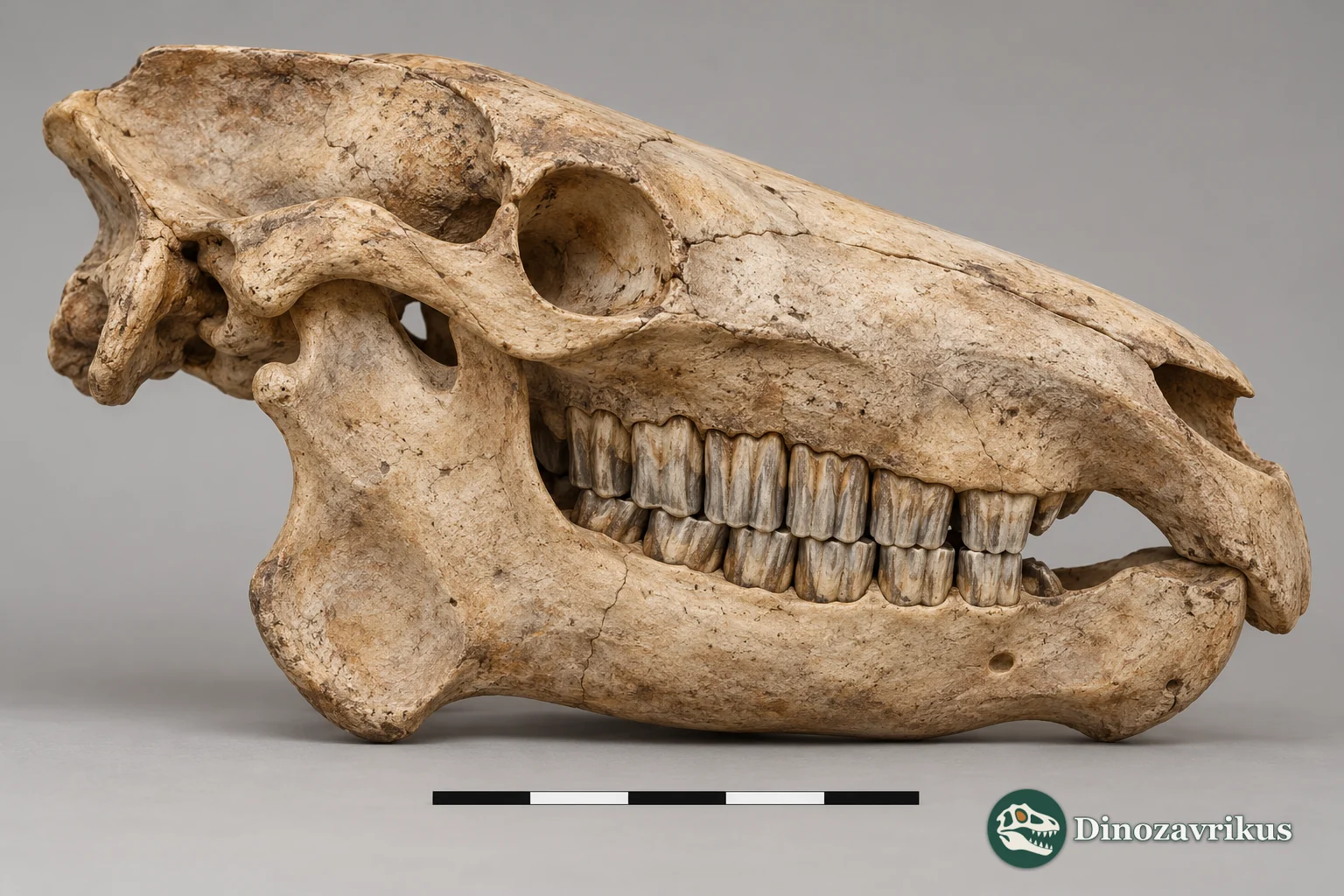
Compared with Nesodon imbricatus, the skull of Adinotherium ovinum is smaller and more gracile. In dorsal view its outline has been described as pentagonal. The skull is long and relatively low, while the profile of the frontal region varies: some individuals have a nearly straight outline, others a stronger rise. Age and individual variation matter, so a single feature should not be assessed outside a series.
The dental apparatus is distinguished by more than size. The upper premolars of Adinotherium have a simpler occlusal pattern than those of Nesodon, although this is easier to see in lightly worn teeth. Lower molars differ in the relative breadth of their anterior portion and talonid. Both genera have enlarged lateral incisors and cheek teeth that are high-crowned but not continuously growing. These traits help frame questions about chewing mechanics, but do not by themselves prove a single dietary specialization.
The Santa Cruz Formation record includes more than isolated teeth. Well-preserved skulls and near-complete skeletons have been described, making the anatomy much better known than in mammals represented by single teeth. Still, a reconstruction of any particular specimen should be tied to its catalogue number and description; a composite outline should not be mistaken for one articulated skeleton.
Body size and growth
Published body-mass estimates for A. ovinum include about 120 kg in a study of postnatal skull growth and a mean estimate of about 75 kg in the 2018 dissertation. The difference is not a measurement of two separate populations. Body mass in an extinct animal is calculated from selected skeletal variables and comparative models using living species; samples, variables and methods can change the result. The range is more honest than a falsely precise single number.
Cassini, Flores and Vizcaíno measured 17 cranial variables in 23 A. ovinum specimens spanning different growth stages. Seven of the sixteen variables compared showed positive allometry, in which a part grows faster than skull length; eight were close to isometric. Changes in the rostrum, palate and muscle-attachment regions were especially relevant. The authors interpreted these patterns as strengthening of the adult chewing system, but did not find support for a highly specialized diet.
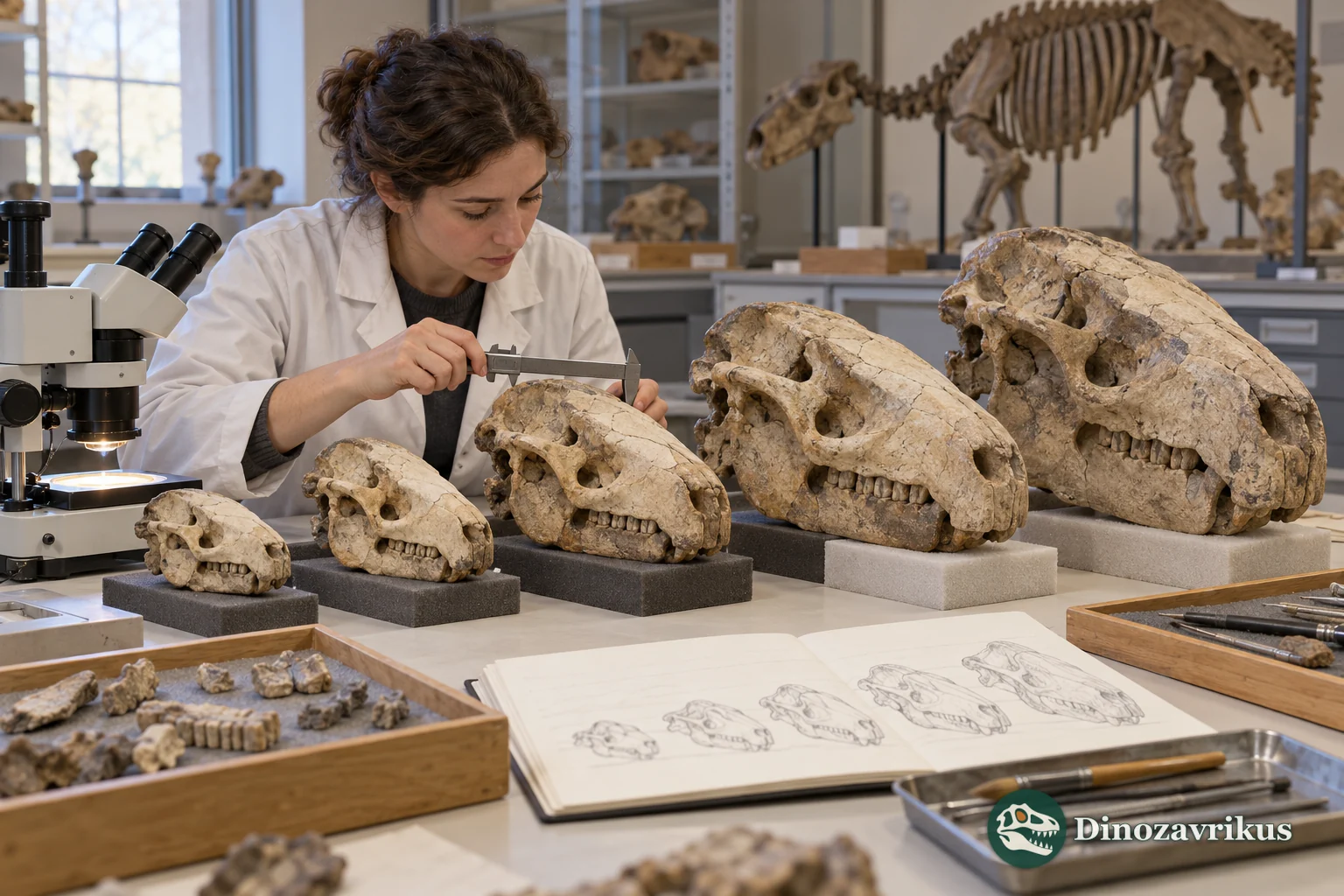
The 2018 dissertation also discusses a bimodal distribution in some measurements of adult skulls. The author suggested it might reflect a physical secondary sexual trait, but presented this as a possible explanation. Without an independent way to determine sex, sexual dimorphism remains a hypothesis rather than a demonstrated fact.
Diet and environment
The skull and teeth support herbivory, but researchers have debated the balance of grasses, leaves and other plants. Cassini's 2013 functional and morphometric study classifies Adinotherium as a medium-sized form that could feed on grasses and leaves depending on availability. Other analyses emphasize similarities between cranial and dental traits and those of animals from more open habitats. Such comparisons do not yield a precise list of plants eaten by an individual.
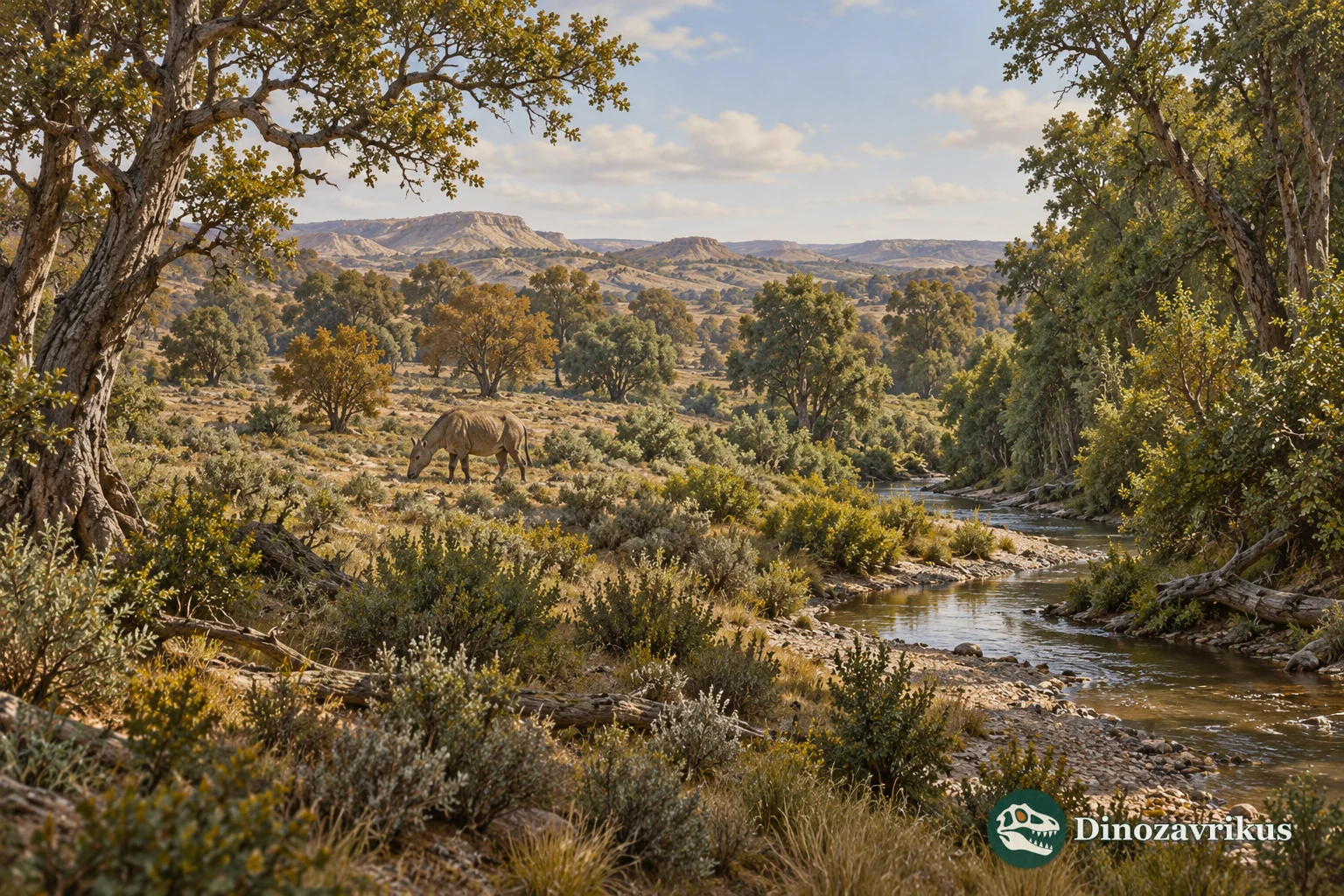
The Santa Cruz Formation was not one unchanging landscape. A paleoecological study of geographically and stratigraphically confined localities along the Río Santa Cruz describes a mosaic of semi-deciduous forests, open areas and gallery vegetation. Isotope studies of the enamel of large herbivores indicate C3 plant consumption and changes in moisture through time. Those results apply to particular samples and intervals, not automatically to the entire range of the genus.
The available evidence does not securely describe reproduction, social groups, seasonal movement or disease in Adinotherium. Near-complete skeletons and skull series inform anatomy and growth, but bones do not automatically preserve behaviour or reproductive biology.
What the reconstructions show
Bones directly record skull, tooth and skeletal form; measured series reveal variation among individuals and growth stages. Diet and habitat are inferred from morphology, comparative models and the formation's geology. Coat colour, soft tissues and specific behaviour in an illustration remain artistic choices.
This distinction matters for Adinotherium: its resemblance to a sheep inspired the nickname “Patagonian sheep,” but the animal belonged to a separate South American lineage of notoungulates. The nickname does not imply close relationship to sheep and cannot replace anatomical comparison.
Frequently asked questions
When did Adinotherium live?
The best-studied material comes from the early Miocene Santa Cruz Formation of Patagonia. Individual sections have their own dates, and the age range of an entire formation should not be assigned to every specimen without its locality context.
What is the type species of Adinotherium?
A 2019 review of the Santa Cruz fauna names Adinotherium magister as the type species. A 2018 revision recognizes A. ovinum as the only valid species in the formation and synonymizes several historical names with it. Type designation and the accepted species list answer different questions.
How much did Adinotherium weigh?
Published estimates include about 75 kg and about 120 kg. These are calculations from bones and comparisons with living animals, not direct weighing, so they should be reported with their source and uncertainty.
What did Adinotherium eat?
It was herbivorous. Comparative analysis supports a mix of leaves and grasses depending on availability, but the exact diet of an individual cannot be established.