

Adunator was a small Paleocene eutherian known mainly from dental fossils. Its type material comes from Europe, while similar North American teeth have prompted changing synonymies and relationship hypotheses.
The genus is included in the ancient mammal catalogue. The fossil record is informative about teeth but leaves the body and behaviour largely unknown.
Quick facts
| Scientific name | Adunator Russell, 1964 |
|---|---|
| Type species | Adunator lehmani Russell, 1964 |
| Group | Early placental mammal; classification disputed |
| Age | Paleocene; exact interval depends on the specimen |
| Range | Walbeck, Germany; Cernay-lès-Reims, France; North American material assigned by some authors |
| Type specimen | Wa 368, dental material from Walbeck |
| Known remains | Mostly isolated teeth and dental fragments |
| Body size | No reliable whole-body estimate from a complete skeleton |
What can the fossils tell us?
Donald Russell described Adunator lehmani in 1964 from material at Walbeck. The type specimen Wa 368 allows comparisons of dental anatomy, but it is not a complete skull or skeleton.
Researchers compared the Walbeck type with North American jaws and teeth. Some authors treated Mckennatherium and Diacocherus names as part of Adunator; others retained distinctions because the upper and lower teeth were not consistently associated.
The genus has been discussed in connection with Walbeck, Cernay-lès-Reims and North American localities. These are separate fossil assemblages, and their ages should not be reduced to one precise date without a specimen-level stratigraphic context.
Several studies placed Adunator among erinaceomorphs, while a phylogenetic proposal considered it near the stem of Macroscelidea. Most available characters come from teeth, so the wider relationship remains debated.
The name and type material
French palaeontologist Donald Russell established Adunator in his 1964 monograph on European Paleocene mammals. The type species is A. lehmani. Its key specimen, Wa 368, comes from Walbeck in Germany and preserves dental material rather than an articulated skeleton.
Russell also discussed material from Cernay-lès-Reims in France. Later comparisons questioned whether every tooth assigned to the genus belonged to one coherent group. The map of reported occurrences therefore reflects successive taxonomic decisions as well as fossil geography.
No complete skeleton is known. Teeth cannot establish the animal's body proportions, tail length, gait, coat or colour. A small molar measurement reported for some North American samples is a tooth dimension, not a body-size estimate for every specimen assigned to the genus.
Dental anatomy and what it can show
Descriptions of Adunator emphasize the shape of its lower molars and premolars. Researchers compared the relative size of the molars, the arrangement of cusps and the form of the talonid basin. Those characters help distinguish fossil teeth, but many early eutherians share combinations of similar dental traits.
Comparative studies have sometimes inferred a diet of small animal prey from the teeth. No stomach contents, coprolites or direct feeding traces are known for Adunator, so a specific menu is not established.
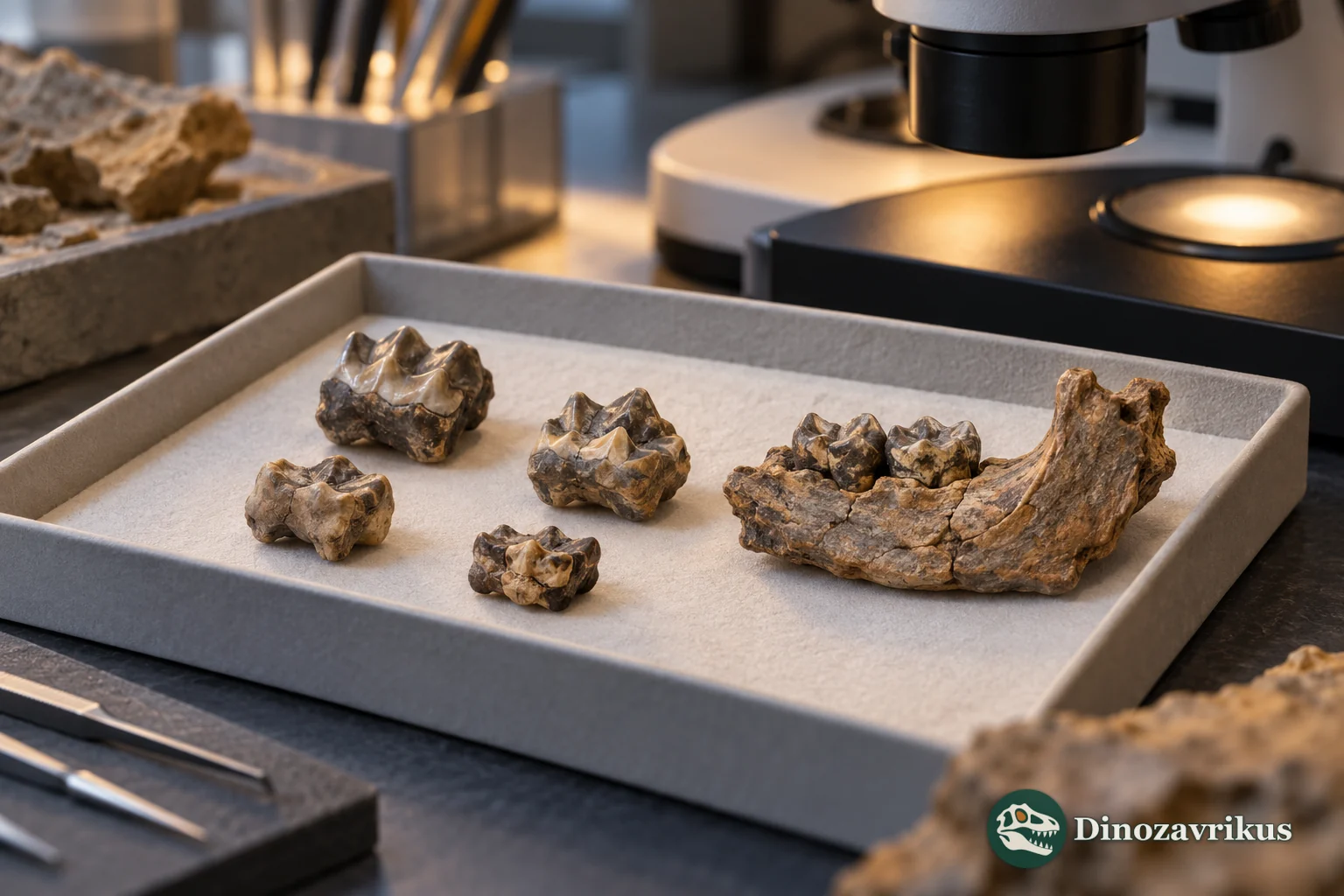
Names, synonyms and changing relationships
The most persistent taxonomic question concerns North American dental material once described under names such as Mckennatherium and Diacodon minutus, later called Diacocherus. Bown and Schankler's 1982 review judged some lower-tooth differences too slight to justify separate genera. Novacek and colleagues later treated Diacocherus as a synonym of Adunator. Other authors continued to distinguish some samples, especially where upper and lower teeth could not be linked in the same individual.
Ross Secord's study of the Tiffanian land-mammal record recognized Adunator amplus from Rock Bench Quarry in Wyoming and discussed how far the genus could be expanded. Its diagnosis rests on dental comparisons, not a full skeleton.
Higher classification is also unsettled. Many studies place the genus among early Erinaceomorpha. Hooker and Russell's 2012 phylogenetic treatment proposed a position on the stem of Macroscelidea. Both interpretations rely heavily on limited dental characters, which can evolve in similar ways in unrelated mammals.
Age, geography and the limits of reconstruction
European records connect Adunator with Paleocene faunas at Walbeck and Cernay-lès-Reims. North American specimens come from several localities and stratigraphic intervals, and their referral to the genus varies among revisions. A single exact age range would hide these differences.
The sediment and associated fauna at each locality provide the best evidence for its environment. The teeth alone do not demonstrate one particular forest type or behaviour. The cover reconstruction is deliberately hypothetical: it illustrates a small early mammal, not a measured portrait of Adunator.

Until more associated cranial and postcranial remains are found, the most secure story of Adunator concerns its tooth anatomy and the history of competing names. Broader claims about size, movement or ecology should remain provisional.
Frequently asked questions
When did Adunator live?
Its fossils are assigned to Paleocene faunas, but the precise interval depends on the locality and on which North American samples are included in the genus.
Where was the type species found?
The type species Adunator lehmani was described from Walbeck, Germany. Specimen Wa 368 anchors the name but is dental material, not a complete skeleton.
Is a complete skeleton known?
No. Most evidence consists of isolated teeth and dental fragments, so body proportions and many aspects of its behaviour remain unknown.
Why are Mckennatherium and Diacocherus sometimes treated as synonyms?
Some revisions considered their lower teeth too similar to those of Adunator for separate genera. Other authors retained distinctions because upper and lower teeth are not always associated.