

Aegyptosuchus peyeri is known from the Cenomanian rocks of Egypt’s Bahariya Oasis. Ernst Stromer described it in 1933. Part of the skull survived the wartime destruction of the Munich museum, allowing researchers to compare it with later finds from Morocco.
Quick facts
| Species | Aegyptosuchus peyeri |
|---|---|
| Age | Cenomanian, Late Cretaceous |
| Locality | Bahariya Oasis, Egypt |
| Formation | Bahariya Formation |
| Holotype | BSPG 1912 VIII 177, partial cranium |
| Collection | Bavarian State Collection, Munich |
What can the fossils tell us?
The back of the head can be compared directly with later finds. Associated vertebrae were destroyed and are known from Stromer’s account.
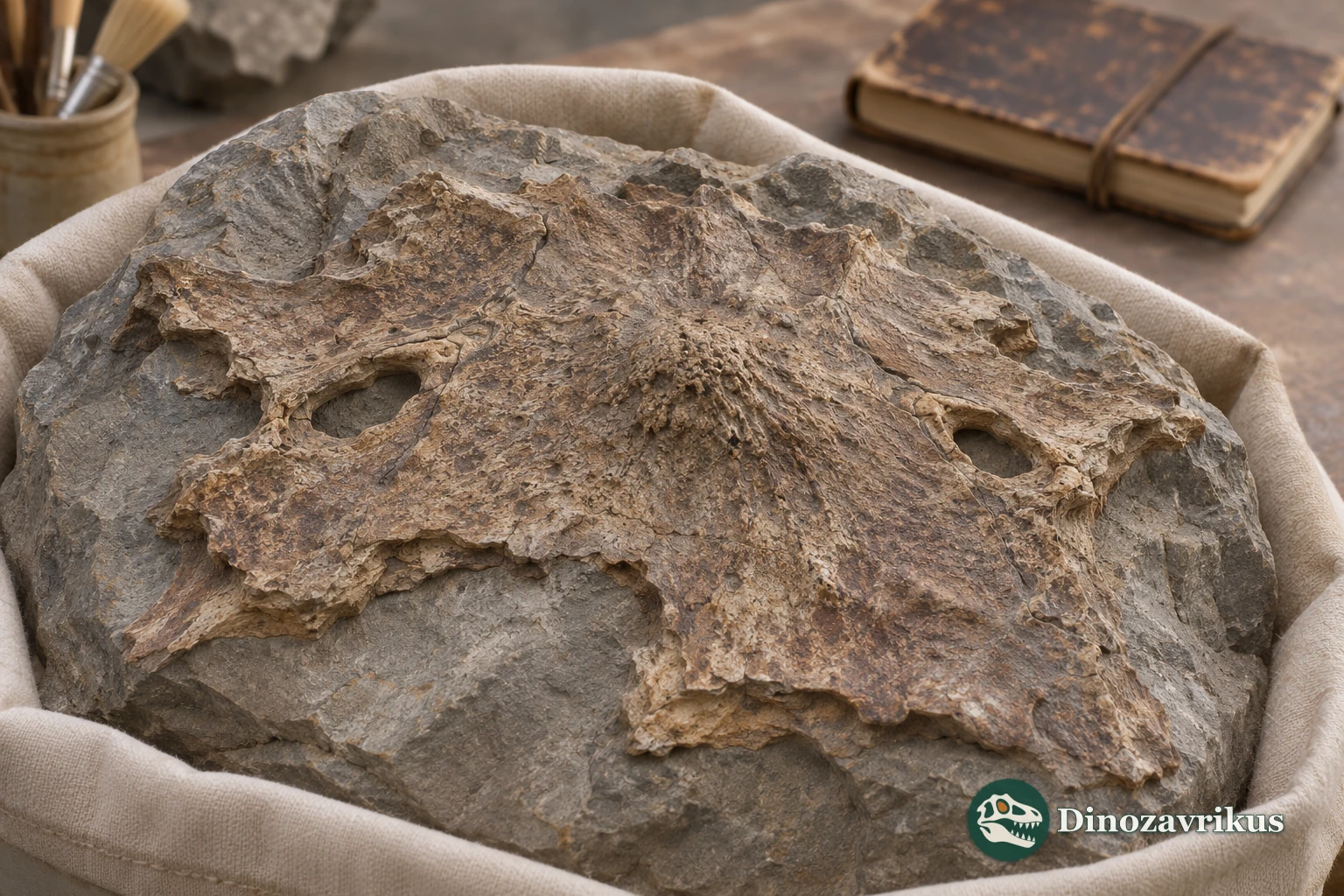
The skull table carries a rough central swelling and two small fossae. These details survive, but the missing snout leaves its proportions unknown.
Shared features link Aegyptosuchus to the Moroccan Aegisuchus. Similarities in drawings of Stomatosuchus also raise the possibility that the two Egyptian names refer to the same animal.
What survived in Munich
Stromer described Aegyptosuchus from the Bahariya Formation in Egypt’s Western Desert. The specimen now consists of part of the rear of the skull. Vertebrae described with the find were destroyed during the Second World War.
The skull table is thick and the upper temporal fossae are small. A rough swelling lies on the midline. The comparable swelling on the Moroccan Aegisuchus is more clearly defined and framed by a shallow vascular depression. No equally distinct border is visible on Aegyptosuchus.
Two comparisons with North African crocodyliforms
Casey Holliday and Nicholas Gardner proposed the family Aegyptosuchidae for Aegyptosuchus and Aegisuchus in 2012. They based the grouping on similarities in the preserved skull region. Comparison of the complete outline of the snout is impossible with the known Egyptian specimen.
A 2020 study noted that several features are also present in old drawings of Stomatosuchus from the same formation. That skull was destroyed, so the comparison relies on published illustrations. Aegyptosuchus may be a junior synonym of Stomatosuchus, but the available overlap is too limited to settle the question.
The coast recorded at Bahariya
Tidal channels and vegetated coastal flats occupied areas of the Cenomanian landscape. The formation has also yielded fish, turtles and dinosaurs, including Spinosaurus. These fossils and sediments establish the regional setting. The skull fragment alone gives little evidence of which habitats Aegyptosuchus used or what it ate.
Frequently asked questions
Where does the skull come from?
It comes from the Cenomanian Bahariya Formation of Egypt’s Western Desert.
Was all of Stromer’s material destroyed?
Part of the skull survived. The vertebrae described in association with it were lost.
How does it differ from Aegisuchus?
The rough central swelling is less sharply defined, and the clearly bounded surrounding depression seen on Aegisuchus is absent.
Could it be the same animal as Stomatosuchus?
That possibility was proposed on the basis of similarities visible in published illustrations. The surviving material cannot settle it.