

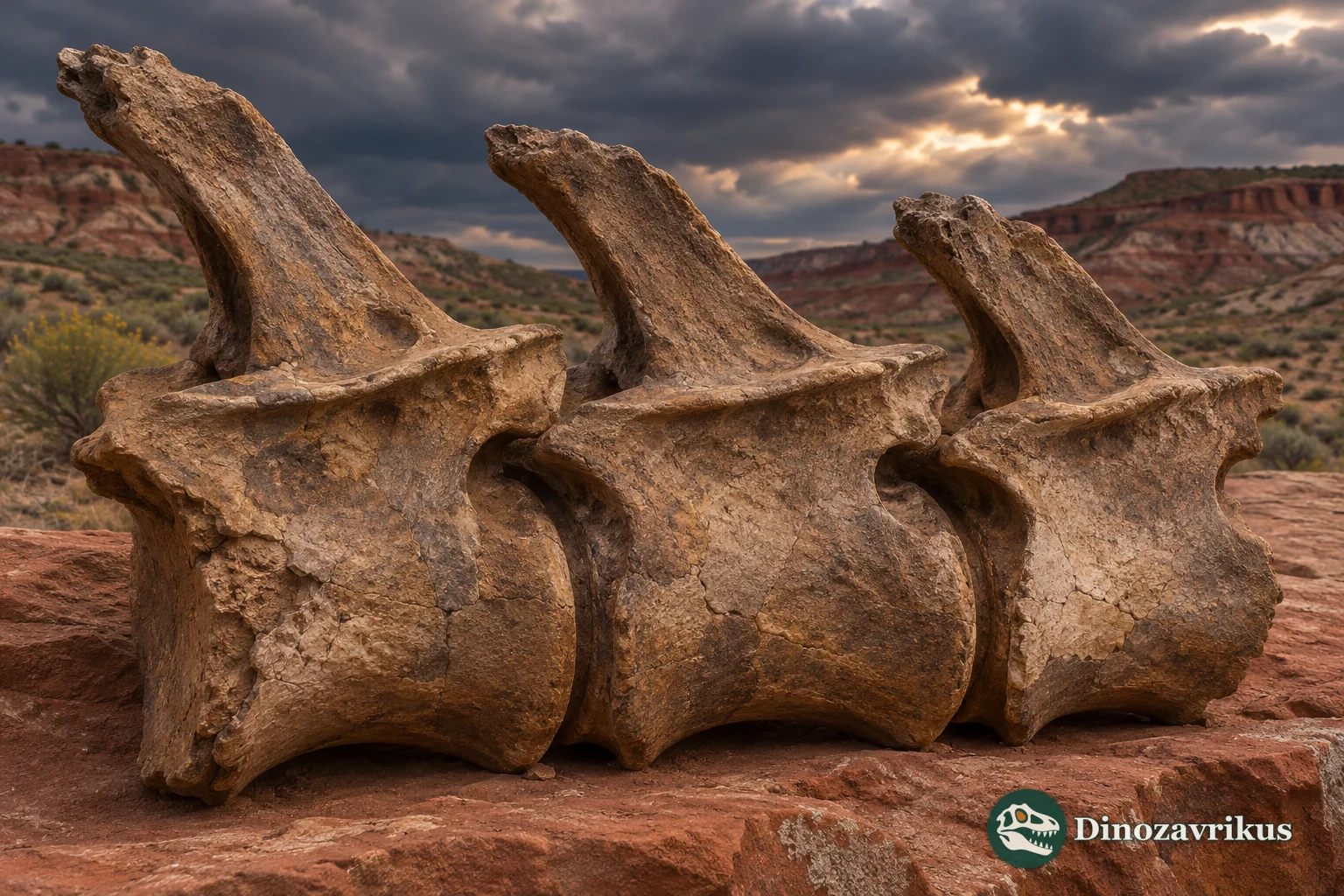
Aeolosaurus was a Late Cretaceous sauropod from Argentina. Its species are compared primarily through their tail vertebrae. Some bony projections lean forwards, and the positions of the joints help distinguish the genus from other titanosaurs.
Quick facts
| Group | Sauropods, titanosaurs (Titanosauria) |
|---|---|
| Age | Late Cretaceous |
| Region | South America (Patagonia, Argentina) |
| Diet | Herbivorous |
| Type species | Aeolosaurus rionegrinus |
| Holotype | MJG-R 1, partial skeleton with tail vertebrae |
| Strata of the type species | Angostura Colorada Formation |
What can the fossils tell us?
It preserves seven anterior tail vertebrae and bones of the girdle and limbs. The skull is unknown.
An articulated tail sequence from central Patagonia shows how joint shape changed along the tail.
A new study of the vertebral features and relationships of the former Brazilian species led to the name Arrudatitan.
Two Patagonian localities
Jaime Powell established the type species, Aeolosaurus rionegrinus, from fossils at Casa de Piedra in Río Negro Province. The partial skeleton comes from the Angostura Colorada Formation. It preserves front tail vertebrae with parts of the shoulder girdle and limbs.
The second species, Aeolosaurus colhuehuapensis, was described in 2007 from UNPSJB-PV 959 in central Patagonia. The specimen includes an articulated series of tail vertebrae. A series makes it easier to place a feature along the tail before comparing it with an isolated bone.
Tail spines and joints
On some vertebrae the neural spines tilt towards the base of the tail, in the direction of the pelvis. The shape of the vertebral bodies and the position of the joint surfaces between them also help identify the bones. In the second Argentine species, a deep hollow occurs near the base of the spine in the front part of the tail.
These features support comparisons with aeolosaurins such as Maxakalisaurus, which some analyses place in that group. The exact relationships depend on which comparable bones each specimen preserves.
What became of the Brazilian species?
The species Aeolosaurus maximus from São Paulo State was previously placed in this genus. A reassessment of its backbone and evolutionary relationships established the separate genus Arrudatitan. The strongest record of Aeolosaurus remains in Patagonia. Its sauropod anatomy supports plant eating, while the fossils offer no direct identification of its food.
Frequently asked questions
Where are securely identified Aeolosaurus fossils found?
They come from Patagonia in what is now Argentina.
What does the type specimen preserve?
MJG-R 1 preserves front tail vertebrae and parts of the girdle and limbs.
Why are the tail vertebrae used to identify Aeolosaurus?
They combine distinctive spine shapes with particular positions of the joint surfaces.
Is the former Brazilian species maximus still an Aeolosaurus?
A revision assigned that species to the separate genus *Arrudatitan*.