

A 234 millimetre upper wing bone from Chad provided the basis for naming Afrocygnus, a Late Miocene swan. The bone is comparable in size to that of a living black swan, but its shape differs. Fossils from Libya and South Africa hint at a wider distribution, with varying certainty about which birds they represent.
Quick facts
| Family | Anatidae |
|---|---|
| Group | Swans |
| Age of type locality | Late Miocene, about 7 million years ago |
| Type locality | Toros-Menalla, Chad |
| Holotype | Left humerus TM 112-00-196 |
| Named by | Antoine Louchart and colleagues, 2005 |
What can the fossils tell us?
The 234 mm humerus is comparable in size to that of a black swan. The measurement sets a scale for the wing bone while leaving the bird’s mass and wingspan uncertain.
The Chadian ulna resembles those of swans. Its size and geological context supported referral to the named species, although the preserved end lacks a unique feature.
The Chadian type specimen defines the species. The Libyan material was cautiously compared with it and the South African find was tentatively assigned at genus level.
One wing bone named a swan
Antoine Louchart, Patrick Vignaud, Andossa Likius, Hassane Taisso Mackaye and Michel Brunet named Afrocygnus chauvireae in 2005. The genus name means African swan and the species honours palaeornithologist Cécile Mourer-Chauviré. The holotype comes from site TM 112 in the Anthracotheriid Unit of Toros-Menalla, Chad, dated by the authors to about seven million years ago.
The complete left humerus measures 234 millimetres long and 12.9 millimetres across at the narrowest part of the shaft. The shape of the bone distinguished the fossil from living members of Cygnus. A black swan provides a useful size comparison for this element. The exact dimensions of the complete bird are unknown.
How far did it range?
The lower fragment of a right ulna, TM 242-03-021, came from another Toros-Menalla site. It matches small swans in size and general form, although its surviving anatomy is too similar to living swans to identify it by itself. The researchers considered it likely to belong to the same species as the humerus. The two specimens do not represent one associated skeleton.
At Sahabi in Libya, fossils once compared with geese were referred to Afrocygnus cf. A. chauvireae. The abbreviation signals a cautious comparison with the Chadian species. A humerus from early Pliocene Langebaanweg in South Africa was subsequently compared with the genus. That tentative identification is a possible range extension without a species-level match.
A swan near freshwater
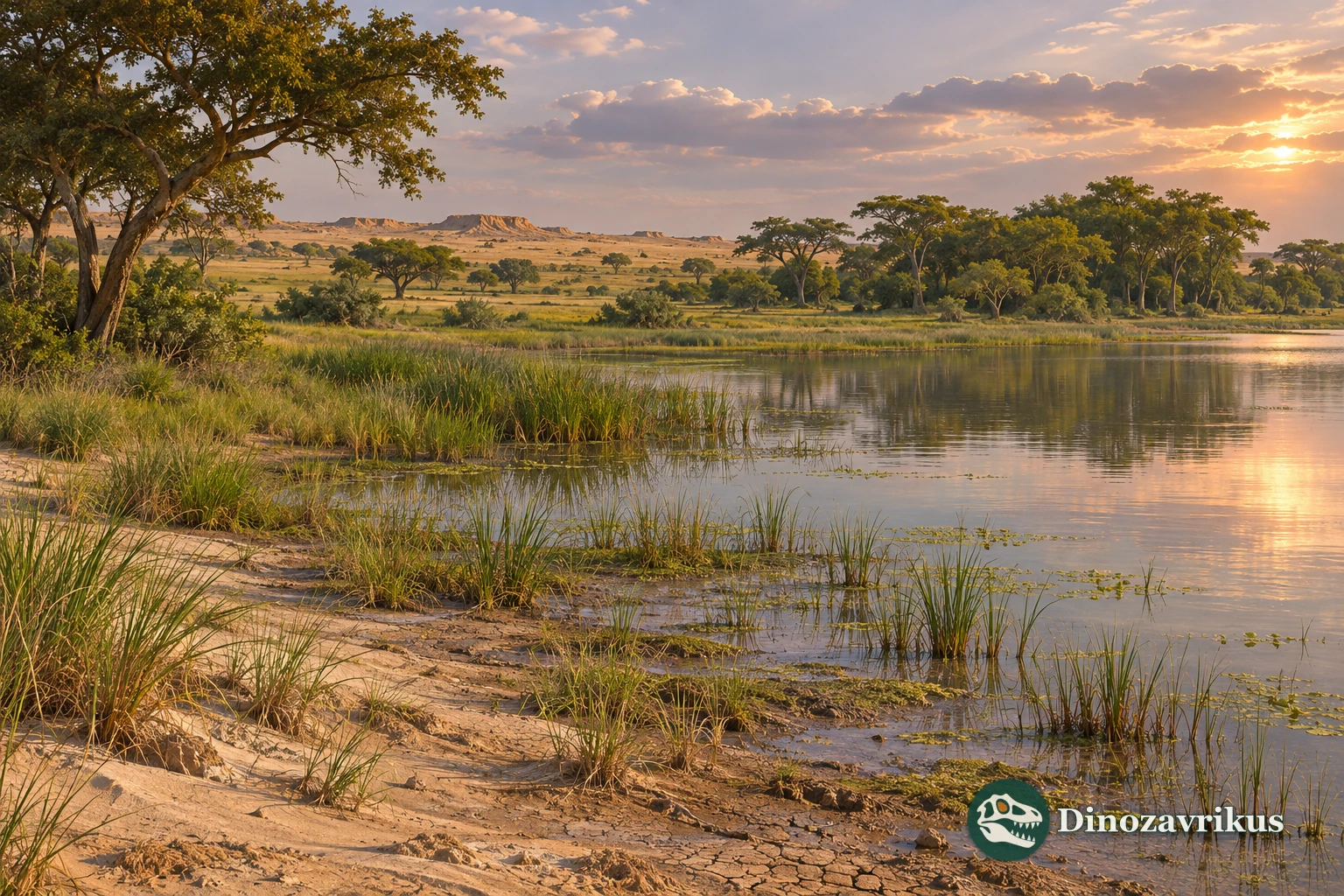
The Chadian and Libyan material led the original authors to infer calm freshwater bodies near the deposits. Wing bones do not reveal what the bird ate. A swan-like outline is a reasonable way to illustrate its affinities, while the precise neck length, bill and colour remain matters of interpretation.
Fossil waterfowl occupied a range of habitats. In Australia, the foot of Wilaru suggests a greater emphasis on walking on land. The Chadian Afrocygnus material preserves wing bones, so the same kind of foot-based comparison is unavailable here.
Frequently asked questions
Why is Afrocygnus considered a swan?
The combination of features in the upper wing bone was closest to those of swans when compared with other living and extinct waterfowl.
What is 234 millimetres long?
That is the length of the holotype humerus, one bone in the wing. It is not a measurement of the full bird or its wingspan.
Is the species known from South Africa?
A South African wing bone was tentatively compared with the genus. The named species is based on material from Chad.
When did Afrocygnus disappear?
The fossil occurrences give approximate ages for the recorded populations. They do not establish exactly when the lineage disappeared.