

Agadirichnus is a name for fossil tracks from the Maastrichtian Tagragra Formation near Agadir, Morocco. The prints were first described in 1954, but the original specimens were later regarded as lost, creating uncertainty about how securely the name could be used. In 2018 researchers revisited the historical tracksite, studied new material and designated a neotype. Their work supported a pterosaurian interpretation, but it did not uncover the bones of the animal that made the impressions.
Quick facts
| Name | Agadirichnus elegans Ambroggi and de Lapparent, 1954 |
|---|---|
| What is named | An ichnotaxon based on fossil tracks, not a skeleton-based genus |
| Type locality | Tagragra, near Agadir, Morocco |
| Formation and age | Tagragra Formation, Maastrichtian, Late Cretaceous |
| Reassessment | A neotype was designated after the site was rediscovered in 2018 |
| Track condition | The reported impressions are isolated, not a continuous trackway |
| Trackmaker | Interpreted as pterosaurian; the skeletal taxon is unknown |
What can the fossils tell us?
The named material comes from Maastrichtian beds of the Tagragra Formation. Prints record contact with sediment but do not preserve bones or soft tissues.
The 2018 authors designated a neotype after the original material was regarded as lost. This anchors use of the name but does not connect it to a bone-based genus.
Morphotype I was tentatively compared with Pteraichnus; morphotype II matched the original Agadirichnus elegans concept. They are not one demonstrated trackway.
The isolated prints do not establish stride length, speed, wingspan, colour, diet, or the exact species of trackmaker.
A name described in 1954
Jacques Ambroggi and Albert-Félix de Lapparent named Agadirichnus elegans in 1954 from footprints near Agadir. At the time, the impressions were discussed as possible lizard tracks. The name is an ichnotaxon: it classifies a recurring trace form, not an animal known from a skeleton.
The original slabs later became unavailable for comparison. Without the type material, researchers could not easily check the morphology that supported the name. In 2003, Jean-Paul Billon-Bruyat and Jean-Michel Mazin suggested that Agadirichnus might be an older name for Pteraichnus, and argued that the track taxonomy needed tighter criteria. A 2009 reassessment also treated the lost originals as a problem for establishing the taxon's validity.
The rediscovered Tagragra site
In 2018, Moussa Masrour, Marc de Ducla, Jean-Paul Billon-Bruyat and Jean-Michel Mazin revisited the historical Tagragra tracksite. New impressions from the locality allowed the researchers to compare the traces with the earlier description. They designated a neotype, a replacement name-bearing specimen used when the original type is lost or unavailable.
The study reassessed Agadirichnus elegans as a valid pterosaurian ichnotaxon. This is a conclusion about the origin and naming of tracks. It is not the discovery of a pterosaur body fossil, and the neotype does not identify a particular skeleton-based genus.
Two forms, not one continuous trail
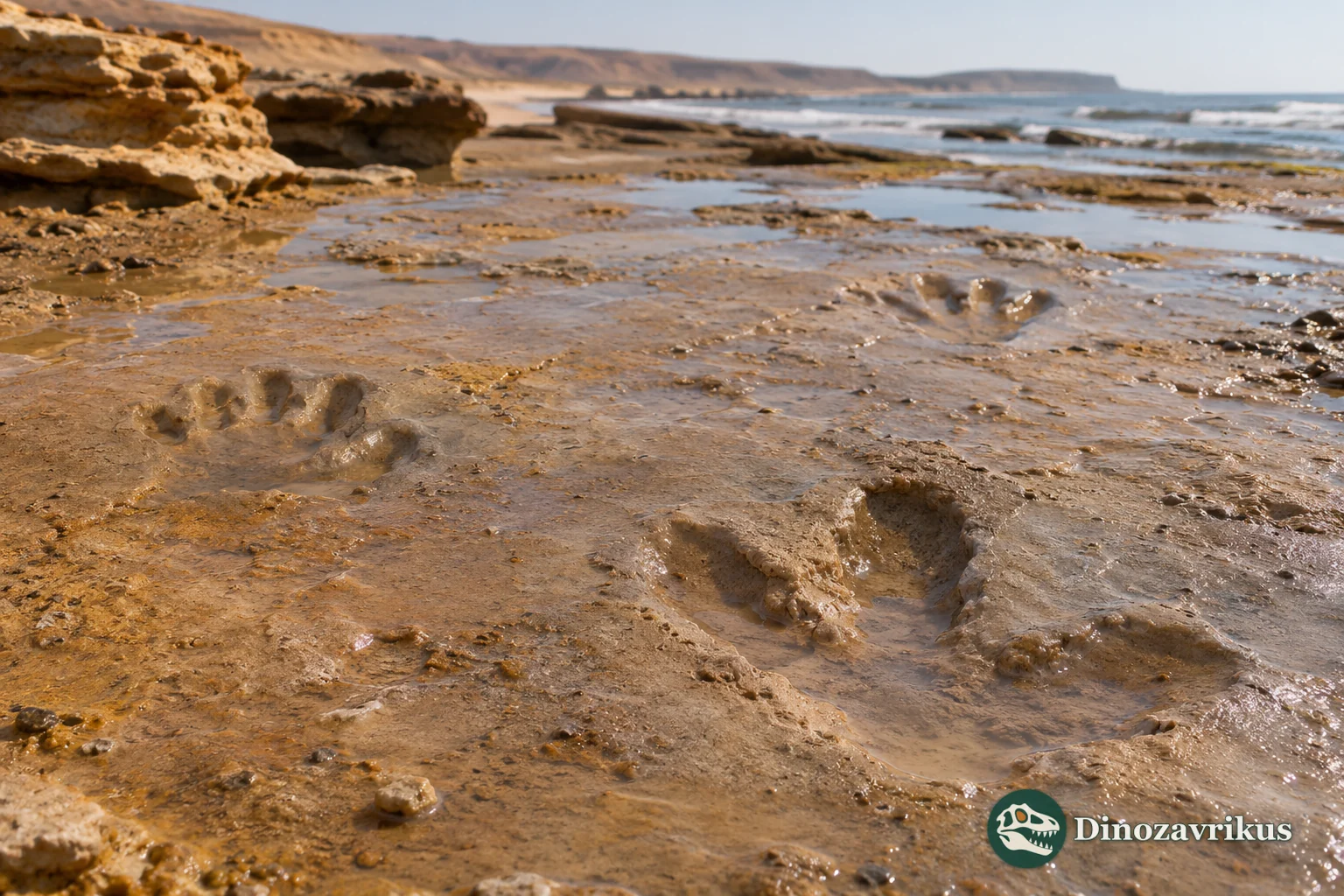
The 2018 paper distinguished two morphotypes at the locality. The first was tentatively referred to Pteraichnus; the second matched the original concept of Agadirichnus elegans. The authors' distinction helps prevent every print from the site being assigned to one name just because it occurs in the same formation.
The studied prints are isolated rather than arranged in a true trackway. They therefore do not provide a sequence from which to calculate stride, pace angle, speed, or direction of travel. Nearby impressions may belong to different steps or individuals, and the rocks do not show that the animals crossed the surface at the same time.
What the tracks can and cannot identify
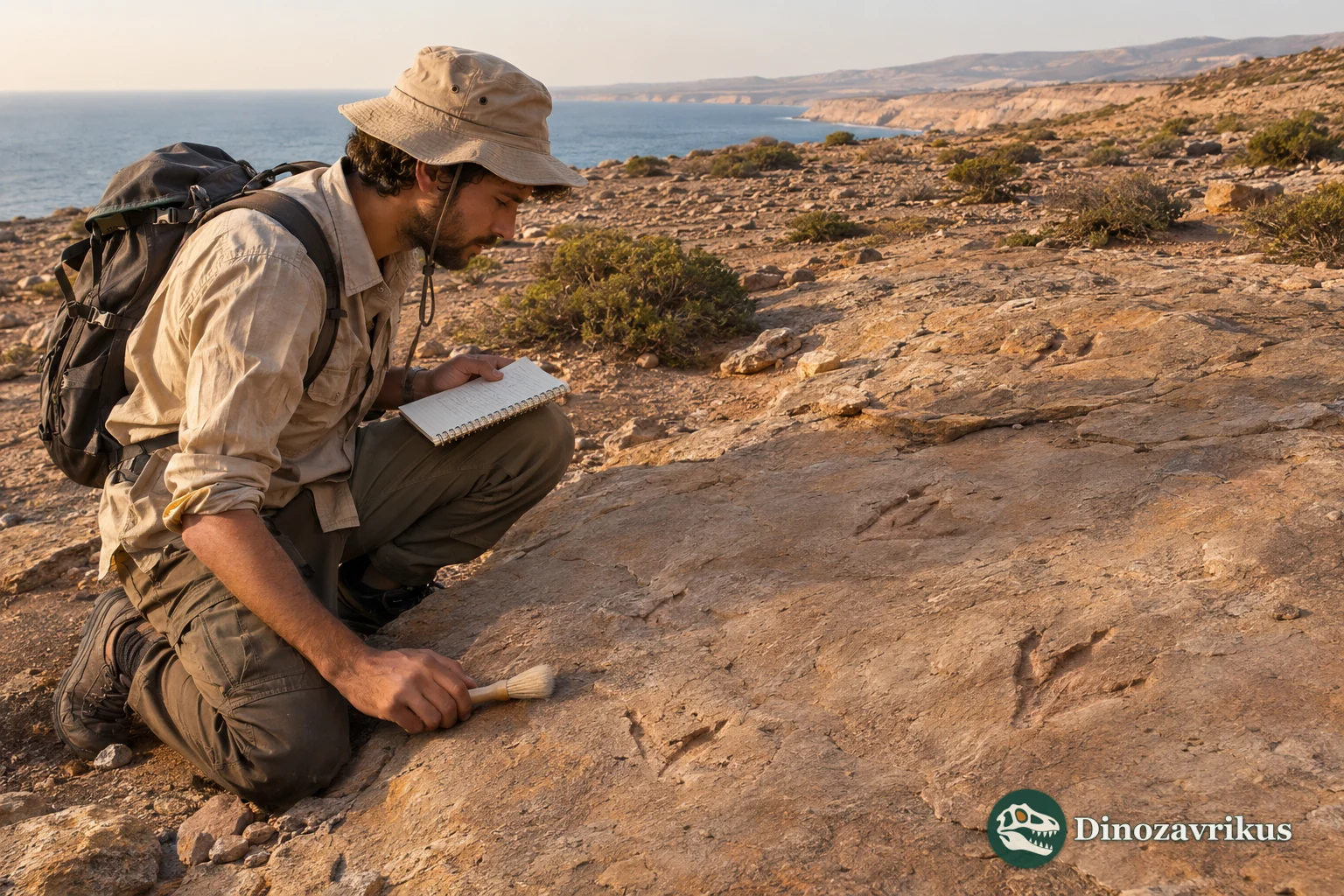
The form of the hand and foot impressions, compared with other fossil traces, led the authors to support a pterosaurian identity. Track morphology can record the digits that touched the ground and the way an animal loaded the sediment. It is less informative about traits that never contacted the surface, such as the skull, wing membrane, colour, or crest.
The tracks do not securely identify a skeletal genus or species. A possible relationship to broad pterosaur groups can be discussed by comparing print shape and the regional fossil record, but such comparisons remain inference. Pteraichnus illustrates how trace names and skeletal taxonomy need to be kept distinct. Haenamichnus offers a useful contrast because its longer sequences permit questions about step arrangement that isolated Tagragra prints cannot answer.
Age and coastal setting
The tracks come from the Tagragra Formation, dated to the Maastrichtian Stage of the Late Cretaceous. That places the impressions near the end of the Cretaceous Period. The age of a track-bearing layer does not show that the maker belonged to a specific skeleton-based species known from another site or that it followed a particular migration route.
The rediscovered locality has produced several isolated impressions, but not a continuous sequence on the surfaces studied in 2018. The cover shows an imagined coastal flat with separated prints. It is not a photograph of the Tagragra site, and it avoids assigning a precise body shape to an animal known only through traces.
Frequently asked questions
Is Agadirichnus an animal?
No. It is an ichnotaxon, a name for a fossil trace. No associated bones establish a skeleton-based genus.
Why was a neotype needed?
The original 1954 specimens were later regarded as lost. The 2018 team rediscovered the historical locality and designated new name-bearing material.
Were all the Tagragra prints assigned to Agadirichnus?
No. The 2018 study distinguished two morphotypes. One was tentatively compared with Pteraichnus; the other matched Agadirichnus elegans.
Can the exact pterosaur species be identified?
No. The print morphology supports a pterosaurian interpretation but does not preserve the diagnostic bones needed to name a skeletal genus or species.