

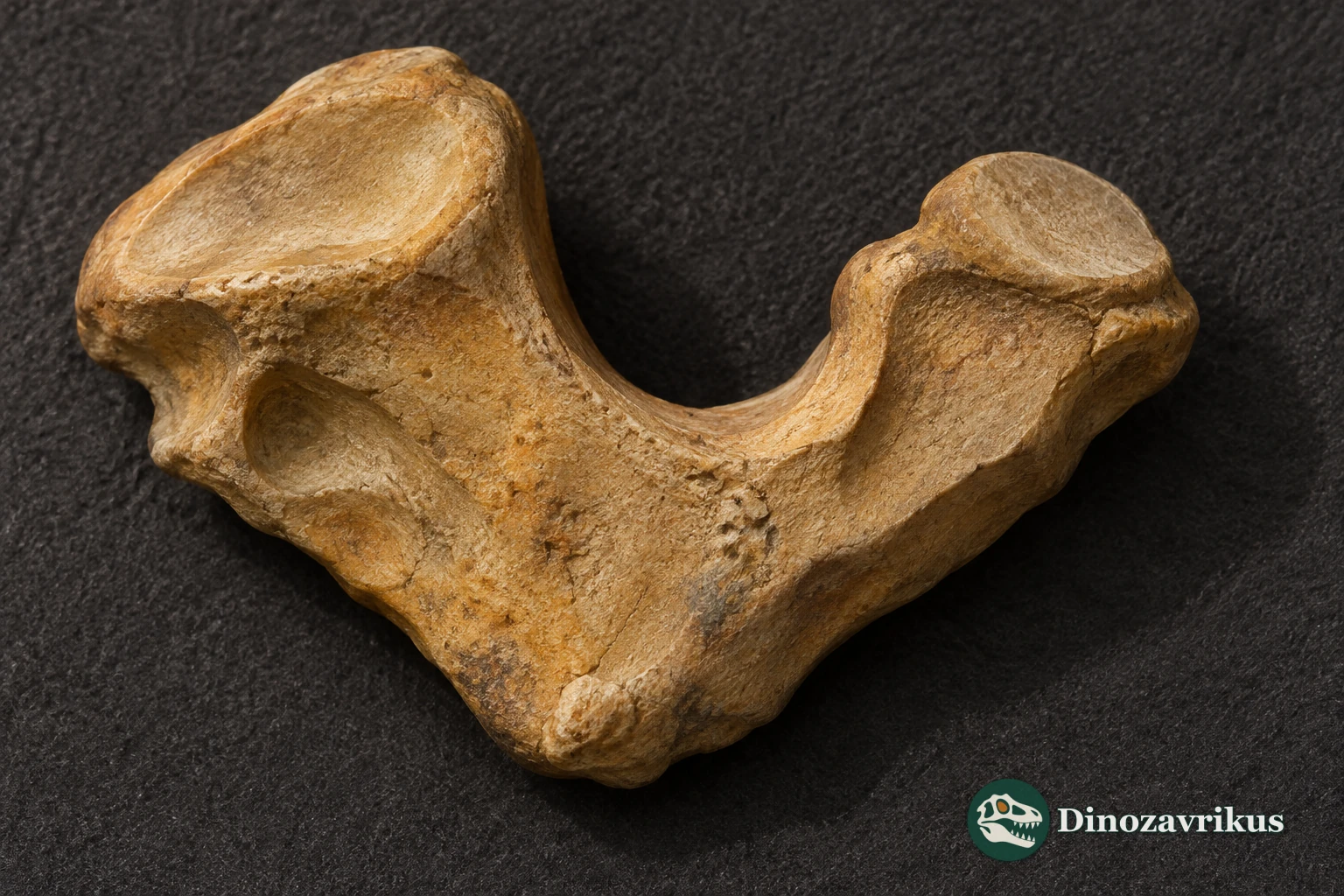
Aiolornis incredibilis was a large flying member of the teratorn family. It was named from a small wrist bone recovered in a Nevada cave. Fragmentary wings from other sites enabled comparisons with Merriam’s teratorn, while leaving considerable uncertainty about the full wingspan.
Quick facts
| Type species | Aiolornis incredibilis |
|---|---|
| Family | Teratornithidae |
| Age of attributed material | Late Pliocene and Pleistocene, some assignments uncertain |
| Type locality | Smith Creek Cave, Nevada, USA |
| Holotype | LACM(CIT) 5067 |
| Type material | Right ulnare, a wrist bone |
What can the fossils tell us?
The complete ulnare was about 43% larger than the compared bone of Merriam’s teratorn in Howard’s account.
The humeral shaft from California has a flatter cross section and the scar of the broad back muscle follows a distinct edge.
Comparisons with other teratorns suggested roughly five metres. A later estimate based on wing area and proportions gave about 4.2 metres.
A Nevada wrist and a California humerus
Hildegarde Howard described LACM(CIT) 5067 from Smith Creek Cave in 1952. The bone resembled the wrist of Teratornis merriami but was considerably larger. She introduced the species as Teratornis incredibilis.
In 1999 Kenneth Campbell, Eric Scott and Kathleen Springer described a partial humerus from late Pliocene deposits near Temecula, California. The shaft is 37.8 mm wide by about 22 mm deep at the point measured. Merriam’s teratorn has a rounder shaft, and its muscle attachment occupies a different position. The team erected Aiolornis after reexamining the material.
Which bones set the scale?
A beak fragment and pieces of forearm from southern California, and part of a wing-hand bone from Guanajuato, Mexico, were also assigned to the genus. In many cases, the assignment relied on large size and similarity to other teratorns. The authors noted that some of the older pieces could belong to a different bird.
The estimate of around five metres used comparisons with better-known teratorns. Alan Cannell and Federico Degrange later derived about 4.2 metres and 25 kilograms from comparative wing proportions and a relationship between wing area and mass in raptors. The figures are estimates from incomplete material, which cannot establish the detailed shape of the living wing.
Frequently asked questions
Why was Aiolornis separated from Teratornis?
The wrist and other wing elements showed differences in shape and muscle attachment as well as size.
How wide were its wings?
Published estimates include about five metres and about 4.2 metres, both inferred from incomplete specimens.
Where was the type found?
Smith Creek Cave in the Snake Range in eastern Nevada.
Has a complete skeleton been found?
The material consists chiefly of separate wing bones and part of a bill. Some referrals remain uncertain.