

Alalcomenaeus cambricus was a small arthropod in the Middle Cambrian Burgess Shale. Its paired frontal appendages carried three long claws and a fine flagellum; behind the head shield, the trunk had 11 segments with biramous limbs. Complete specimens measure about 4.5–5.5 centimetres, and the museum summary gives a maximum near 6 centimetres.
A few dozen specimens are known from Walcott Quarry, but Collins Quarry on Mount Stephen yielded more than 300. A later claim about nervous tissue concerned an indeterminate Chinese specimen and remains disputed. Alalcomenaeus is in the Cambrian animal catalogue, alongside Leanchoilia and Odaraia.
Quick facts
| Scientific name | Alalcomenaeus cambricus Simonetta, 1970 |
|---|---|
| Group | Megacheira; family Leanchoiliidae |
| Age | Middle Cambrian, Wuliuan Stage; about 505 Ma in the Burgess Shale account |
| Holotype | USNM 155658, a 45 mm complete specimen |
| Localities | Walcott and Raymond quarries; Collins Quarry on Mount Stephen |
| Maximum length | About 6 cm in the museum summary |
| Diet | Probably carnivorous; no specific prey is established |
What can the fossils tell us?
Paired cheirae carry three long claws and a slender flagellum. Grasping and sensory functions are plausible interpretations, but fossils do not show how the limbs moved or what prey was taken.
Burgess specimens preserve a compact head shield, segmented trunk, biramous limbs and a spatulate telson with terminal spines.
Several dozen specimens are known from Walcott Quarry, while more than 300 were collected at Collins Quarry. This describes particular assemblages, not abundance across every Cambrian sea.
A proposed nervous system was studied in an indeterminate Alalcomenaeus from Chengjiang, China, not the Burgess Shale type species. A 2023 reassessment argued overlapping gut, appendage and segment signals could explain the pattern.
From a handful of fossils to a large quarry collection
Alberto Mario Simonetta described Alalcomenaeus cambricus in 1970 from a small set of fossils originally collected by Charles Doolittle Walcott. The holotype, USNM 155658, is a complete 45 mm fossil from Walcott Quarry in the Smithsonian National Museum of Natural History. Harry Whittington revisited the early material in 1981 and retained only some of Simonetta’s original specimens in the species.
A much larger collection came from Collins Quarry on Mount Stephen. Royal Ontario Museum field parties excavated the site from the early 1980s; the Glossopleura-zone locality yielded more than 300 specimens. Derek Briggs and Desmond Collins used this material for a detailed redescription in 1999. The hundreds of fossils come from one locality and should not be conflated with the smaller Walcott and Raymond samples.
Three claws at the front, eleven segments behind
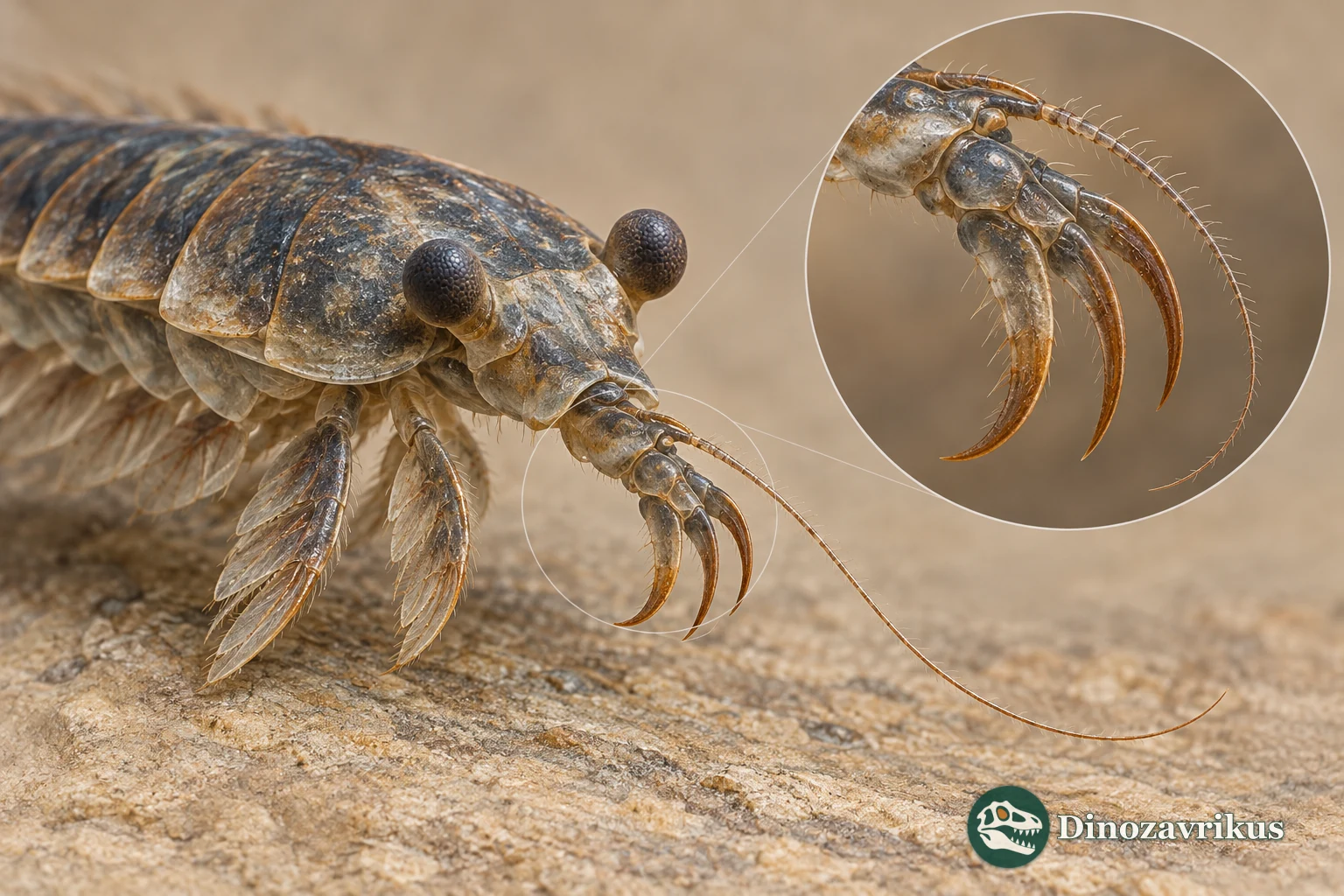
A single shield covered the head. In front were paired cheirae, the “great appendages” that give megacheirans their name. Each Alalcomenaeus cheira has a compact base, three long claws and a fine flagellum. Researchers interpret the claws as grasping structures and the flagellum as sensory, but these functions are inferred from shape.
The head also carried short-stalked lateral eyes and smaller median eyes. Behind it lay an 11-segment trunk with two strong dorsal ridges. Inner limb branches could support walking; flattened outer branches bore fine lamellae. Tooth-like structures at the limb bases may have helped process food. At the rear was one spatulate telson with long terminal spines, not a multi-part tail fan.
Movement and a probable predatory role
Strong inner limbs and flattened outer flaps suggest movement along the bottom and possibly through water. Lamellae may have contributed to gas exchange, though the function of every flap is not demonstrated. Grasping frontal limbs and tooth-bearing limb bases support a probable carnivorous interpretation; no widely accepted stomach contents or captured prey establishes a precise menu.
A disputed nervous-system interpretation
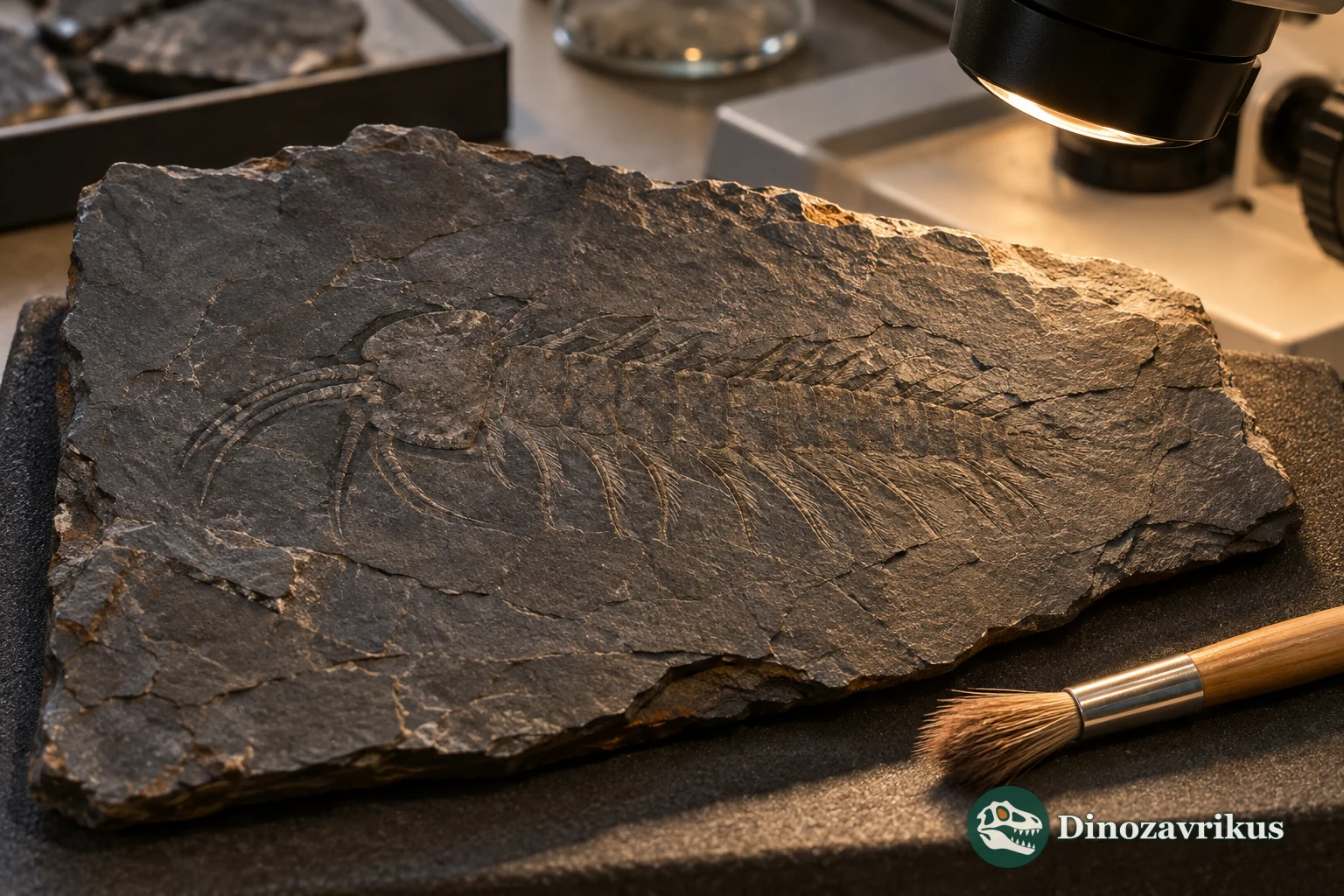
Tanaka and colleagues reported structures interpreted as a nervous system in an indeterminate Alalcomenaeus from China’s Chengjiang biota in 2013, using micro-CT and iron mapping. This was not the Burgess Shale type species or its holotype.
In 2023, Aria, Vannier, Park and Gaines reassessed fossil claims of neural tissue. For the Chinese specimen, they argued that overlapping signals could include the gut, the space around it, appendage traces and segment boundaries. The methods did not isolate nervous tissue securely. This does not show that neural tissue could never fossilise; it means the particular pattern is not firm evidence of a brain or nerve cord.
The cover is an artistic reconstruction. The head, segment count, limbs and frontal cheirae follow fossil descriptions; colour, pose and nearby prey are illustrative.
Frequently asked questions
How large was Alalcomenaeus?
The holotype is about 45 mm long, another complete specimen, ROM 45616, about 55 mm, and the museum summary gives a maximum near 6 cm.
What was its great appendage?
One of a pair of frontal cheirae with three long claws and a fine flagellum. Grasping and sensory roles are interpretations based on form.
Why is its proposed nervous system debated?
The proposed pattern came from an indeterminate Alalcomenaeus in the Chinese Chengjiang biota. A 2023 reassessment argued gut, appendage and segment traces could overlap.
Where were the most fossils found?
More than 300 specimens were collected at Collins Quarry on Mount Stephen. The animal is much rarer in the Walcott and Raymond collections.