

Alamodactylus byrdi is a Late Cretaceous pterosaur from Texas whose name rests on a fragmentary left wing. A few bones in specimen SMU 76476 preserve useful features of the humerus, but no skull or complete skeleton is known.
It is listed in the pterosaur catalogue among other Cretaceous forms. Its first description compared the humerus with pteranodontids, but later analysis recovered it elsewhere within Pteranodontia; that shift concerns evolutionary interpretation, not the identity of the bones.
Quick facts
| Scientific name | Alamodactylus byrdi |
|---|---|
| Group | Pteranodontia; recovered outside Pteranodontoidea in the 2013 analysis |
| Age | Late Cretaceous, early Coniacian |
| Locality | Atco Formation, Austin Group, Texas, USA |
| Holotype | SMU 76476, fragmentary left-wing material |
| Diagnostic traits | Humeral midshaft constriction and D-shaped distal section |
What can the fossils tell us?
SMU 76476 includes a humerus, distal metacarpal IV and the proximal end of the first wing phalanx. Later description added other fragments assigned to that same museum specimen.
The 2013 diagnosis emphasizes a constricted midshaft and D-shaped distal cross-section of the humerus. The bone is damaged and crushed, so comparisons require care.
No described skull or complete skeleton is known. A precise wingspan, crest, colour, diet and behaviour cannot be directly inferred from the holotype.
From a partial wing to a named genus
Timothy Myers reported SMU 76476 in 2010 in a study of pterosaurs from the Austin Group. At the time, the material was tentatively compared with pteranodontids. Brian Andres and Myers later reviewed Texas pterosaurs, diagnosed the specimen and named Alamodactylus byrdi in 2013. The specific name honours Gary Byrd, who discovered the fossil.
The generic name combines a reference to the Alamo with the Greek-derived pterosaur suffix dactylus, a reference to the elongated wing finger characteristic of pterosaurs.
What SMU 76476 preserves
The principal elements are a left humerus, the distal end of metacarpal IV and the proximal end of the first phalanx of the fourth wing digit. Andres and Myers also reported a proximal syncarpal, a manual phalanx and several uncertain fragments from the same catalogue specimen. These additions do not turn the material into a complete skeleton.
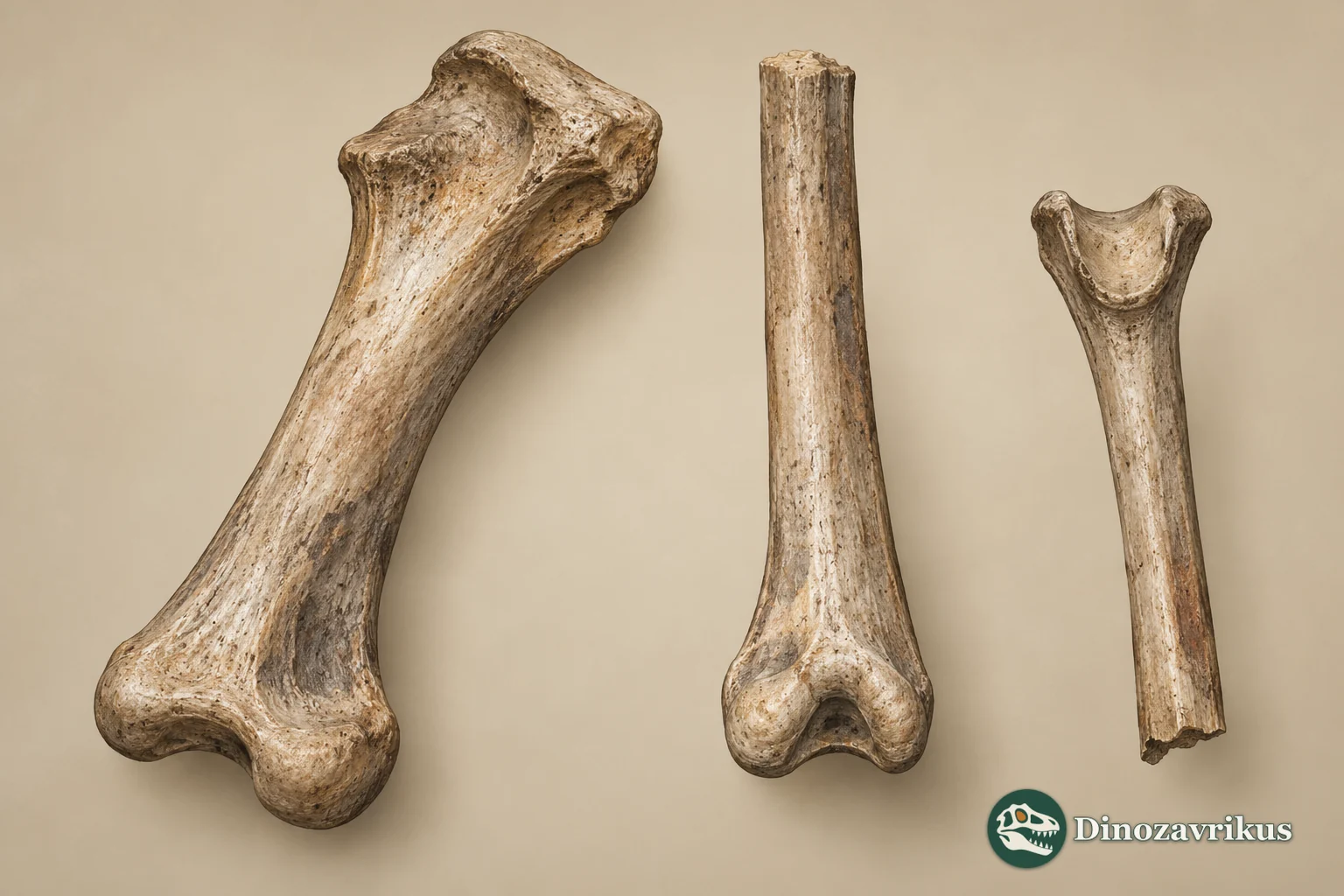
The fossils are compressed and damaged. That condition makes some comparisons difficult and means a reconstruction should not smooth away uncertainty by presenting an idealized, complete wing as though it had been found.
How the humerus supports a diagnosis
Andres and Myers diagnosed Alamodactylus using a combination that includes a constricted middle of the humeral shaft and a D-shaped cross-section at its distal end. Their phylogenetic analysis recovered the genus as a pteranodontian outside Pteranodontoidea. These results depend on comparative characters and the taxa included in the analysis.
The 2010 tentative comparison with pteranodontids was a reasonable starting hypothesis for a fragmentary wing. The later named genus and revised placement show why an early resemblance is not the same as an established close relationship.
Atco Formation and the Texas record
SMU 76476 comes from the Atco Formation of the Austin Group in north-central Texas, in deposits assigned to the early Coniacian. Published locality information narrows the area to the region north of Dallas, but does not securely fix the collecting spot to a single outcrop.
The Austin Group records marine sedimentation in the region. It provides a geological setting for the fossil, but it does not prove that Alamodactylus fed on fish or spent all of its time over open water. No stomach contents, tooth row or associated prey is known from the holotype.

Size and missing anatomy
Wing elements can constrain parts of limb anatomy, but a reliable total wingspan has not been established for Alamodactylus. Estimates based on another genus would depend on assumed proportions. There is no described skull to establish the shape or size of a crest, and no direct evidence for colour, soft tissues or body pattern.
The available record is narrow but useful: it identifies a pterosaur with a distinctive humerus in a Texas assemblage and offers a testable place in pterosaur phylogeny. It leaves the animal’s head, feeding anatomy and much of its life history unknown.
Frequently asked questions
What is the Alamodactylus holotype?
SMU 76476 is a fragmentary left wing, including a humerus, part of metacarpal IV and a wing phalanx.
Where was Alamodactylus found?
The specimen comes from the Atco Formation of the Austin Group in north-central Texas.
Why did its classification change?
The 2010 report tentatively compared the wing with pteranodontids; the 2013 review named a distinct genus and recovered it elsewhere within Pteranodontia.
Do we know its wingspan?
No reliable wingspan is established from the fragmentary wing material.