

Amebelodon was a North American Miocene proboscidean with an elongated lower jaw and paired, flattened lower tusks. For its type species, A. fricki, the jaw with tusks and molars is the central direct evidence. The trunk and whole body in life art rely on broader proboscidean comparisons and remains of other individuals.
The genus is listed in the ancient mammal catalogue. Platybelodon had markedly wider lower tusks; its broad ‘shovel’ should not be copied directly onto Amebelodon. Later Anancus illustrates a different proboscidean arrangement of jaws and tusks.
Quick facts
| Scientific name | Amebelodon Barbour, 1927 |
|---|---|
| Type species | A. fricki |
| Group | Proboscidea, Amebelodontidae |
| Type material | Long lower jaw with tusks and molars |
| Type locality | Near Freedom, Frontier County, Nebraska |
| Principal North American age | Late Miocene |
| Diet | Plant eater; details vary by species and sample |
What can the fossils tell us?
The A. fricki type is a lower jaw with two flattened lower tusks and molars. A toe bone and rib fragment found nearby were not securely associated with that individual.
A 2022 study examined Florida A. floridanus molars and tusks. Its mainly browsing signature and lower-tusk tip wear suggest plant feeding and scraping, but these are not observations on the Nebraska A. fricki holotype.
A 2023 analysis proposed Stenobelodon for A. floridanus. A 2025 revision assigned a neotype and retained the species in Amebelodon. Both interpretations evaluate real fossils and different diagnostic combinations.
Keith's Nebraska discovery
A. S. Keith found the large fossil jaw on his farm near Freedom in Frontier County, Nebraska. Phillip Orr acquired it for a palaeontological collection in April 1927, and Erwin Barbour named Amebelodon fricki. Barbour's expanded 1929 account described and photographed the mounted jaw, with its paired lower tusks and cheek teeth. The specimen is not a complete skull or skeleton.
A toe bone and part of a rib were found with the jaw, but Barbour explicitly regarded their association as uncertain. Bones found close together need not come from one animal. The type jaw measures one individual and cannot establish the proportions of every member of the genus.
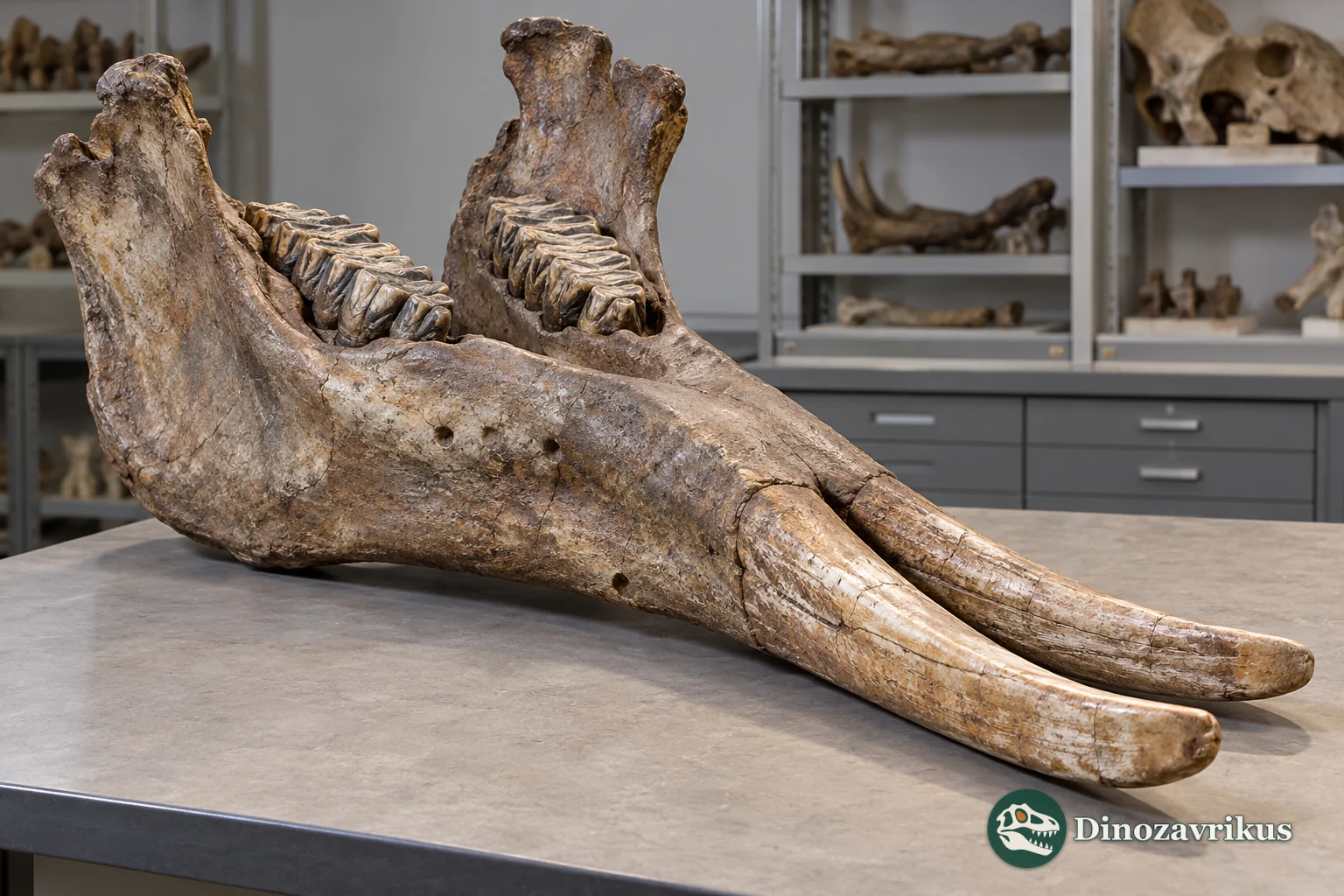
Paired lower tusks and feeding wear
The mandibular symphysis extends forward and holds two somewhat flattened lower incisors. They are expanded compared with ordinary round tusks, yet much narrower than the extreme blade of Platybelodon. Molar ridge patterns provide another set of characters for distinguishing forms; a detached tusk alone is not always enough.
The word ‘shovel-tusker’ can imply constant scooping through mud. A 2022 microwear study of Florida A. floridanus found molar marks consistent mainly with browsing on woody vegetation. Its lower tusks showed tip wear compatible with scraping. Other shovel-tusked genera displayed different wear, so the jaw's shape alone does not fix one universal action. Those microscopic results come from Florida specimens, not Keith's Nebraska type jaw.

Age and the contested Florida species
Barbour's original age estimate placed the Nebraska find in the late Pliocene or early Pleistocene. Subsequent mammal biochronology has revised the principal North American Amebelodon occurrences to the late Miocene. The old label is part of the history of discovery, not a current date that should be copied onto the fossil.
The genus boundary is also under review. A 2023 study proposed moving the more conservative A. floridanus into Stenobelodon. A 2025 analysis instead retained it in Amebelodon, clarified the loss of older type material and designated a neotype from Mixson's Bone Bed in Florida. Both papers assess combinations of teeth and tusks; neither changes the status of A. fricki as the type species.
A trunk is strongly supported by relationships within proboscideans, but its exact length, skin colour and ear shape are not preserved in the type jaw. The cover and feeding scene are interpretations, not photographs of a living or excavated individual.
Frequently asked questions
What is the Amebelodon fricki type specimen?
A lower jaw with paired lower tusks and molars found near Freedom, Nebraska. Nearby toe and rib bones were not securely associated with it.
Was its lower jaw as broad as Platybelodon's?
No. Both had flattened lower tusks, but Platybelodon developed a much broader distal cutting blade.
Did Amebelodon shovel mud with its tusks?
The name does not establish that behaviour. Wear on Florida A. floridanus lower-tusk tips is more consistent with work on woody vegetation than persistent abrasive mud scooping.
Why is A. floridanus sometimes called Stenobelodon?
A 2023 revision proposed a new genus for it, while a 2025 neotype study retained it in Amebelodon. The taxonomic boundary remains under discussion.