

Amecephalus was a trilobite from Cambrian seas in what is now North America. Articulated fossils of one species show a long thorax and a small tail shield. Nevada specimens provided the type species, and Idaho material has helped researchers assess the boundaries between species.
Quick facts
| Group | Trilobites |
|---|---|
| Age | Cambrian |
| Genus named by | Charles Walcott, 1924 |
| Type species | Amecephalus piochensis |
| Lectotype | Dorsal shield USNM 15434b |
| Type material | Chisholm Formation, Nevada |
What can the fossils tell us?
USNM 15434b has a part and counterpart on the two surfaces of a split slab. It serves as the species lectotype.
This count comes from one specimen of Amecephalus normale. Specimens with missing segments show fewer.
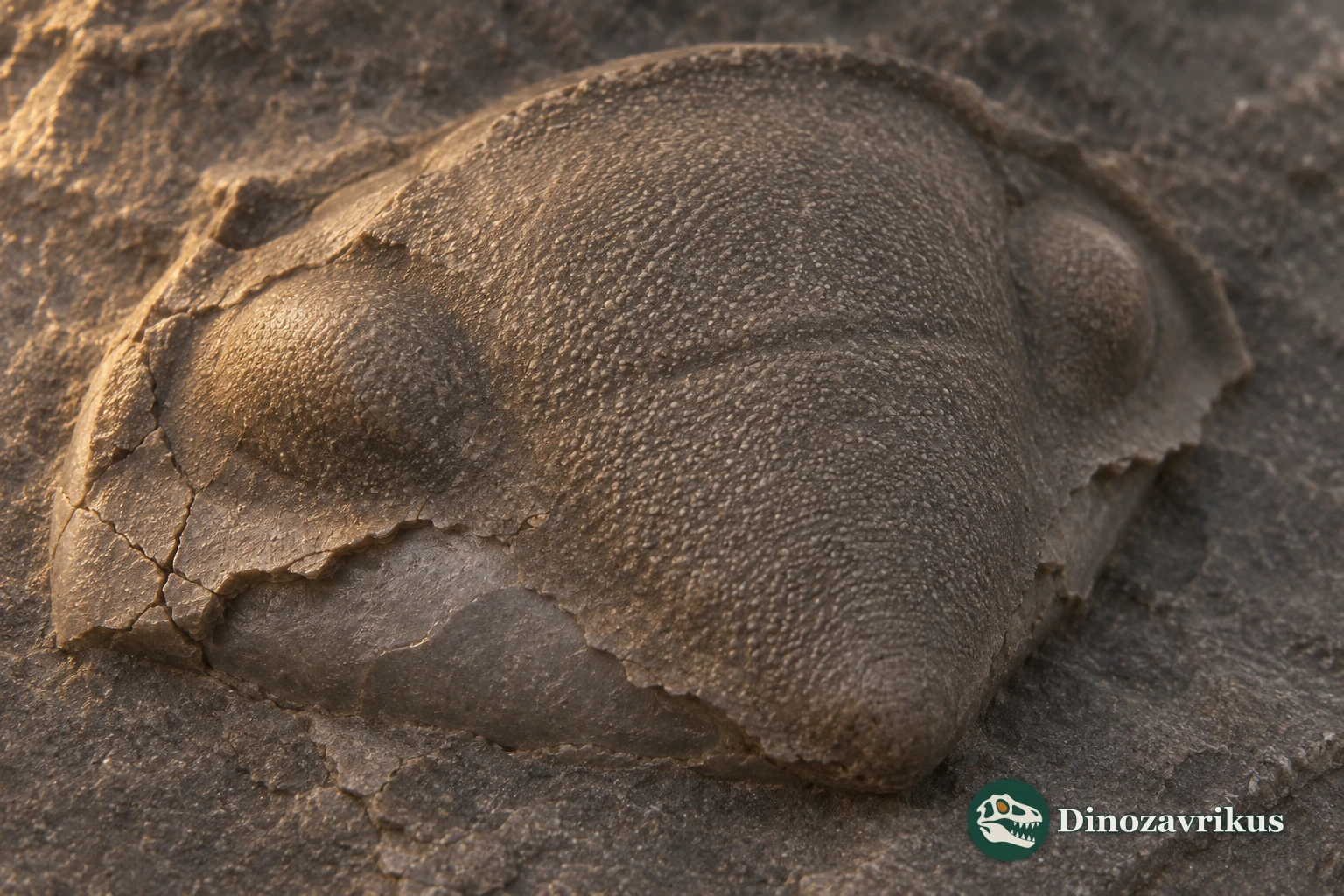
Cracks in shale specimens cut across the rim and frontal field of the head. The width of these areas can change after burial.
The Nevada type material
Charles Walcott described Ptychoparia piochensis in 1886 and made it the type species of the new genus Amecephalus in 1924. The original specimens were probably collected from old mine dumps near the Half Moon Mine at Pioche. The lectotype, USNM 15434b, preserves a nearly complete shield as part and counterpart.
A re-examination of the collection found that some historically associated specimens differ from the lectotype. Some individual assignments remain debated. A shared museum lot number does not show that every fossil in the lot belongs to one species.
Articulated fossils from Idaho
Fossils of Amecephalus normale occur in the lower Lakeview Limestone of Idaho. Their beds are placed in the Ptychagnostus praecurrens Zone, named after a species of Ptychagnostus. The articulated fossils show how the segments taper towards a small tail shield. At least 19 segments can be counted on one shield.
The tail shield of Amecephalus normale is roughly rectangular with rounded corners. There are three rings on the axis followed by a rounded terminal piece. Fine branching traces occur on the frontal field and the free cheeks.
Changes caused by compaction
In 2020 Frederick Sundberg compared the positions of anatomical landmarks on cranidia of the Nevada type species and Amecephalus normale from Idaho. The front half of the Nevada cranidia is broader. Cracks in the frontal field could have spread the sides during compaction in shale. Sundberg therefore considered the shape alongside the relief of the furrows and the grain of the exoskeleton.
Frequently asked questions
Where was the type species of Amecephalus found?
Its type material comes from the Cambrian Chisholm Formation near Pioche, Nevada.
What survives in the lectotype?
It is a nearly complete dorsal shield preserved on two corresponding slab surfaces, numbered USNM 15434b.
How many thoracic segments did the Idaho species have?
At least 19 can be counted on one fossil of Amecephalus normale. That count applies to the specimen.
Why is it difficult to compare material from Nevada and Idaho?
The Nevada shields are flattened in shale. The limestone specimens retain a different relief, so some apparent differences can result from preservation.