

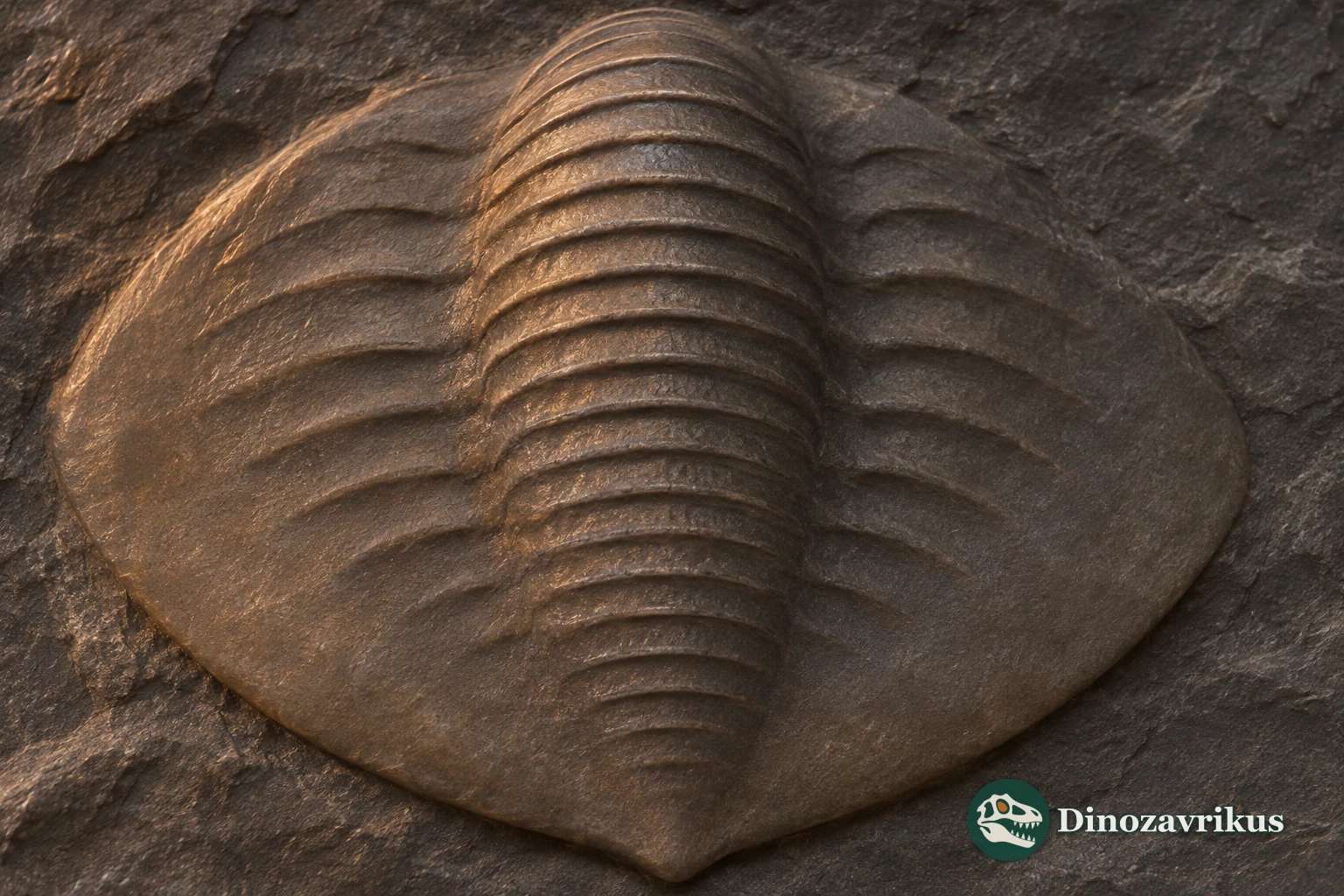
Young Ameura had a tail shield with an almost semicircular rear margin. In larger specimens the shield is elongated and more pointed. Measurements of fossils from Nebraska show that these changes took place while many other proportions of the shell remained similar.
Quick facts
| Group | Proetida |
|---|---|
| Age | Late Carboniferous and early Permian |
| Named by | J. Marvin Weller, 1936 |
| Type species | Ameura sangamonensis |
| Thorax | Nine segments |
| Ohio tails | 5.5–25 mm long |
What can the fossils tell us?
The cheek spines extend nearly the length of the thorax. The tail shield has a broad, smooth rim.
In the Nebraska sample, the rear rim widens relative to the sides.
A total length of about 6 cm was estimated from shell proportions. The isolated shields do not give total body length directly.
The name behind the genus
J. Marvin Weller established Ameura in 1936. He selected Phillipsia (Griffithides?) sangamonensis, described by Fielding Meek and Amos Worthen in 1865, as the type species. Later work combined this species and A. major under the name A. missouriensis (Shumard, 1858).
Halszka Osmólska disputed the priority of the epithet missouriensis on the grounds that an earlier, similar Shumard name had been applied to a different trilobite. The literature therefore uses more than one name for comparable material, while Weller’s original type designation can be traced to the 1865 species.
Nine segments and a long tail axis
The glabella of A. missouriensis is widest between the eyes and narrows toward the front. The crescent-shaped eye lobes sit well back on either side. The cheek spines reach nearly the length of its nine-segment thorax.
The tail shield is longer than wide. Numerous close-set rings cross the elevated axis, with ribs on the flanks. The ribs fade into a broad, smooth rim. Twenty-two Ohio tail shields measure 5.5 to 25 mm long. The Ohio study estimated a typical complete length of about 6 cm and suggested that some individuals might have approached 9 cm.
Which proportions changed with growth
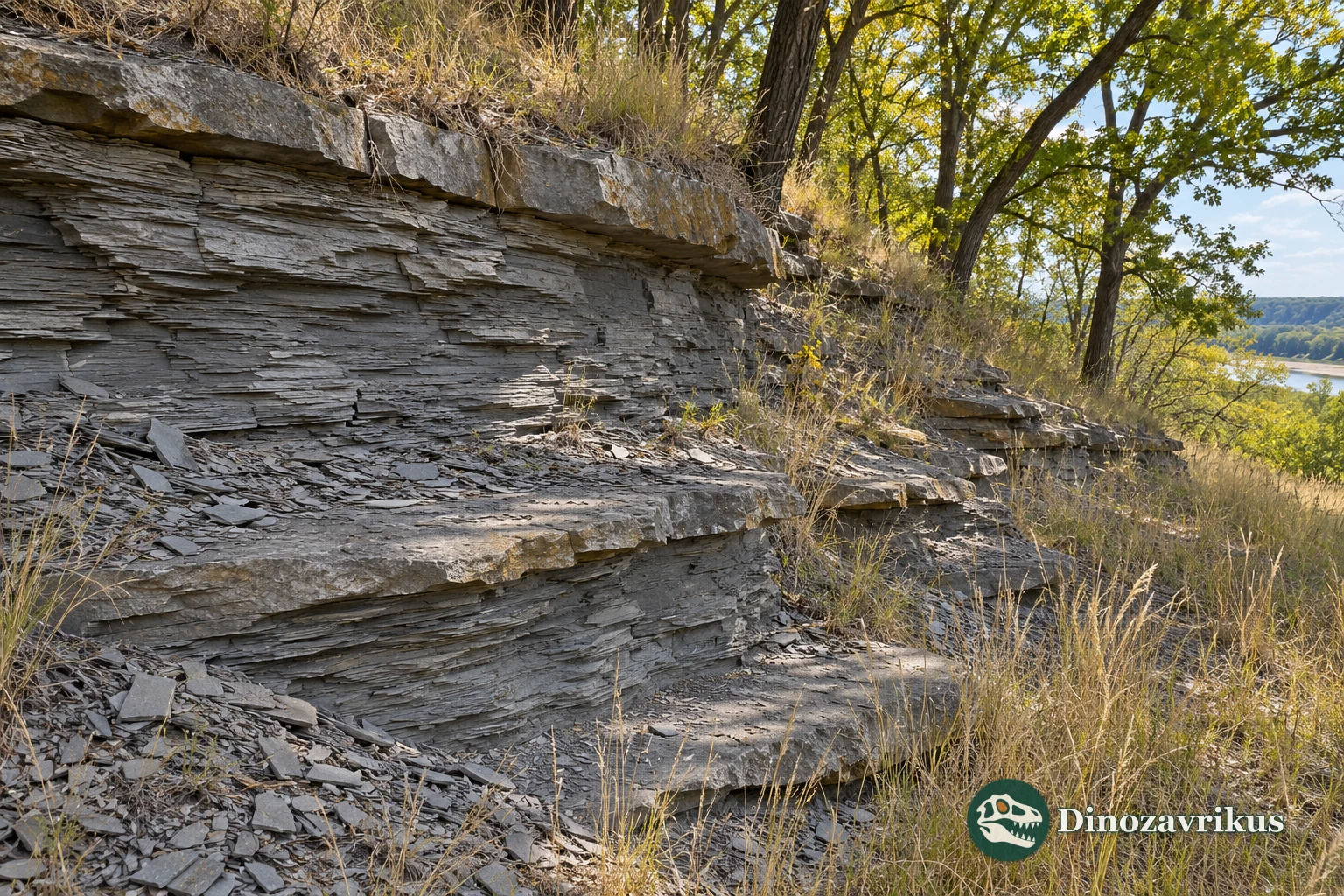
The Bonner Springs Shale of eastern Nebraska yielded a sample of 100 cranidia, 94 tail shields, 26 free cheeks and nine complete shells. In most of the measurements, pairs of dimensions scaled at much the same rate. The tail nevertheless became more triangular or parabolic in outline and its rim widened toward the rear relative to the sides.
All of the complete shells already have the full adult count of thoracic segments. Some of the smallest head shields may belong to an earlier stage, but they closely resemble small specimens with the adult segment count. In other Nebraska deposits, Ameura and Ditomopyge occur on both sides of the Carboniferous–Permian boundary.
Frequently asked questions
How many thoracic segments did Ameura have?
The described adult shells have nine movable thoracic segments.
How does a juvenile tail differ from that of a larger individual?
A small tail has a nearly semicircular rear margin. In larger specimens the outline lengthens and the rear rim becomes wider.
Does the 25 mm measurement give a full body length?
It is the maximum tail shield length in the measured Ohio sample. Total lengths were estimated separately.
What name did Weller choose for the type species?
He chose the species originally named Phillipsia (Griffithides?) sangamonensis. Several later works include that material in A. missouriensis.