

Ammosaurus was an Early Jurassic sauropodomorph from what is now Connecticut. The type skeleton preserves much of the pelvis and hindlimbs. Those bones are central to a long-running question about whether to place this animal within Anchisaurus or give it a genus of its own.
Quick facts
| Group | Early sauropodomorphs |
|---|---|
| Age | Early Jurassic (middle Hettangian) |
| Region | North America (Connecticut, United States) |
| Diet | Exact diet unknown |
| Type species | Ammosaurus major |
| Holotype | YPM VP 208, partial pelvis, vertebrae and hindlimbs |
| Formation | Upper part of the Portland Formation at Manchester |
| Length | About 2.5 m in a reconstruction of the type individual |
What can the fossils tell us?
YPM VP 208 preserves material from the spine, hips and hindlimbs. Its head and forelimb proportions must be inferred from comparison.
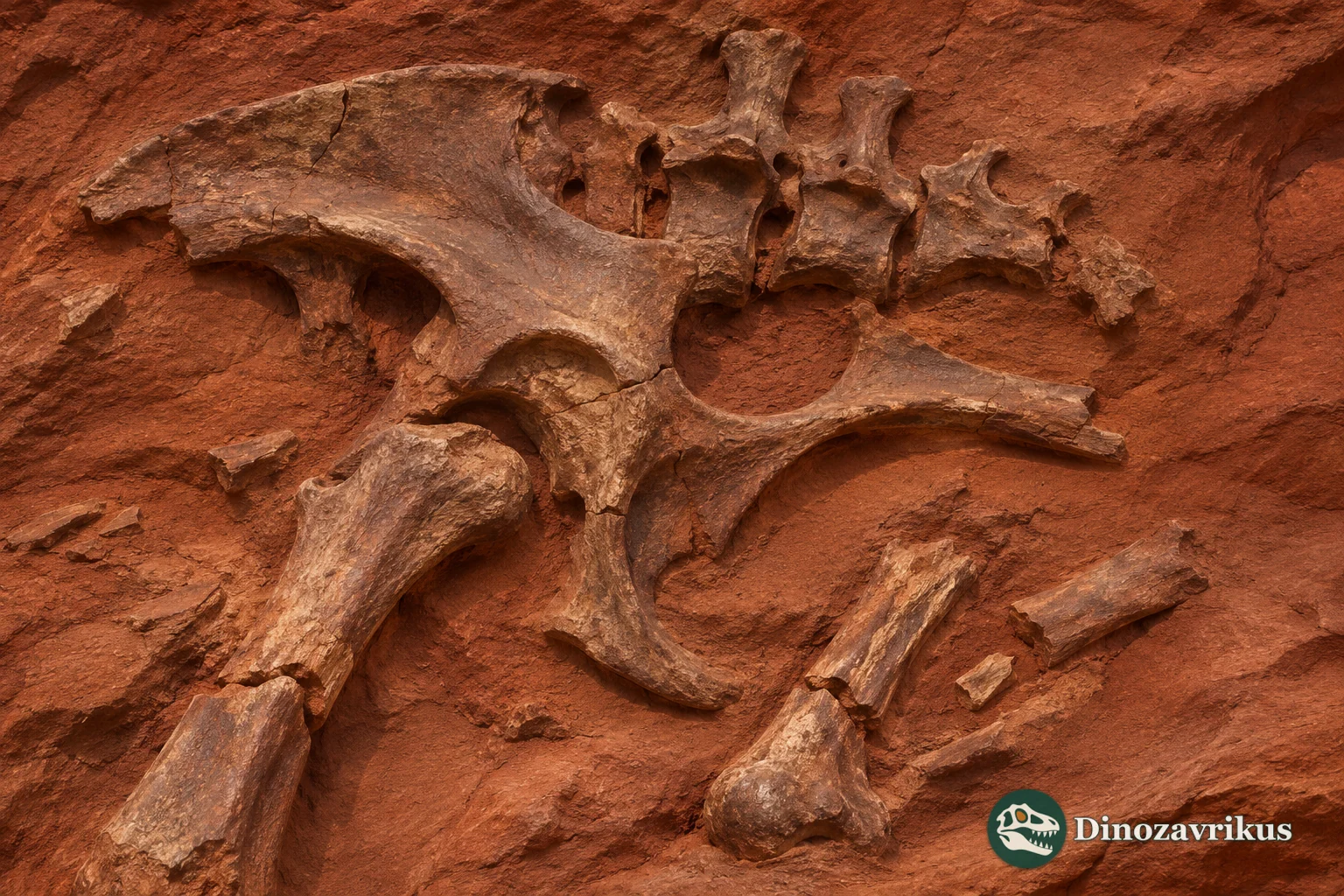
A 2025 reassessment described a bony rim enclosing the opening in the pubis of Ammosaurus. The comparable opening reaches an edge in Anchisaurus.
Features of the second and third sacral ribs formed another line of evidence in the proposal to recognise two genera.
A skeleton in red sandstone
Quarrying near Manchester in 1884 uncovered the largest of the three articulated sauropodomorph specimens described from that site. YPM VP 208, now at the Yale Peabody Museum, preserves much of the pelvic region and hindlimbs with vertebral material. A recent estimate put the length of this individual at about 2.5 metres.
The fossil came from the upper part of the Portland Formation, dated in the regional review to the middle Hettangian. Othniel Charles Marsh named the species as Anchisaurus major in 1889. Two years later he moved it to Ammosaurus, meaning ‘sand lizard’, a reference to the rock that held the skeleton.
The case for two genera
The quarry also yielded the more complete specimen now used to define Anchisaurus. Adam Yates's 2010 revision brought the Manchester material together under Anchisaurus polyzelus after comparing the skeletons. The largest specimen had often been assigned to Ammosaurus before that revision.
Peter Galton and colleagues reinstated it as a distinct genus in a 2025 reassessment. They emphasised that the opening in the pubis is fully enclosed in YPM VP 208, whereas it is open along a margin in the Anchisaurus type. They also identified differences in the underside of the second sacral rib and the connection of the third rib to its vertebra. They interpreted the two as close relatives within Anchisauridae.
What the fossils leave open
The limbs and hips constrain the outline of the rear half of the body. Much of the head and forequarters remains conjectural, and the type lacks direct evidence of the animal's diet.
The 2025 study also suggested that YPM VP 2125, fragmentary material recovered at East Windsor, might belong to Ammosaurus. The comparison rests on a few elements, including the shape of a crest on the upper arm bone. The better-preserved Manchester specimen remains the basis for recognising the genus.
Frequently asked questions
Where was Ammosaurus found?
The type specimen was collected in 1884 near Manchester, Connecticut, from sandstone of the Portland Formation.
What does the name Ammosaurus mean?
It means ‘sand lizard’, referring to the rock in which the bones were preserved.
Is Ammosaurus still considered a separate genus?
A 2010 revision included it in Anchisaurus. Researchers in 2025 argued for recognising it separately on the basis of the pelvis and sacrum.
How long was the type individual?
A 2025 estimate put its reconstructed length at about 2.5 metres. The figure applies to that individual.