

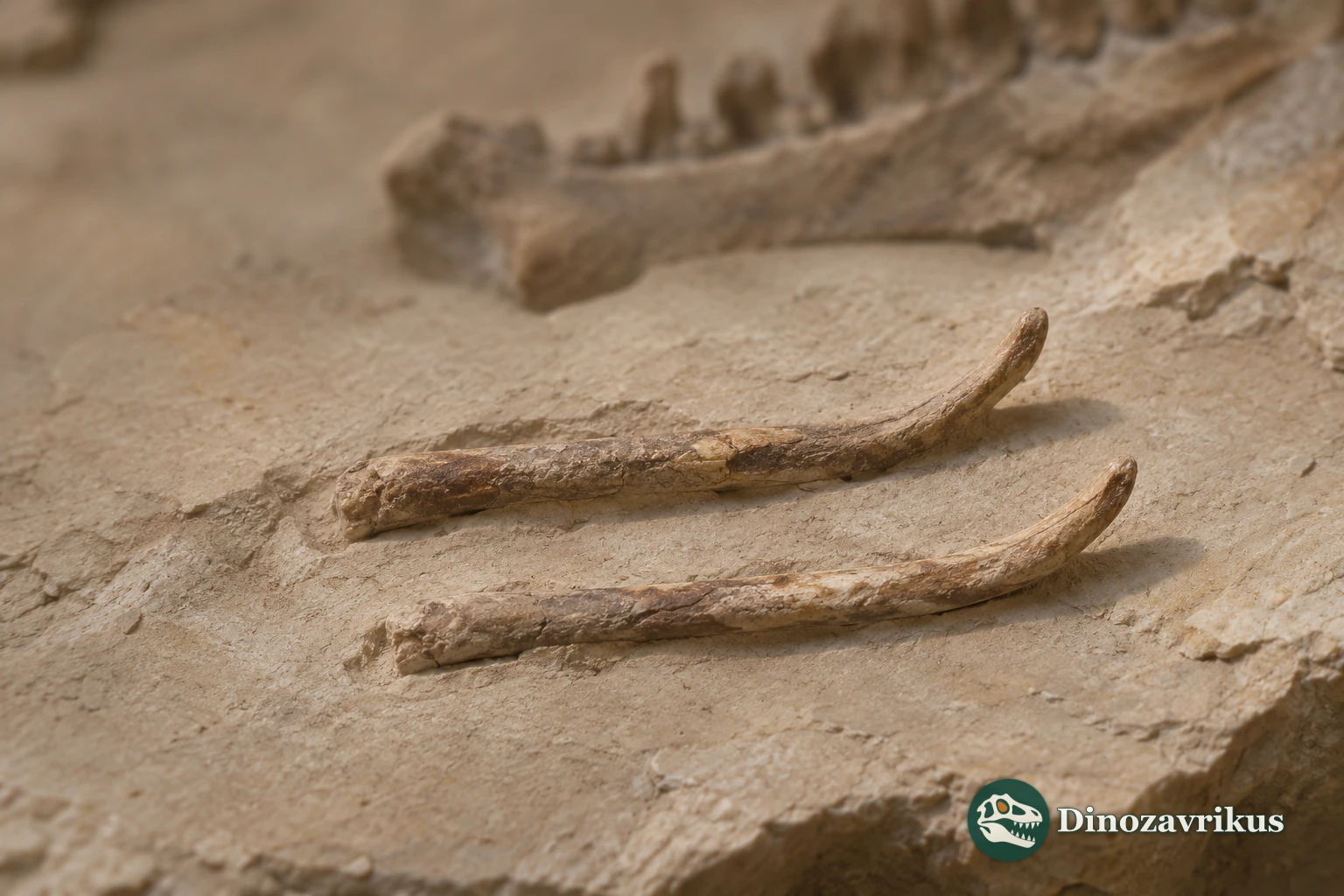
Amphicotylus lived in Late Jurassic North America. A Morrison Formation skeleton preserves the small paired bones that helped support its tongue and throat. Their curvature and the shape of the palate suggest that it may have opened its mouth in water while breathing through nostrils that remained above the surface.
Quick facts
| Type species | Amphicotylus lucasii |
|---|---|
| Best-preserved specimen | A. milesi, GMNH-PV0000229 |
| Group | Goniopholididae, Neosuchia |
| Age | Late Jurassic, Kimmeridgian for the Wyoming skeleton |
| Rock unit | Morrison Formation |
| Collection | Gunma Museum of Natural History, Japan |
What can the fossils tell us?
GMNH-PV0000229 is the nearly complete type of A. milesi, from the Brushy Basin Member. Other material of the genus often consists mainly of skull bones.
The fossil preserves the bony margins of the passage, which is partly open underneath behind the maxillae. Its soft lining is unknown.
Comparisons with a Chinese alligator and a Siamese crocodile suggest a mechanism for closing a throat valve. Only its bony supports survive in the fossil.
Cope’s species and the Wyoming skeleton
Edward Drinker Cope named Amphicotylus lucasii in 1878. He moved it to Goniopholis ten years later. Charles Mook subsequently reinstated the original combination. Both names therefore appear in accounts of North American fossils.
The Wyoming skeleton was discovered in 1993 at East Camarasaurus Quarry, in sandstone of the Brushy Basin Member. Junki Yoshida and colleagues described it as A. milesi in 2021. The species name honours Clifford Miles for his work on the excavation and curation. The type includes the jaws, limbs and much of the vertebral column.
Bones around the air passage
Amphicotylus had an elongated, flattened snout. On either side of that of A. milesi, a notch accommodated the enlarged fourth tooth of the lower jaw. The internal opening is long and narrows in the middle. The bony floor of the nasal passage is partly open behind the maxillae.
A similarly elongated passage occurs in another Morrison goniopholidid, Eutretauranosuchus. The type species of Amphicotylus bears extra flanges along the bony septum, while the lower surface of the septum is smooth in A. milesi. Even these closely related animals differed in the details of the palate.
How a throat valve could have worked
A. milesi preserves paired rod-shaped bones of the hyoid apparatus with their rear ends bent upwards. The researchers measured the bend and examined muscle attachments in living Siamese crocodiles and Chinese alligators. They proposed that equivalent muscles could lift a fold between the mouth and the throat.
With the valve closed, air could still pass from the external nostrils to the throat while the mouth was open underwater. The nostrils would need to remain above the surface. The fossil supports this model through the shape of its bones, while the valve and muscles have decayed.
Frequently asked questions
When was the nearly complete skeleton found?
It was found in 1993 at East Camarasaurus Quarry, Wyoming, and named as the type of A. milesi in 2021.
What could the proposed throat valve do?
It could separate an open mouth from the throat while air entered through the nostrils above the water.
Which fossils support the valve hypothesis?
The palate and the curved paired bones supporting the throat. The soft tissues were inferred from living crocodilians.
Why does the type species appear under Goniopholis?
Cope moved his species to Goniopholis in 1888. Amphicotylus was later reinstated.