

Amphipelargus is a fossil bird from the Greek island of Samos, known from the lower end of a shin bone. The same find was first compared with storks and later assigned to ergilornithids, a group now allied with ostriches. The evidence does not allow the detailed reconstruction that would be possible for a bird represented by a complete skeleton.
Quick facts
| Group | Ergilornithidae |
|---|---|
| Age | Late Miocene |
| Locality | Samos, Greece |
| Holotype | Distal third of left tibiotarsus, A.123 |
| Repository | Natural History Museum, London |
What can the fossils tell us?
A.123 is the distal third of a left tibiotarsus. No skull, wing or complete skeleton is known for the species.
Richard Lydekker measured the width across the condyles. This is a bone measurement, not an estimate of the bird’s height.
Interpretations of the anatomy and family relationships changed. Newly described Turkish wing bones belong to a different bird.
A bone from the Forsyth-Major collection
Richard Lydekker named Amphipelargus majori in his 1891 catalogue of fossil birds in the British Museum. The type specimen, A.123, came from the Forsyth-Major collection, purchased in 1889. It is now part of the collections of the Natural History Museum in London.
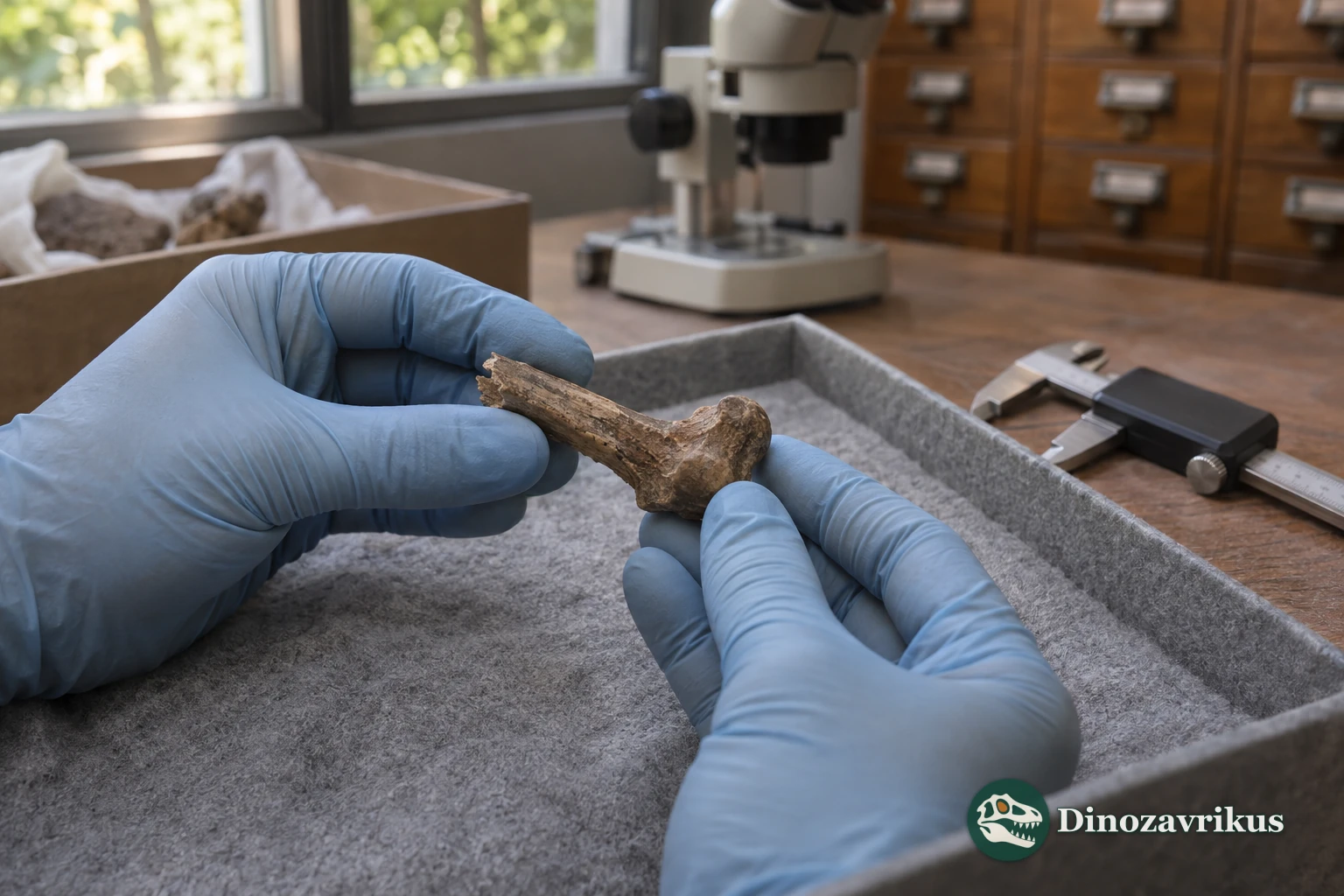
The specimen is the distal third of the left tibiotarsus, the principal long bone of the bird’s lower leg. Lydekker illustrated both its anterior surface and the end of the joint. The width across the distal condyles is 25 millimetres. His comparison with the greater adjutant stork concerned the dimensions and proportions of this part of the leg. It does not establish that the fossil bird had the same standing height, body proportions or general appearance.
The original catalogue labelled the deposit Lower Pliocene. Subsequent summaries place the Samos material in the late Miocene. The description does not establish the exact discovery date of the bone or identify a precise collecting spot on the island.
Why its classification changed
Lydekker recognised a mixture of features. The broad joint and groove suggested a resemblance to cranes, while other details of the distal end looked more like those of storks. He placed his new genus in the stork family. In 1981 Colin Harrison reassigned it to Ergilornithidae, which was then associated with the crane order.
The interpretation of ergilornithid relationships subsequently changed. They came to be regarded as an extinct lineage allied with ostriches. A 2026 study of wing bones from Kayaca in Türkiye supported that placement and confirmed flightlessness for the bird represented by those bones. However, the Turkish material was tentatively assigned to Urmiornis, not to the Samos species of Amphipelargus. It provides evidence about the larger group rather than a new skeleton of the type species.
What the fossil does not reveal
The type species remains known from its single holotype. Separate toe bones from Kryopigi in northern Greece have been tentatively compared with Amphipelargus. The limits of the genus are also debated: in 2025 a Pakistani species formerly called Urmiornis cracrafti was assigned to Amphipelargus. Its age and anatomical details should not be transferred to the Samos specimen.
There is no reliable estimate of body mass, standing height or wingspan for the Samos bird, and its beak, plumage, food and reproduction remain unknown. Membership of the broader palaeognath lineage does not supply those missing details. For example, Lithornis belonged to that major bird lineage and retained flight. Flightlessness is likely for Amphipelargus on the basis of its ergilornithid relationships, but its own wing bones have not been found.
Frequently asked questions
Where was Amphipelargus found?
The type specimen came from Samos in Greece. It is assigned to the late Miocene.
Which part of its skeleton is known?
The distal third of the left tibiotarsus, or shin bone. Specimen A.123 is in the Natural History Museum in London.
Was it a stork?
That was the original classification. It was later reassigned to Ergilornithidae, a group that recent work places close to ostriches.
Why is there no reconstruction of the bird itself?
The surviving leg fragment cannot reliably establish the head, plumage or body proportions. The illustrations instead show an imagined environment and a fossil-study scene.