

Amphiperatherium is a genus of small fossil metatherians known from Cenozoic deposits in Europe. Most finds are isolated teeth or jaw fragments. Their shapes underpin both species identifications and an ongoing debate over whether the genus can be reliably separated from the closely related Peratherium.
The name remains in use, although its diagnostic boundaries are still discussed. This profile belongs in the ancient mammal catalogue as a metatherian whose research history is closely tied to changing interpretations of dental variation.
Quick facts
| Scientific name | Amphiperatherium Filhol, 1879 |
|---|---|
| Type species | A. frequens (von Meyer, 1846); historically named combinations and synonymy complicate the record |
| Group | Metatheria, Herpetotheriidae |
| Age | Reported from the Early Eocene to Middle Miocene; early assignments are debated |
| Range | Western, Central and south-eastern Europe |
| Main evidence | Isolated molars, premolars and jaw fragments |
| Body size | Not directly measured from a complete skeleton |
| Ecology | Diet and behaviour are not directly established |
What can the fossils tell us?
Isolated upper and lower teeth and small jaw fragments are used to compare species. A single crown rarely preserves enough context to reconstruct a full tooth row or body.
Cusp shape, tooth proportions and wear vary within samples. Researchers disagree about whether some differences separate Amphiperatherium from Peratherium or fall within variation.
Reports from several European countries document fossils in distinct layers. They do not represent one simultaneous population, and some identifications have been revised.
The name and a contested genus boundary
Henri Filhol introduced Amphiperatherium in 1879 for fossil metatherians from French phosphorite deposits. It began as a subgenus within a broader Peratherium; later authors treated it as a separate genus. The type species is generally cited as A. frequens, originally described under another generic combination. The name A. lemanense was later treated as a junior synonym of A. frequens.
Dental rows supplied the proposed distinctions. Descriptions emphasised the pattern of molar size along the jaw and the form of particular cusps and crests. A study of abundant material from Dormaal, Belgium, found that some of those traits vary within samples assigned to Peratherium constans. Its authors regarded A. brabantense as indistinguishable from that variation and questioned the separation of the two genera.
This does not make every named Amphiperatherium species an automatic synonym of Peratherium. Later studies continue to use species of Amphiperatherium, including material from the late Palaeogene of south-eastern Europe. The careful conclusion is narrower: the genus is widely used, but its diagnosis and membership need testing against large, comparable samples.
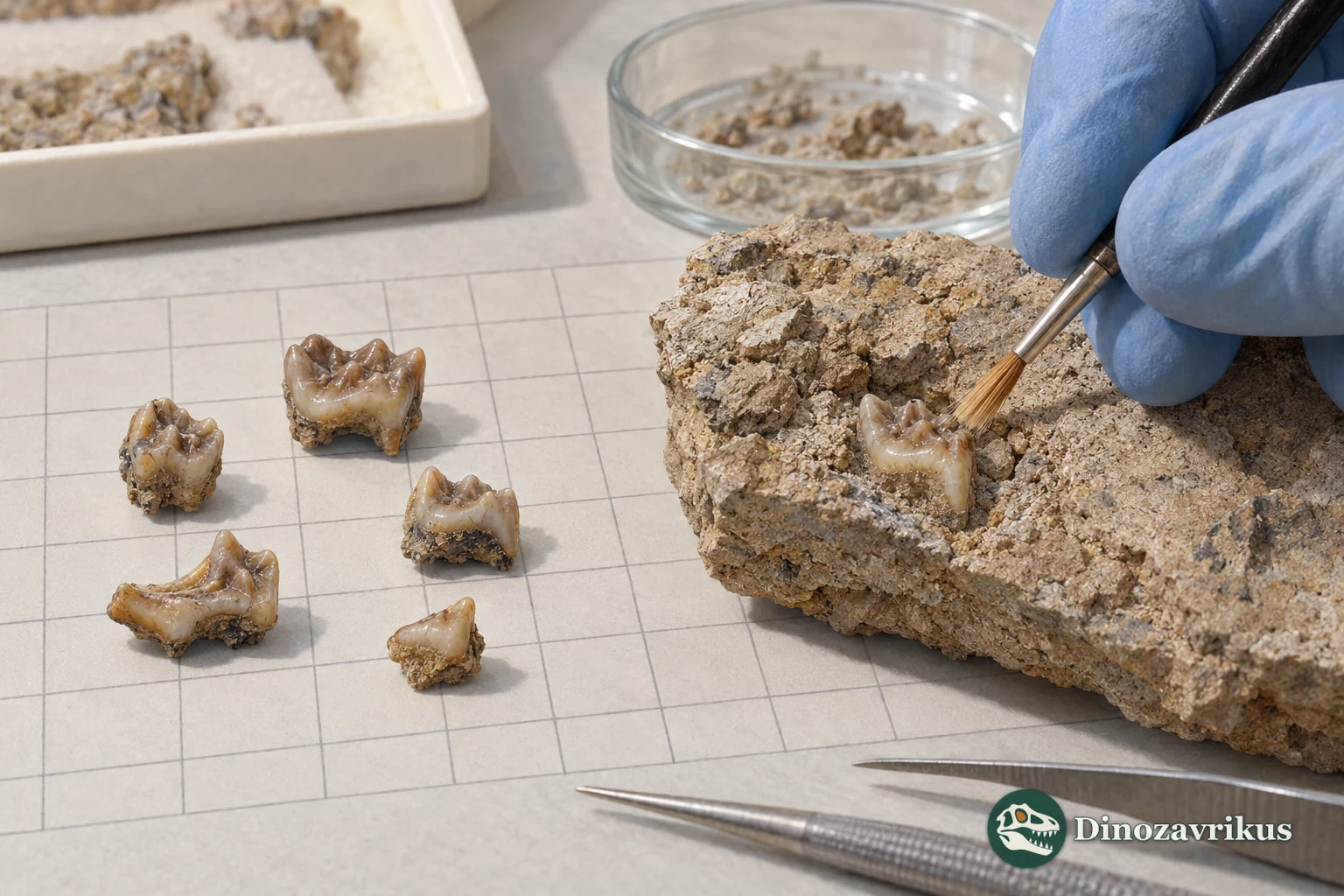
What the fossils preserve
Collections are dominated by isolated upper and lower molars, premolars, canines and short jaw fragments. A study of Serbian localities described dozens of dental specimens assigned to A. exile and A. minutum from several sites and horizons. Measurements allow comparisons among samples, but an isolated tooth is not a separate individual or a complete skeleton.
Postcranial fossils are uncommon. Some collections include fragments of humeri and calcanei, but they do not provide a reliable reconstruction of the limbs or whole-body proportions. Names are anchored to type material; the confidence of a new identification depends on preservation and the position of each tooth in the jaw.
Age and European distribution
Fossils assigned to Amphiperatherium have been reported from France, Belgium, Germany, the United Kingdom, Spain, Portugal, Switzerland, Czechia and Serbia. Some species are associated with Early Eocene sites, while others come from the Late Eocene, Oligocene and Miocene. The youngest European records are usually linked to A. frequens.
This span summarises the ages of separate localities and taxonomic identifications; it is not a continuous record of one species. Early records are particularly sensitive to the boundary drawn between Amphiperatherium and Peratherium. Reassigning a few teeth can change a local occurrence without erasing later records supported by their own evidence.
Size, diet and way of life
No complete skeleton in the studies used here provides a direct body-length or mass measurement. A small body is inferred from the small teeth and comparison with related metatherians, not measured from an entire animal.
Teeth support identification and comparison, but do not establish a precise diet. An insect-eating or omnivorous animal is a plausible analogy for some related forms, yet stomach contents, coprolites or feeding traces attributable to Amphiperatherium are not known. Its locomotion, nesting, reproduction, daily activity and the presence of a pouch are likewise not securely documented by the available fossils.
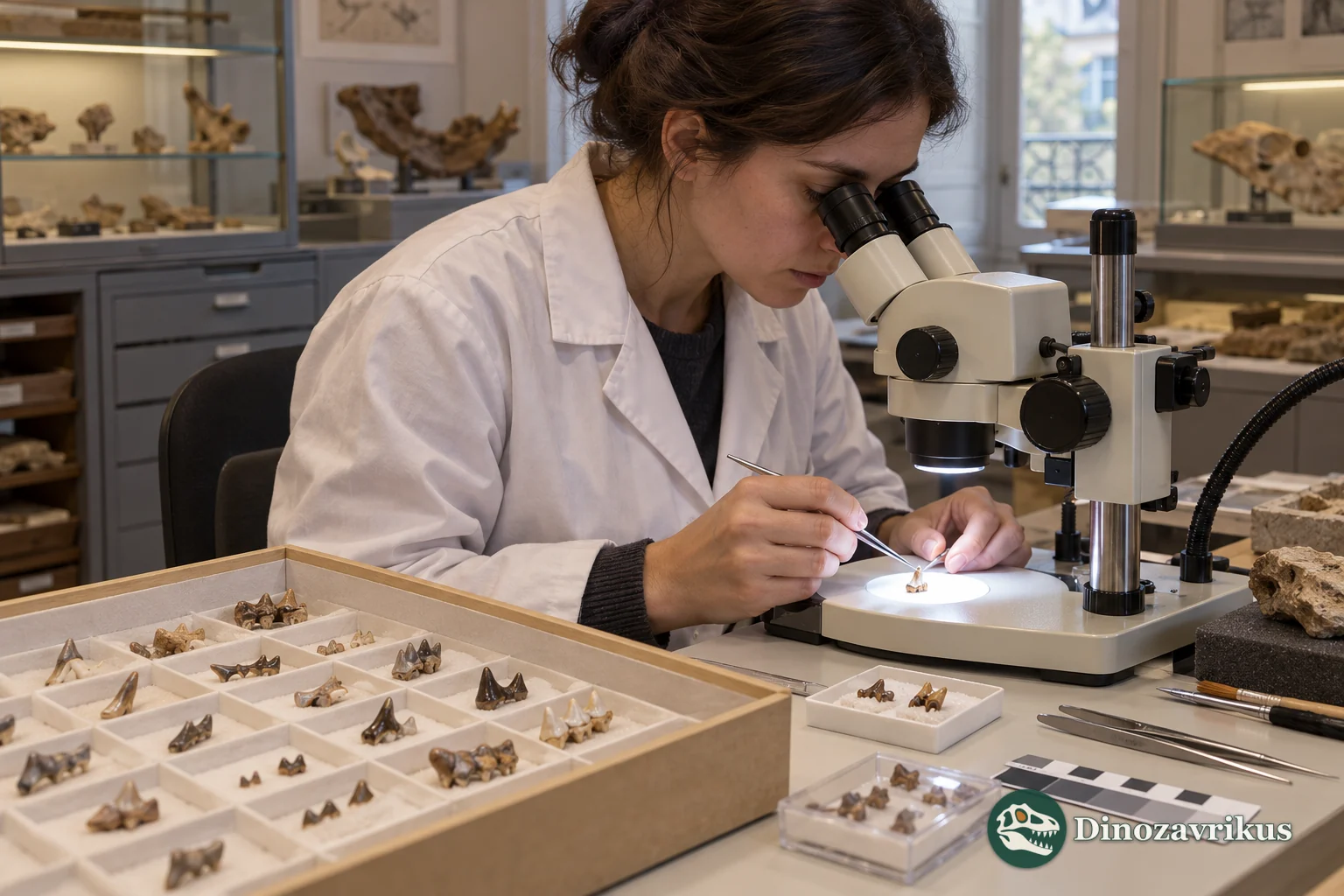
What can be reconstructed
The fossils establish European metatherians whose teeth have been assigned to Amphiperatherium and its species. Dated assemblages document the name across a broad span of Cenozoic deposits. At the same time, some diagnostic traits overlap with Peratherium, and the skeleton and soft tissues remain poorly represented.
The small, long-tailed animal on the cover is therefore a cautious, family-level artistic reconstruction, not a recovered portrait of the genus. Fur length, colour, ear shape and behaviour are not preserved by the known dental material.
Frequently asked questions
When did Amphiperatherium live?
Published records span the Early Eocene to Middle Miocene, but early occurrences depend on how authors distinguish Amphiperatherium from Peratherium.
Where are its fossils found?
Mostly in Europe, including France, Belgium, Germany, the United Kingdom, Spain, Portugal, Switzerland, Czechia and Serbia. Different species come from different sites and ages.
Why is the genus debated?
It was separated from Peratherium using subtle dental traits. A large fossil sample showed that some of those traits vary among close forms, prompting authors to question the distinction.
What is known about its size and diet?
Complete skeletons and direct dietary evidence are lacking. Small body size is inferred from the teeth, while insectivory or omnivory remains a comparative hypothesis rather than an established menu.