

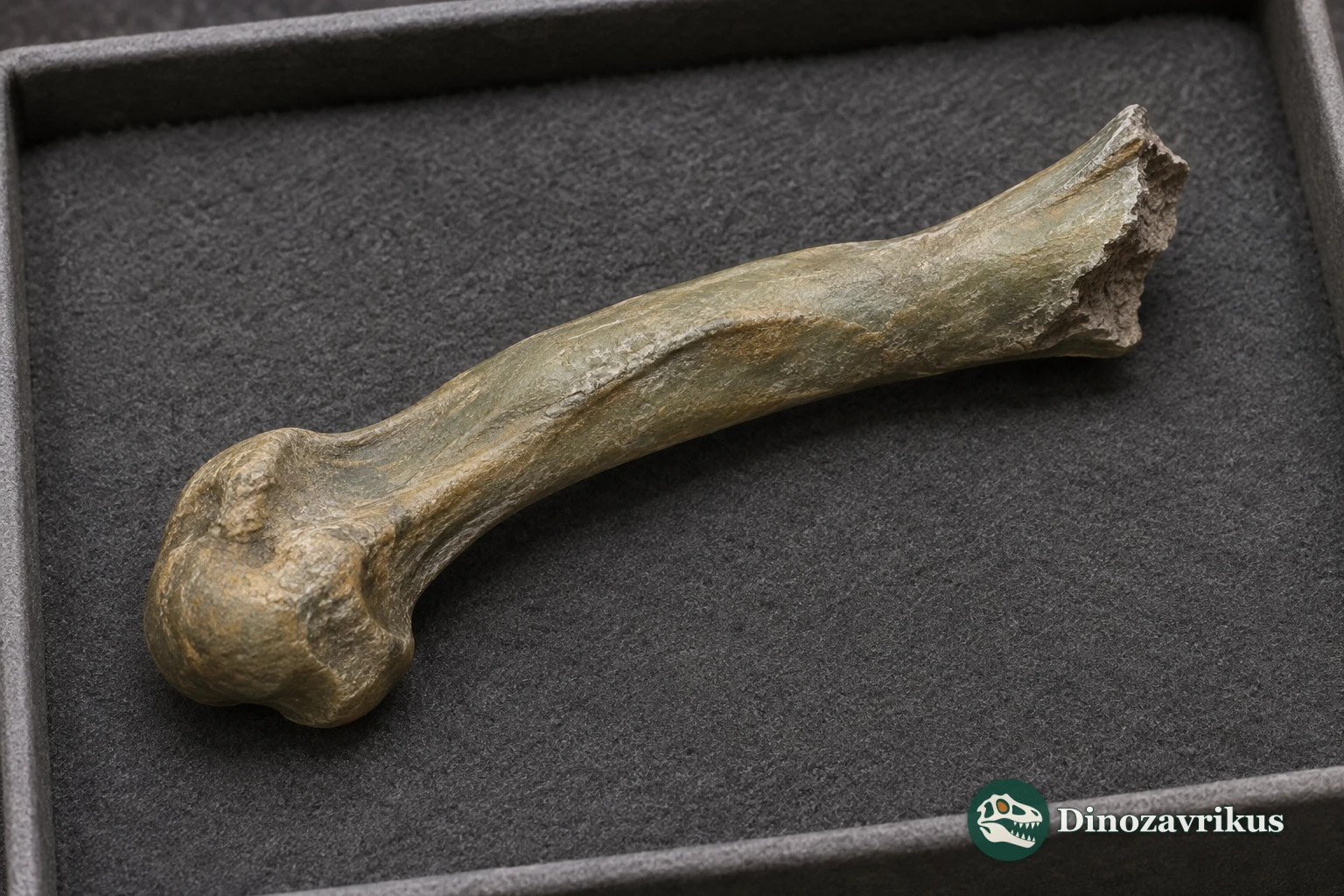
Anatalavis rex is known from two incomplete upper wing bones found in New Jersey. Their short, stout shafts led researchers to separate the bird from Telmatornis. The fossils come from near the Cretaceous–Palaeogene boundary, but their precise age has yet to be established.
Quick facts
| Type species | Anatalavis rex |
|---|---|
| Group | Birds, possibly related to waterfowl |
| Age | Latest Cretaceous or earliest Palaeocene |
| Locality | Hornerstown, New Jersey, United States |
| Holotype | YPM 902, incomplete right humerus |
What can the fossils tell us?
The shoulder end is missing on both fossils. The proportions of the surviving shaft and the shape of the elbow can still be compared with those of other birds.
The material comes from the lower Hornerstown Formation. The old collection records do not fix the position of either bone relative to the Cretaceous–Palaeogene boundary.
A comparison with a skeleton from the London Clay supported a connection to waterfowl. Later work separated the English species and highlighted differences between the humeri.
Two finds made nine years apart
J. G. Meirs collected the left humerus in 1869. W. Ross found the right one in 1878. Both came from Hornerstown in Monmouth County and are held at the Yale Peabody Museum. The right humerus, YPM 902, is the type specimen. The left, YPM 948, was referred to the same species.
Robert Shufeldt named the species Telmatornis rex in 1915. In 1987 Storrs Olson and David Parris gave it its own genus. The humerus differs from that of Telmatornis in having a stouter, more strongly bowed shaft. The elbow end of the type bone is 13.6 mm wide. The span from the lower end of the pectoral crest to the ventral condyle is 49.1 mm, a measurement of part of the bone.
A boundary fossil and an English comparison
The lower Hornerstown Formation in New Jersey records shallow marine deposition. The bird fossils have been assigned either to the latest Cretaceous or to the earliest Palaeocene. The marine sediments show where the bones were buried. They leave open whether the bird regularly ventured out over the sea.
In 1999 Olson used a more complete English skeleton to propose a relationship to magpie geese. The English species is now generally treated separately as Nettapterornis oxfordi. Comparisons of the upper wing bones showed a much longer ventral epicondyle in Anatalavis rex. The bill of the American bird is still unknown.
Frequently asked questions
Why was Anatalavis given a new genus?
Comparisons showed that its humerus had a proportionately shorter, thicker and more curved shaft than that of Telmatornis.
What does the name mean?
It combines Latin elements meaning duck, wing and bird.
Does the fossil tell us what the bird ate?
The fossils are parts of the wing. No bill or evidence of food has been identified.
Did Anatalavis survive the end-Cretaceous extinction?
The two finds have not been securely dated to either side of the boundary, so they cannot answer that question.