

Fossils can preserve more than shape. In some bones and teeth, researchers identify traces of proteins. The study of ancient proteins is called palaeoproteomics. Unlike ancient DNA, protein evidence does not provide a direct readout of the genome, but it can sometimes help test relationships, identify biological sex or show which molecular components survived mineralisation.
Protein residues in fossils are usually altered and fragmented. Detecting a signal does not mean a complete molecule or a full genetic portrait has survived. Researchers must also determine whether the material came from the ancient tissue or entered during excavation, storage, conservation or laboratory work.
What may survive in bone and teeth
Proteins are chains of amino acids. After death, those chains break apart, change chemically and interact with minerals and the burial environment. Temperature, moisture, sediment chemistry and the history of a specimen affect the rate of change, so fossils of the same age need not preserve proteins equally well.
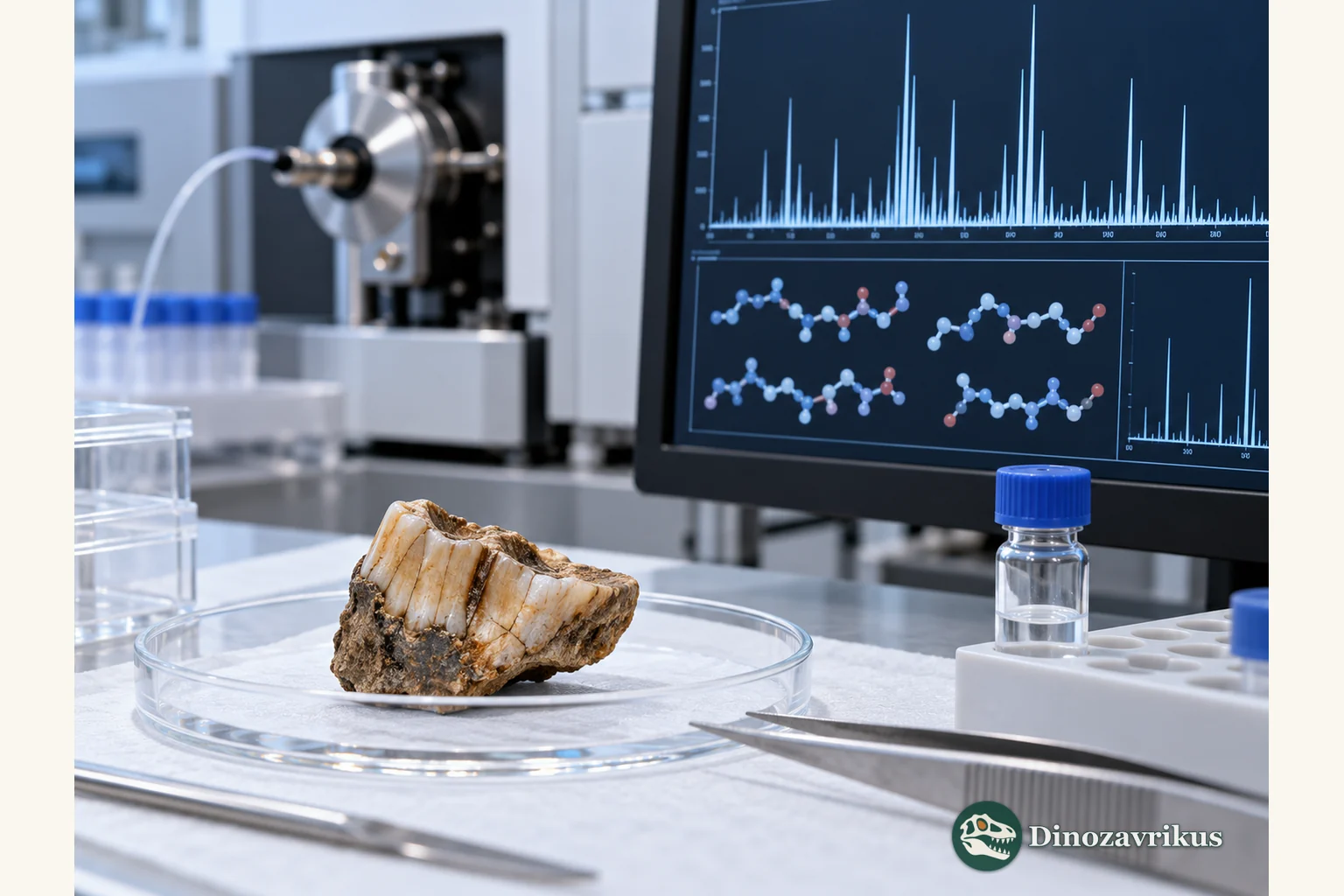
Collagen, a major protein in bone, is a frequent target. Tooth enamel is also valuable: it contains little organic matter, but its dense mineral structure can sometimes protect protein residues. In mass spectrometry, prepared molecules are ionised and their mass-to-charge ratios measured. Researchers compare the resulting patterns with known protein sequences.
How fragments become biological evidence
Scientists look for signals corresponding to peptides, short sections of a protein chain. They assess how well each spectrum matches a proposed sequence and how specific that match is. Some fragments can be compared among living animals; amino-acid differences may help test evolutionary relationships. A short peptide, however, cannot necessarily distinguish one species from another, especially if the sequence is shared widely.
Analysis of enamel proteins from Homo antecessor and Homo erectus showed how partial sequences can contribute to hypotheses about relationships where DNA is poorly preserved. A 2025 study of four Paranthropus robustus teeth used enamel proteins to examine biological sex and variation among individuals. These are case studies, not a rule that a single peptide resolves a taxonomic debate.
In 2025, researchers reported protein sequences from the enamel of an Early Miocene rhinocerotid from Arctic Canada, dated to about 21–24 million years ago, and from fossils sampled in Kenya’s Turkana Basin spanning as much as 18 million years. The studies assessed chemical alterations and the possible endogenous origin of the signals, while also discussing limits on phylogenetic interpretation. They extend evidence from particular specimens and settings; they do not promise that every fossil of similar age will preserve identifiable proteins.
Proteins are not DNA
DNA stores a sequence of nucleotides and, when sufficiently preserved, can reveal many genetic variants. Proteins are made from amino acids and represent only part of the information encoded by genes. Protein analysis is therefore usually less suited to fine-scale population work than a strong DNA record, but may remain possible in some older or warmer-context fossils where DNA has degraded.
Palaeoproteomics does not “bring back” a genome. It provides a set of molecular observations to compare with anatomy and geological context. It is especially useful when morphology allows competing interpretations and the available proteins contain enough variation to test them. Our article on soft tissues reported in dinosaur fossils covers a narrower and more disputed question; this guide focuses on the methods and limits of protein analysis across fossil groups.
How researchers test for contamination
Contamination can come from handling, adhesives, preservatives, soil, laboratory proteins or reagents. Some common proteins occur in many living species, so a short match does not by itself prove an ancient origin. Appropriate controls can include clean preparation, extraction blanks, nearby sediment or associated material, and a documented history of storage and conservation.
Researchers also evaluate chemical modifications and damage expected after long burial, compare candidate sequences against broad databases and inspect important spectra. No single criterion acts as a universal authenticity stamp. Confidence comes from multiple independent checks and a transparent account of how the sample was collected, prepared and analysed.
Mass-spectrometry results also depend on the reference database, search algorithm and statistical thresholds. If the database lacks relevant species or similar sequences are shared among taxa, assigning a peptide to a particular animal becomes less secure. Strong studies report which fragments were identified, how confidently they were assigned and which alternatives were considered.
What the method cannot promise
Palaeoproteomics does not replace anatomy, stratigraphy or reliable dating. It cannot guarantee a complete proteome: researchers often find isolated fragments, and different tissues preserve unequally. Even an authentic peptide may be too short or too conserved to resolve relationships at species level.
Debates over proposed protein signals from very ancient dinosaur bones show why caution matters. Some reported sequences have faced questions about contamination and the difficulty of separating an ancient signal from a modern one. This does not invalidate the whole field: results from younger fossils and enamel provide separate evidence. Each claim must be assessed against its own specimen, controls and analytical record.
The most informative conclusions arise when molecular evidence agrees with anatomy and geological context, while uncertainty is made explicit. Ancient proteins rarely answer a question alone, but they can provide an independent line of evidence for studying past life.
Frequently asked questions
How is palaeoproteomics different from ancient DNA analysis?
It studies proteins or protein fragments rather than DNA sequences. Proteins provide less genetic information, but in some conditions they may survive where DNA does not and can help compare particular biological traits.
Can proteins be recovered from every fossil?
No. Preservation depends on temperature, moisture, mineralisation and specimen history. Even in a promising tissue, too few fragments may remain for reliable analysis.
How do researchers distinguish ancient proteins from contamination?
They use clean preparation, negative controls and, where possible, surrounding material; they also assess chemical damage and compare sequences with broad databases. Confidence depends on several checks, not one match.
Can a protein alone prove that two extinct species are related?
Usually it adds evidence rather than a final answer. Short fragments, incomplete databases and possible contamination limit precision, so protein data are compared with anatomy and geological context.