

Angustinaripterus longicephalus was a Middle Jurassic pterosaur from Sichuan, China. Its name rests on one incomplete skull and lower jaw, whose elongated, low profile helps distinguish it from other long-tailed pterosaurs.
The genus is listed in the pterosaur catalogue. Comparisons with the more complete Scottish Dearc help test its evolutionary relationships, but Dearc’s other bones cannot fill the gaps in the Angustinaripterus specimen.
Quick facts
| Scientific name | Angustinaripterus longicephalus |
|---|---|
| Group | Long-tailed pterosaur; traditionally a rhamphorhynchid |
| Age | Middle Jurassic; the precise stage depends on the formation scheme |
| Locality | Dashanpu, Sichuan Basin, China |
| Holotype | ZDM T8001, an incomplete skull and lower jaw |
| Body size | No reliable wingspan or body-length estimate |
What can the fossils tell us?
ZDM T8001 preserves cranial anatomy, but the back of the skull and the front of the lower jaw are incomplete. No wing, limb or trunk bones are known from this specimen.
Phylogenetic studies have grouped Angustinaripterus with Dearc and Sericipterus as Angustinaripterini. This is a result of character-based analysis, not proof that one was an ancestor of another.
Without postcranial bones, body proportions and wingspan cannot be measured. A long tail is reconstructed from its broader long-tailed group, not preserved in the Angustinaripterus holotype.
A skull from Dashanpu
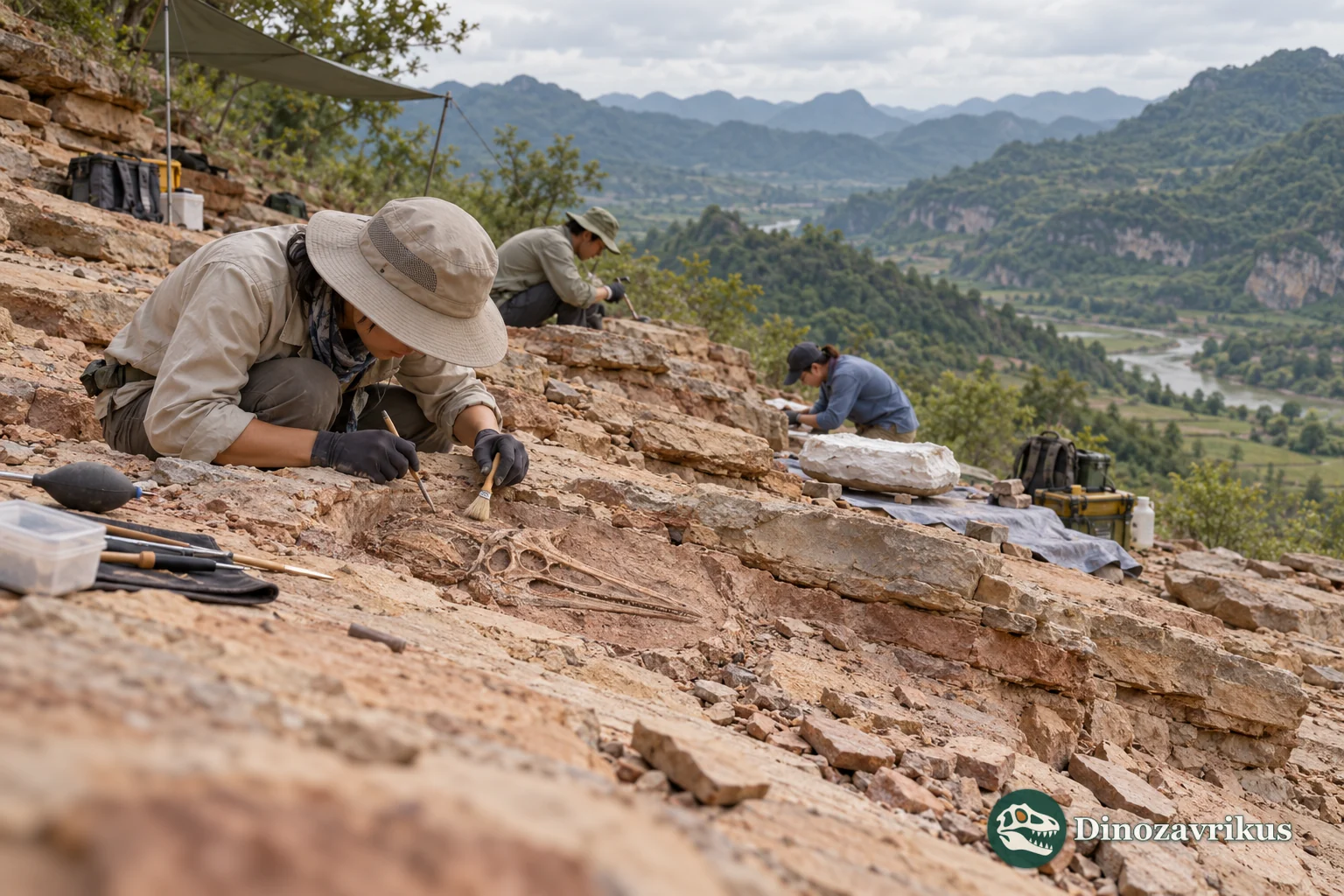
He Xinlu, Yang Daihuan and Su Chunkang named Angustinaripterus longicephalus in 1983 from specimen ZDM T8001. The fossil comes from the Dashanpu locality near Zigong, in Sichuan Province. It is held by the Zigong Dinosaur Museum. The preserved material is an incomplete skull with a lower jaw; the posterior skull is missing and the front of the lower jaw is incomplete.
The specimen comes from the Xiashaximiao Formation in the Sichuan Basin. Published age assignments have differed among stratigraphic schemes, so the formation and Middle Jurassic interval are more secure than a single exact stage. The locality is rich in dinosaur fossils, but that regional association does not show that all recorded animals shared one habitat or interacted.
What the skull shows
The preserved cranium is low and elongated. Its large antorbital opening and details of the cheek region and jaw joint can be compared with other pterosaurs. The tip of the skull is not complete, so estimates of total skull length depend on how the missing margin is reconstructed.
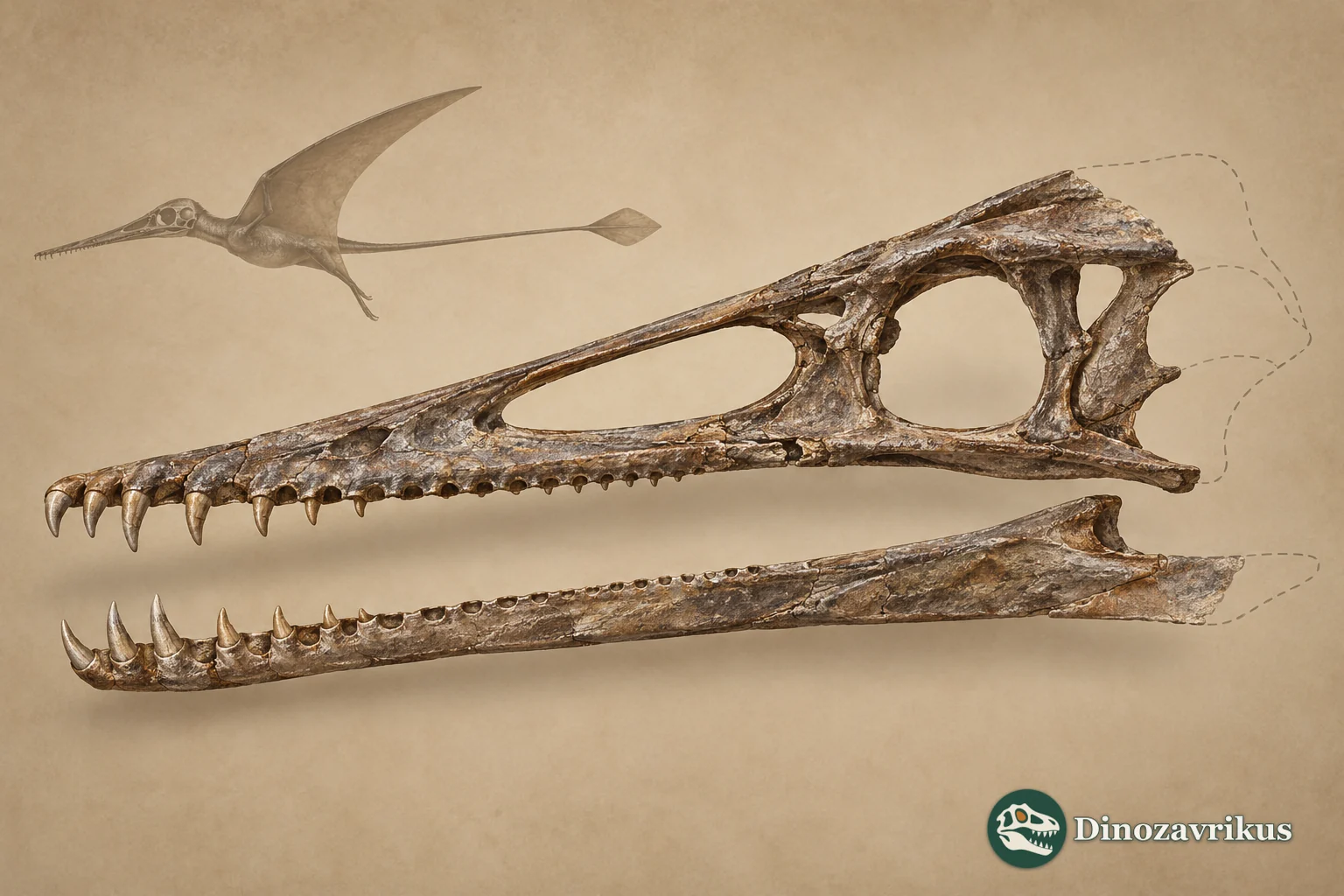
A 2022 comparison with the Scottish pterosaur Dearc sgiathanach noted shared proportions and several cranial features. The authors recovered both, with Sericipterus, in Angustinaripterini. This is a phylogenetic hypothesis based on selected anatomical characters, not evidence of direct ancestry or identical ecology.
Why wingspan is unknown
The holotype contains no wing, shoulder, leg or vertebral bones. A wingspan cannot be measured from it. Scaling the skull against more complete pterosaurs can produce a model estimate, but the result depends on assumed proportions and should not be presented as an observed measurement.
A long tail ending in a vane is expected from its broader long-tailed pterosaur group, which is why it appears in the reconstruction. The tail itself, wing membrane, colour and precise body proportions are not preserved in Angustinaripterus. Teeth show a grasping apparatus, but do not identify a particular prey or hunting method.
A window into Jurassic pterosaur diversity
Even a fragmentary skull can preserve a useful combination of diagnostic traits. Alongside Dearc, the genus suggests that some non-pterodactyloid pterosaurs had relatively large bodies and elongated skulls by the Middle Jurassic. The more complete skeleton of Dearc is a comparison, not a substitute for bones that have never been found in Angustinaripterus.
The fossil record does not show how Angustinaripterus launched, manoeuvred or fed. Those questions need wing and limb anatomy, trace fossils or other independent evidence. The safest description is a diagnosable Middle Jurassic long-tailed pterosaur whose known anatomy is concentrated in the skull.
Frequently asked questions
What is the Angustinaripterus holotype?
ZDM T8001 is an incomplete skull and lower jaw from Dashanpu in Sichuan, China.
Is a complete skeleton known?
No. The described holotype preserves cranial material; no wing, trunk or limb bones are known.
How large was Angustinaripterus?
A reliable wingspan or body length has not been established because the holotype lacks postcranial bones.
Was it related to Dearc?
A character-based analysis grouped them in Angustinaripterini. That supports a proposed close relationship, not direct ancestry.