

Anoualerpeton is a genus of small albanerpetontid amphibians named from fossils in Middle Jurassic England and Early Cretaceous Morocco. Its most useful clues are small bones of the jaws and skull roof. Those details helped researchers distinguish it from other members of an extinct lissamphibian lineage.
The animal belongs in the ancient amphibian catalogue. Its fossils do not make it a true salamander, even if a small, long-bodied amphibian is a convenient way to imagine its general scale.
Quick facts
| Scientific name | Anoualerpeton priscus and A. unicus |
|---|---|
| Group | Albanerpetontidae, an extinct lissamphibian lineage |
| Age | Late Bathonian to Berriasian, in the known records |
| Localities | England and the Anoual region of Morocco |
| Evidence | Small jaws, premaxillae and skull-roof bones |
| Complete skeleton | Not known |
What can the fossils tell us?
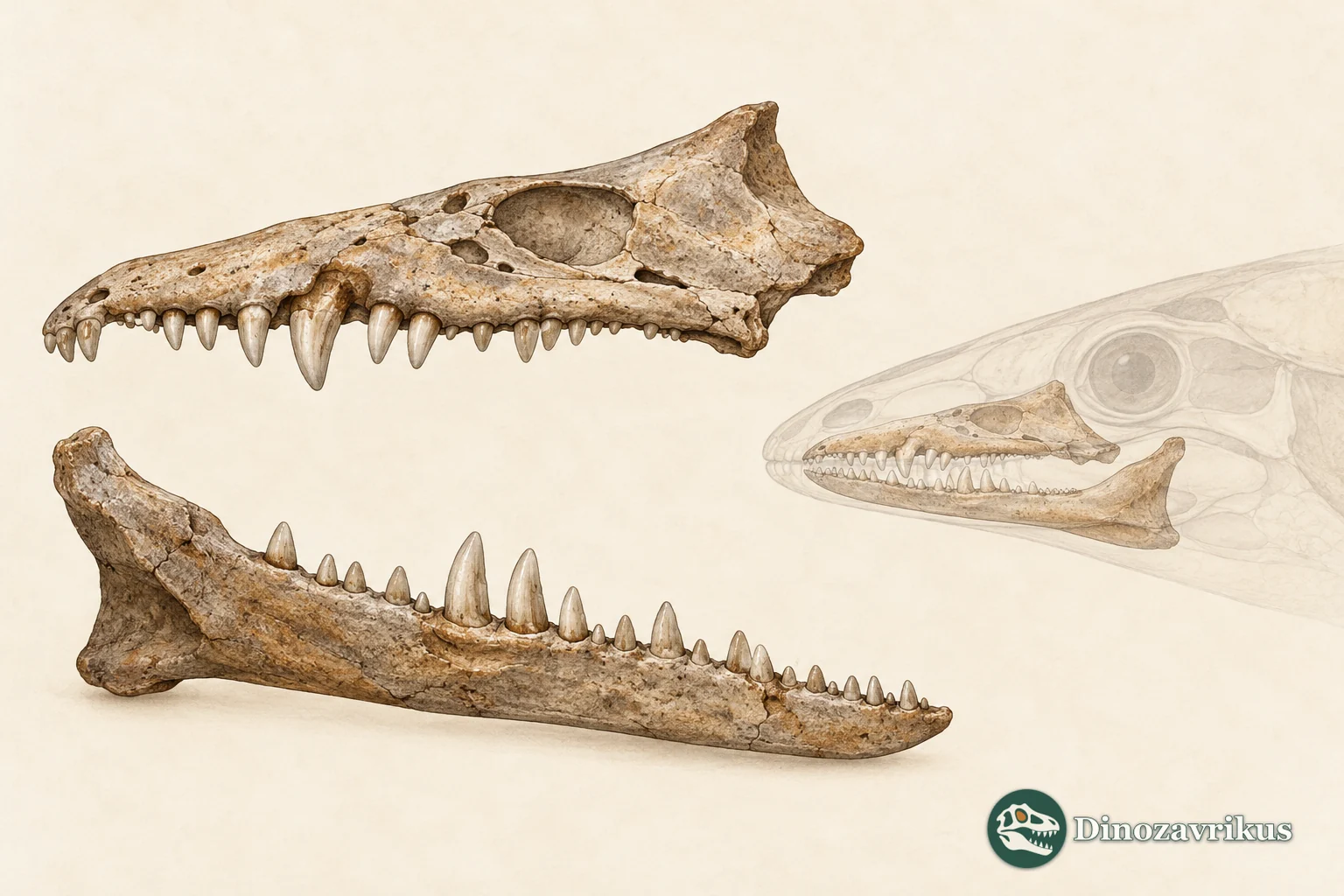
The original description emphasized a convex occlusal margin and marked size differences among the anterior teeth. These features support identification in suitable jaw material; an isolated tooth may not identify a species.
Anoualerpeton priscus is known from Middle Jurassic England; A. unicus was described from Early Cretaceous Morocco. Their separation relies on several cranial characters, not geography alone.
The Paris museum catalogue records this Moroccan specimen as an upper jaw of A. unicus. It is one catalogued fossil element, not a complete skeleton or a direct measure of body length.
The diagnostic record is dominated by small cranial bones. Soft tissue, colour, behaviour and complete body proportions are not preserved; reconstructions are interpretive.
Two species separated by time and geography
Gardner, Evans and Sigogneau-Russell introduced Anoualerpeton in 2003 while describing albanerpetontid material from Morocco and England. The genus includes A. priscus, from the late Bathonian of England, and A. unicus, from Berriasian deposits near Anoual in Morocco. The records are separated by a long interval; they do not represent one population moving between the two sites.
The authors compared premaxillae, maxillae, dentaries and frontals. Their character analysis placed Anoualerpeton close to a group containing Albanerpeton and Celtedens. That relationship is a hypothesis built from anatomical characters, and later finds can change the available comparison.
What the teeth and jaw margins show
The original description noted a convex tooth-bearing margin and heterodonty near the front of the jaw: anterior teeth differ noticeably in size from those behind them. Such a combination is more useful than treating one loose tooth as a complete diagnosis. The shape of the premaxilla and frontal bones also helps separate the two named species and compare the genus with other albanerpetontids.
Tooth size variation does not provide a precise menu. It can inform questions about prey capture and jaw function, but the fossils do not preserve a meal or a witnessed feeding event. Claims about a particular insect or hunting technique would go beyond this material.
A museum record is not a complete animal
The Muséum national d’Histoire naturelle in Paris lists specimen MNHN.F.MCM203 as a maxilla of A. unicus from Anoual, Morocco. Museum catalogues make specimen identity and collection history easier to check, but this entry describes one upper-jaw element. It should not be confused with the complete type series or a whole skeleton.
Some later material has been referred cautiously as cf. Anoualerpeton priscum. The qualifier signals a resemblance rather than an unqualified identification. Because small amphibian bones can be difficult to distinguish, those referrals should not silently expand the secure range of the genus.
How much of the animal can be reconstructed?
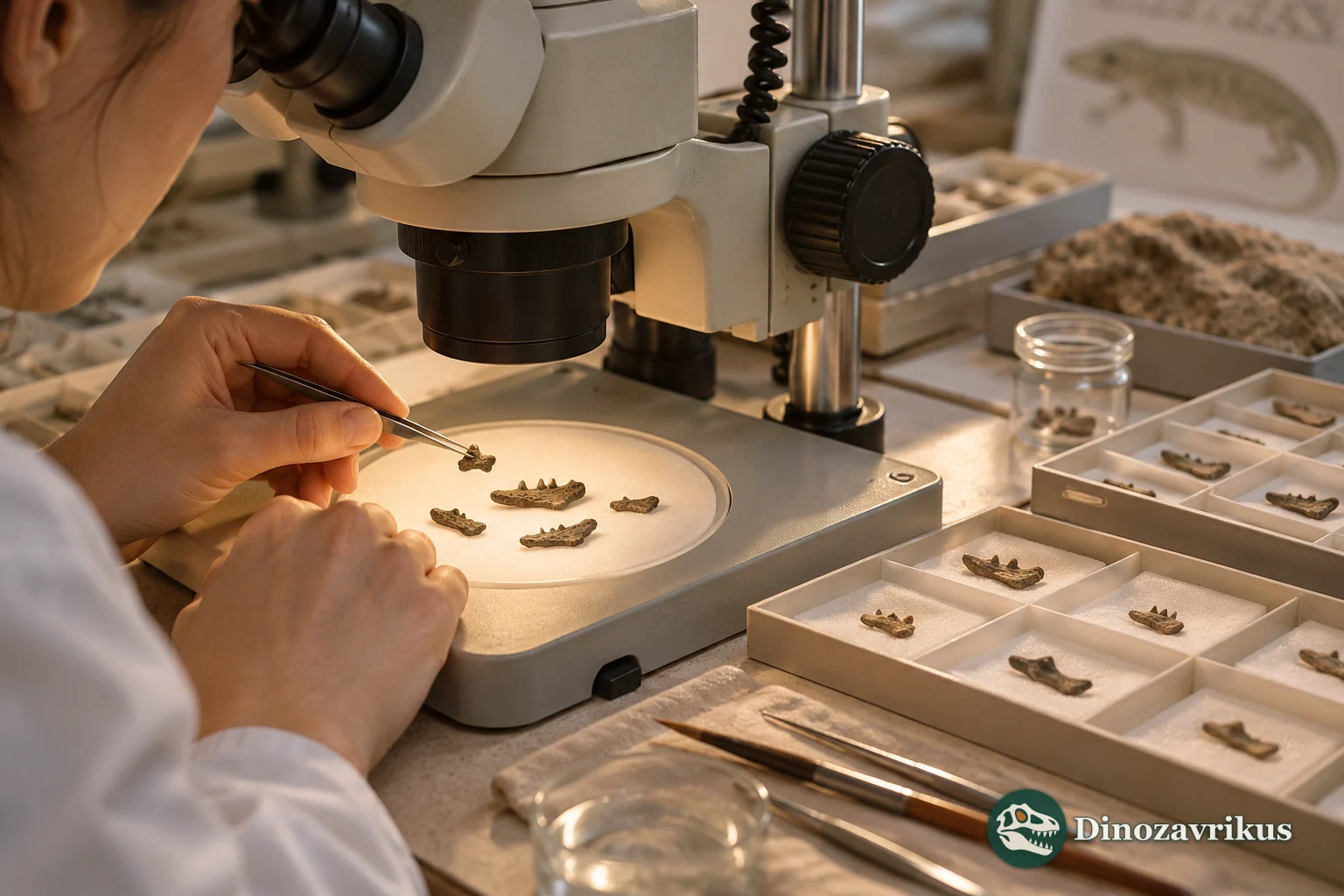
Jaw and skull-roof fragments indicate a very small animal, but a reliable total length is not established by a complete articulated skeleton. The fossils do not preserve skin, colour, calls, reproductive biology or behaviour. Reconstructions that resemble salamanders are visual interpretations, not evidence that albanerpetontids belonged to the modern salamander branch.
Its known occurrences span the Jurassic and earliest Cretaceous. The separated English and Moroccan records are valuable because they show the lineage in different regions and intervals, while the patchy fossil record prevents a confident map of its entire distribution.
Frequently asked questions
Was Anoualerpeton a salamander?
No. It belonged to Albanerpetontidae, an extinct lissamphibian lineage distinct from true salamanders.
Where were its two species found?
A. priscus is known from Middle Jurassic England, while A. unicus was described from Early Cretaceous deposits near Anoual in Morocco.
Is a complete skeleton known?
No. The diagnostic material consists mainly of small skull and jaw bones, so full body proportions are uncertain.
Can its teeth identify what it ate?
They help describe the jaw and compare species, but tooth shape alone does not establish a precise prey list or observed feeding behaviour.