

Anthropodyptes gilli was a large penguin from the Early Miocene of Australia. A nearly complete upper flipper bone found by the Glenelg River in western Victoria is the only specimen. It retains features also seen in large penguins from much older deposits.
Quick facts
| Type species | Anthropodyptes gilli |
|---|---|
| Group | Stem penguins |
| Age | Early Miocene, about 21–17.6 million years ago |
| Locality | Devil’s Den, Glenelg River, Victoria, Australia |
| Holotype | NMV P17167, nearly complete right humerus |
What can the fossils tell us?
Its position and the local sediments led Edmund Gill to identify the Gellibrand Marl as the likely source. No exact position within the original bed is recorded.
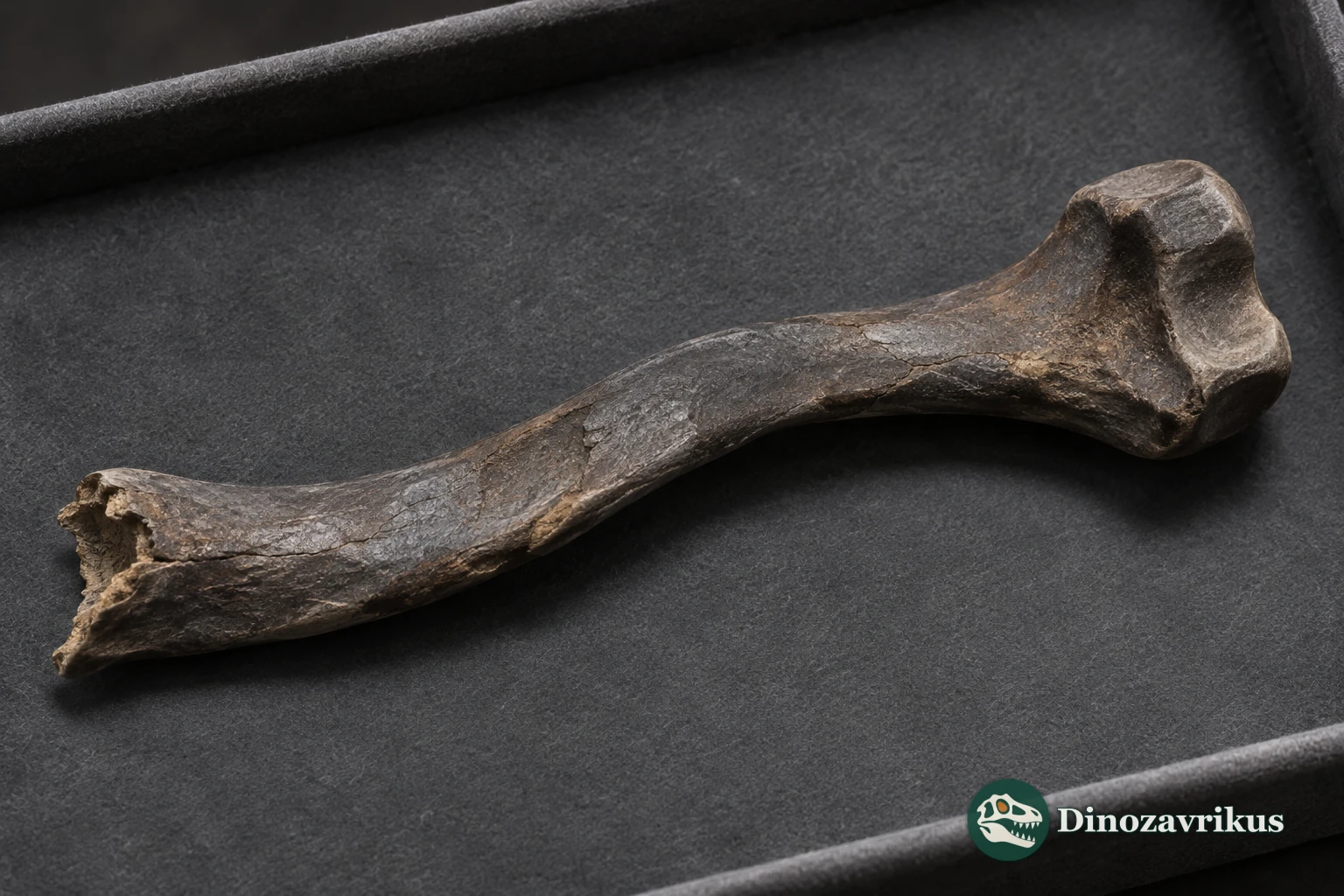
The shoulder end is incomplete. A gently curved shaft and an undivided fossa are among the features that can be compared with those of other penguins.
Analyses of skeletal characters place the fossil outside the group that includes all living penguins. The specimen cannot establish the full proportions of the bird.
A fossil on the bank of the Glenelg
Edmund Gill found the humerus in 1950 at Devil’s Den, north of Dartmoor. It was lying loose on top of marl. Gill linked it to the local marine Gellibrand Marl, whose microfossils give a regional age of roughly 21–17.6 million years.
George Gaylord Simpson named the species in 1959, honouring Gill. The fossil survives in the Museums Victoria collection as NMV P17167. Most of the head of the humerus is missing, as is a small projection at the far end. The remaining portions preserve the shaft and much of the elbow.
Reading the flipper from one bone
The shaft has a gentle S curve and widens towards the elbow. The large fossa near the shoulder end is undivided. The direction of the muscle attachment scars and the relative positions of the two elbow surfaces were among the comparisons that distinguished the genus.
Simpson measured about 114 mm between two named landmarks, the end of a muscle scar and the base of a groove by the elbow. The measurement does not give the full length of the bone or flipper. The fossil indicates a large penguin, but height and mass cannot be read directly from it.
A large early branch that persisted into the Miocene
The humerus resembles that of the New Zealand penguin Kairuku. The front edge of the bone has a different outline, and Anthropodyptes lacks an elongated hollow on the underside of the shaft that is present in Kairuku.
A later phylogenetic analysis placed Anthropodyptes on the penguin stem. Many of the other large stem forms are known from older Palaeogene deposits. The Australian fossil shows that at least one such lineage remained in the Early Miocene.
Frequently asked questions
What part of the penguin was found?
The nearly complete right humerus was found. No skull or associated skeleton is known.
How did researchers date the fossil?
Gill inferred its source from the local geology. Microfossil zones in the Gellibrand Marl supply the age range.
Was Anthropodyptes taller than an emperor penguin?
It was large, but there is no associated skeleton for a reliable comparison of standing height.
Why is it called a stem penguin?
The preserved anatomy places it on an extinct branch of penguins outside the common group made up of living species and their most recent common ancestor.