

Aphaurosuchus was a Late Cretaceous notosuchian from Brazil’s Bauru Basin. Its short, deep snout carried enlarged teeth with serrated edges. CT scans of a well-preserved skeleton helped define the genus. A more fragmentary skull later established a second species.
Quick facts
| Species | Aphaurosuchus escharafacies and Aphaurosuchus kaiju |
|---|---|
| Group | Baurusuchidae |
| Age | Late Cretaceous |
| Region | São Paulo state, Brazil |
| Main specimen | LPRP 0697, skull and nearly complete skeleton |
What can the fossils tell us?
Skull bones, limbs and armour can be associated with one individual. Parts of the tail and some limb elements are incomplete.
The species share features of the nasal and cheekbone. The deeper depression on the forehead bone helps identify A. kaiju, but its function is unclear.
The calculated force depends on the muscle forces and bite points applied to the model. The results allow comparisons without directly measuring a living animal’s bite.
The specimen near Jales
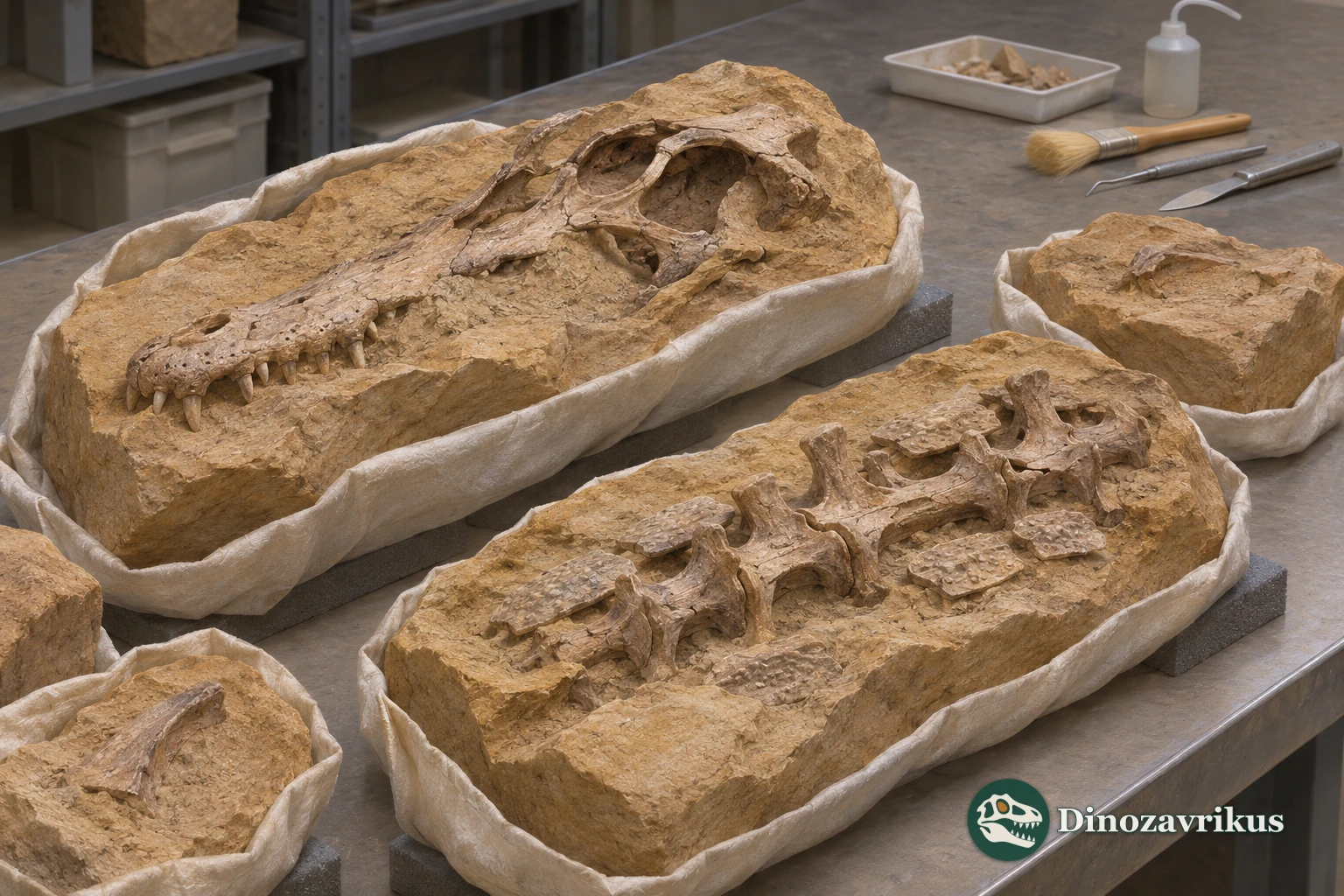
Gustavo Darlim, Felipe Montefeltro and Max Langer named Aphaurosuchus escharafacies in 2021 from a specimen found near Jales in São Paulo state. LPRP 0697 preserves the skull, much of the articulated skeleton and rows of paired bony plates over the vertebrae. Its remains are distributed among six main blocks.
A rock saw cut into the left cheekbone and lower jaw during collection. The marks inspired the specimen’s nickname and the species name. The damage dates to excavation.
Teeth and palate in CT scans
The skull is short, deep and compressed from side to side. Each side of the upper jaw had four premaxillary and five maxillary teeth. The third maxillary tooth is particularly large. Serrations line the cutting edges of its crown.
The researchers separated individual bones in a digital model. The palate helped distinguish the specimen from Baurusuchus, to which earlier work had tentatively assigned it. The back of the palatine bones flares sideways, contributing to an almost triangular outline of the opening beneath each orbit.
A second species from the Adamantina Formation
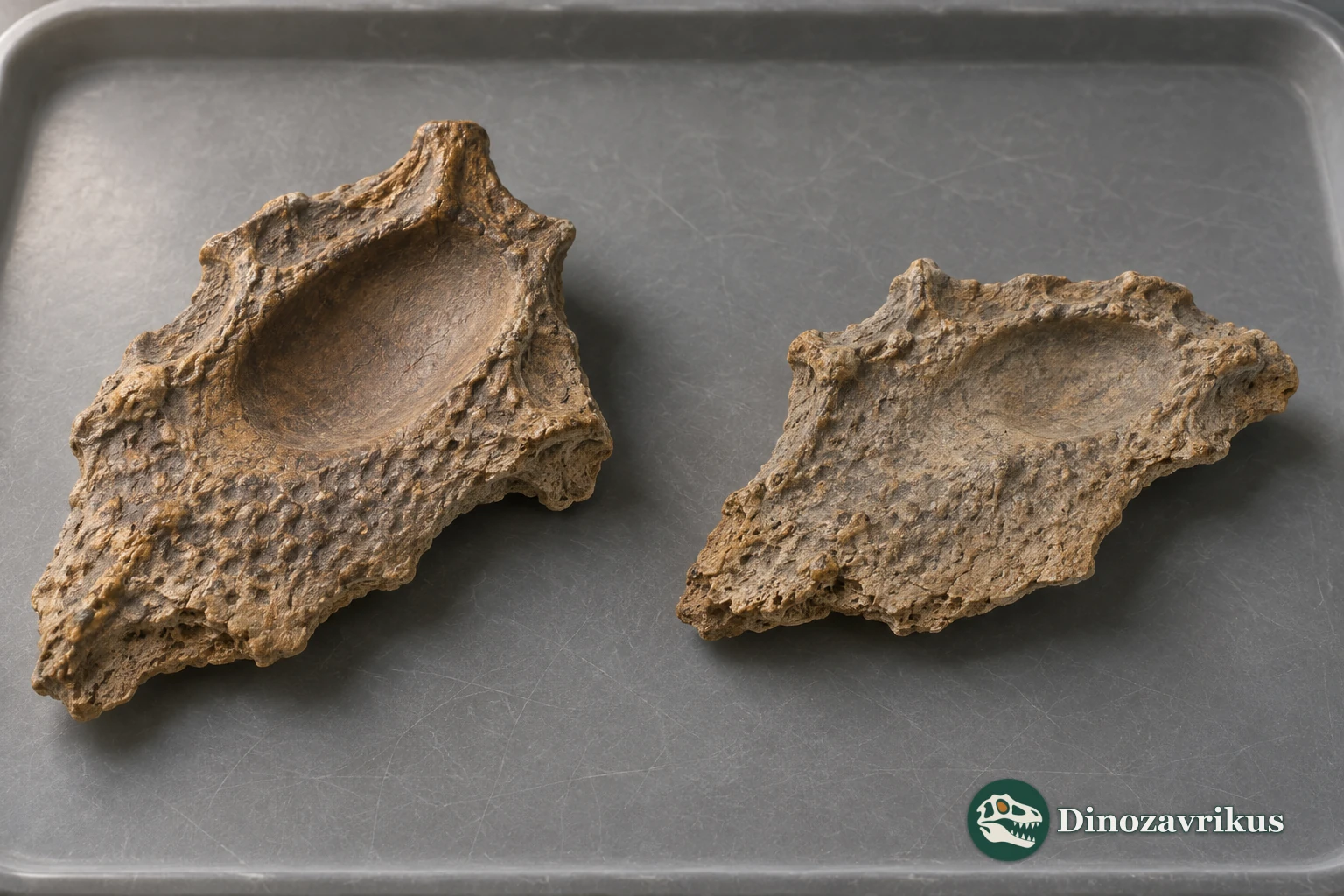
Aphaurosuchus kaiju is based on part of a skull and lower jaw, pieces of the palate and isolated teeth. It shares a depression towards the back of the nasal and an upturned ridge below the orbit with the type species.
A deep depression covers much of the upper surface of the frontal bone in A. kaiju. A pronounced crest lies within it. The structure helped researchers distinguish it from the type species.
Size and bite estimates
The skull of LPRP 0697 is about 33 cm long at its base. An earlier study estimated the individual at roughly 1.7 m in total length using the preserved portions of its skeleton. No similarly complete skeleton is available for the second species.
Biomechanical work on LPRP 0697 produced estimates of 252 N for the skull and 578 N for the jaw in separate bilateral-bite models. The results depend on the assumed muscle forces and where the model was constrained. The serrated teeth are consistent with carnivory, but the remains do not identify particular prey.
Frequently asked questions
How many species have been named?
Two. One has a nearly complete skeleton, while the other is known from parts of the skull and jaw and isolated teeth.
Why did the first specimen get a scar-related name?
The name refers to a rock-saw mark left on the cheekbone and lower jaw during collection.
What distinguishes Aphaurosuchus kaiju?
It has a large, deep depression on the frontal bone, with a prominent ridge within it.
How was its bite estimated?
Researchers modelled the skull and lower jaw under specified muscle loads. The resulting forces depend on the bite points and other assumptions in the model.