

Aphronorus was a small extinct placental mammal known chiefly from Paleocene teeth and fragments of jaws in western North America. Its fossil story is notable for an enlarged fourth premolar with surfaces suited to both puncturing and crushing. That anatomy inspired hypotheses about a specialized diet, but no stomach contents directly identify its food.
The genus is included in the ancient mammal catalogue. Its family placement has shifted between Pantolestidae and Pentacodontidae, so the broader extinct group Pantolesta is a safer summary than presenting one family assignment as settled.
Quick facts
| Scientific name | Aphronorus Simpson, 1935 |
|---|---|
| Type species | A. fraudator Simpson, 1935 |
| Group | Pantolesta; assigned to Pantolestidae or Pentacodontidae |
| Age | Middle to late Paleocene, depending on species |
| Range | Montana, Wyoming and Alberta |
| Main evidence | Isolated teeth, jaw fragments and a cranium of A. orieli |
| Diet | Animal prey is plausible; mollusc specialization remains a hypothesis |
| Open question | Family placement and species boundaries |
| Type specimen | USNM 6177, left lower jaw with P4–M3 |
What can the fossils tell us?
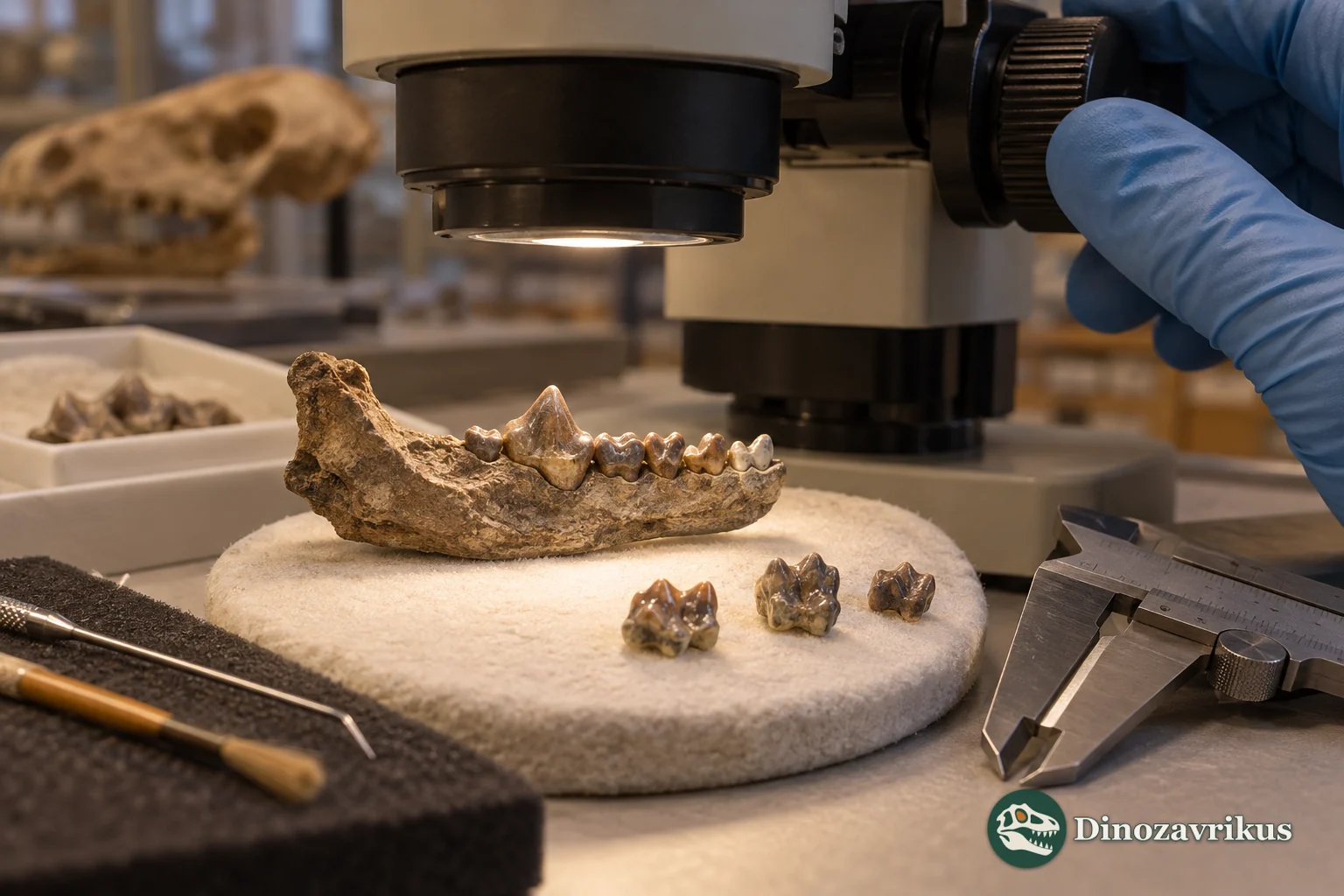
USNM 6177 is the left lower jaw of A. fraudator with P4–M3, collected by A. C. Silberling from the Gidley and Silberling quarries in Montana. It is not a complete skull or skeleton.
The enlarged P4 is a notable feature of Aphronorus. Its shape permits functional hypotheses about food processing but cannot identify one exact prey item.
Cranium USNM 309880 from the Bangtail locality preserves a natural cast of part of the braincase. It records some internal contours, not the brain’s soft tissues or behaviour.
A. fraudator, A. orieli and other named forms come from different Paleocene localities and horizons. Their records should not be treated as one population.
The name and type jaw
George Gaylord Simpson established Aphronorus in 1935. Its type species, A. fraudator, is based on specimen USNM 6177, a left lower jaw preserving P4–M3. A. C. Silberling collected it from the Gidley and Silberling quarries in the Fort Union Formation of Montana. The jaw anchors the name, but it cannot reveal the whole skull or body proportions.
Teeth and possible feeding
Simpson compared Aphronorus with Pentacodon, distinguishing them partly by premolar and molar proportions. The enlarged fourth premolar has a prominent crown with puncturing and crushing surfaces. Later fossils provide upper teeth and jaws for comparison, although most species remain represented by incomplete material.
Gingerich, Houde and Krause proposed that A. orieli may have been a terrestrial animal-eater, perhaps specializing in molluscs. Terrestrial snails occur at the Bangtail site, and heavy tooth wear is compatible with crushing. These observations do not prove a mollusc-only diet: no gut contents are known, and wear can result from several foods or grit.
The Bangtail cranium
Material described from Bangtail, Montana, includes the cranium USNM 309880 assigned to A. orieli. Its preserved length is about 56.6 mm; the original authors estimated a condylobasal length near 58 mm and a breadth around 36 mm from incomplete parts. The estimated values are not measurements of a complete skull.
A natural cast of part of the braincase is preserved inside the cranium. It records selected contours, including impressions associated with venous sinuses, but is not a complete brain. The cheek teeth are heavily worn, consistent with an adult individual; the specimen cannot establish an age in years.
Species, age and classification
Names used in the genus include A. fraudator, A. simpsoni, A. orieli, A. ratatoski and A. bearspawensis. The amount of evidence differs among them. The Bangtail sample of A. orieli includes a cranium and jaw fragments, whereas several other assignments rely chiefly on isolated teeth.
The genus spans more than one Paleocene fauna: the type species is associated with middle Paleocene deposits, while other species occur in later records, including early Tiffanian faunas. Family placement also varies. Some sources retain Aphronorus in Pantolestidae, while other classifications assign it to Pentacodontidae. Both labels reflect a history of comparison within Pantolesta; neither should obscure the fragmentary evidence.
What remains unknown
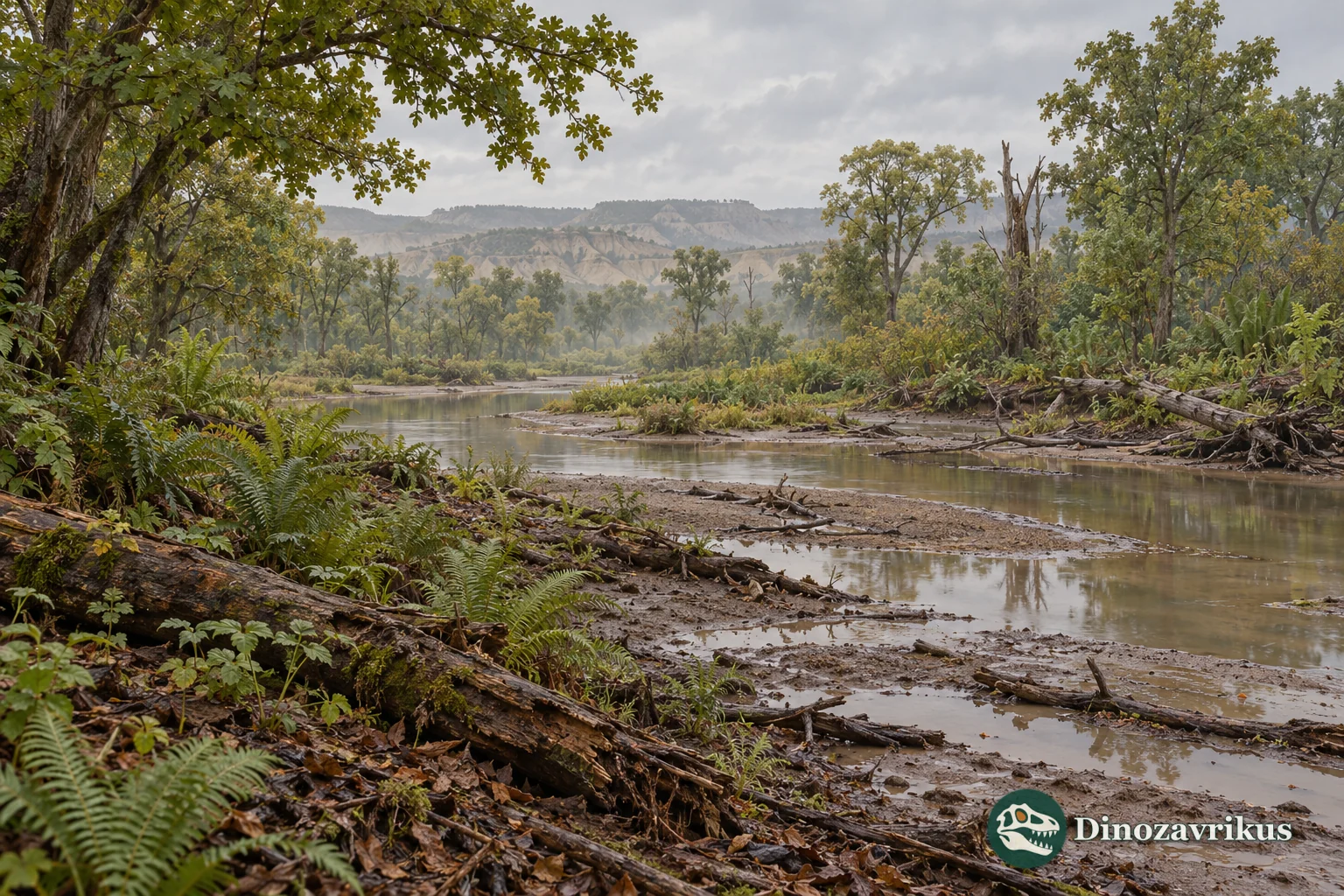
Fossils document the dental apparatus and, for A. orieli, some cranial anatomy. They preserve no fur, colour, social behaviour or hunting scene. A small terrestrial animal is a reasonable reconstruction, but its exact body mass and daily activity are not directly measured. A picture can suggest a Paleocene woodland setting while keeping those details visibly interpretive.
Frequently asked questions
When did Aphronorus live?
Its named species span middle to later Paleocene faunas. The exact interval depends on which species assignment is considered.
What is the type specimen?
USNM 6177, a left lower jaw of A. fraudator with P4–M3 from the Fort Union Formation in Montana.
What did Aphronorus eat?
Animal prey is plausible from its teeth. A possible specialization on land snails has been proposed for A. orieli but is not directly proven.
Why is its classification debated?
Different authors have placed the genus in Pantolestidae or Pentacodontidae, reflecting differing interpretations of its dental and other fragmentary evidence.