

Aprosdokitos mikrotero was a small penguin from Seymour Island, near the Antarctic Peninsula. It is named from a humerus just 50.8 mm long. Before treating the size as a feature of a new species, the researchers tested whether the bone could have belonged to an immature penguin.
Quick facts
| Type species | Aprosdokitos mikrotero |
|---|---|
| Group | Sphenisciformes |
| Age | Late Eocene, near the Eocene–Oligocene transition |
| Locality | Seymour Island, Antarctic Peninsula |
| Holotype | MLP 00-I-1-19, humerus measuring 50.8 mm |
What can the fossils tell us?
Its shaft is slender and nearly straight, with a single undivided fossa towards the shoulder. This resembles the pattern in other Palaeogene penguins.
The authors assessed the form of the joints and changes in bone surface during growth. Both lines of comparison supported a mature individual.
Another small penguin humerus lacks part of the elbow region needed for close comparison. It was left unassigned to Aprosdokitos.
A fossil from Submeseta III
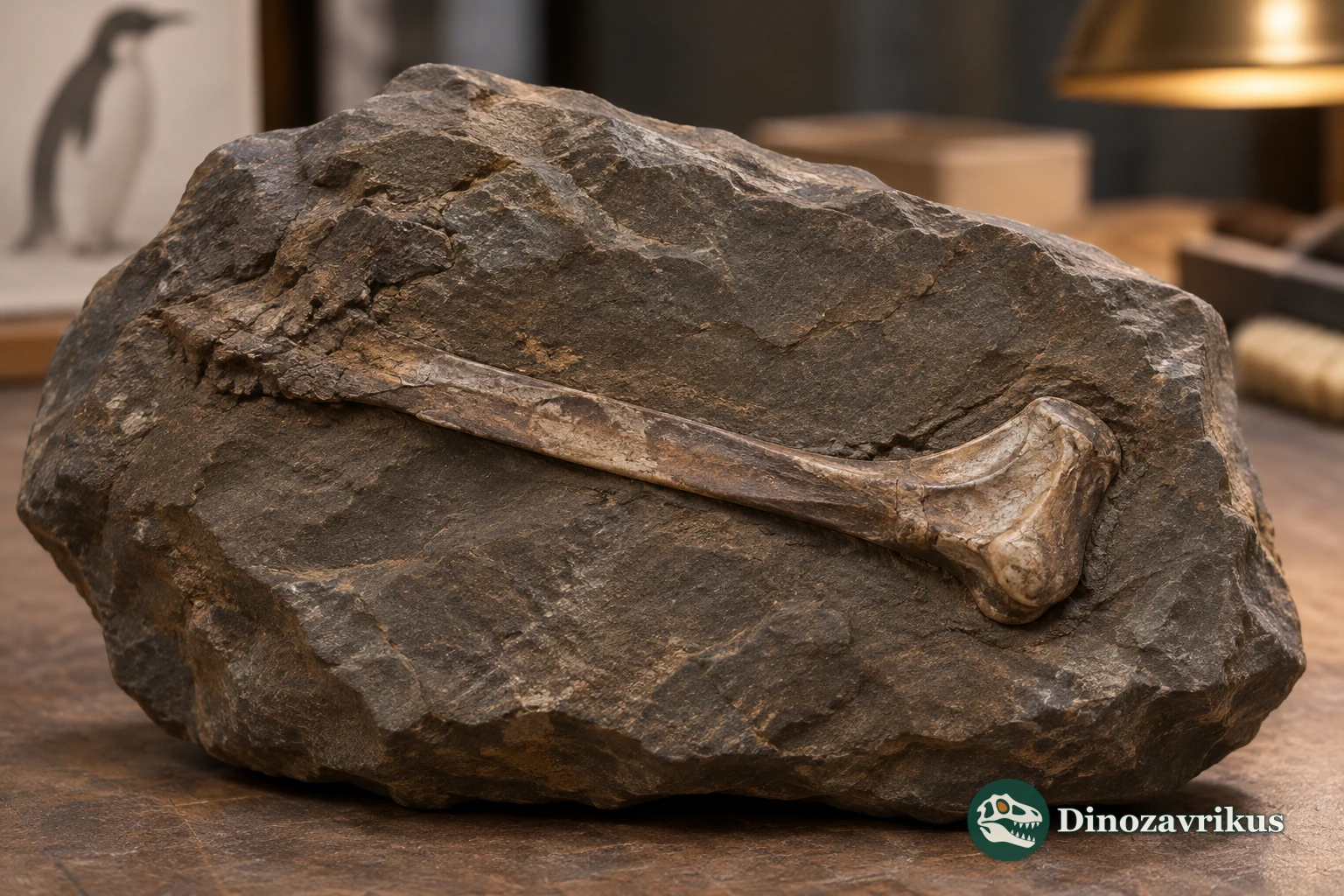
The type was collected in 2000 from locality DPV 16/84 on Seymour Island. It comes from Submeseta III, the upper part of a marine sedimentary sequence. The type paper referred the site to the late Eocene, with room for uncertainty near the earliest Oligocene.
Carolina Acosta Hospitaleche, Marcelo Reguero and Sergio Santillana named the genus and species in 2017. The name combines words for unexpected and very small. The Museo de La Plata holds the type as MLP 00-I-1-19.
How the authors distinguished a small adult
The type humerus is 50.8 mm long and 9.5 mm wide at the elbow. An undivided fossa survives at the shoulder end, in contrast to the subdivided structure of the living little penguin. The bone is distinctly smaller than many comparable Antarctic fossils, including material compared with Delphinornis.
A small bone by itself admits several explanations. The authors examined the joint ends and surface texture against a growth series of modern chinstrap penguins and compared the morphology with known wing abnormalities. The preserved bone looked mature. They found no deformation of the kind expected from the pathologies they considered.
A second bone with a missing comparison
The second specimen, MLP 13-IX-28-385, came from older deposits at site IAA 2/13 on Seymour Island. It shares the small, slender form of the type but is broken in part of the elbow region. It was left as an indeterminate penguin. The secure record of the genus therefore consists of one bone, with no direct evidence of plumage or diet.
Frequently asked questions
How big was its flipper?
The humerus measures 50.8 mm. The other flipper bones are unknown, so the full length of the flipper cannot be measured.
Could it have been a chick?
The joints and bone surface were compared with developmental series of living birds. Their morphology supported identification as a small adult.
Are there two specimens of Aprosdokitos?
Only one is assigned to the genus. The other small fossil lacks enough of the diagnostic region for a secure assignment.
Was it related to the living little penguin?
Both are penguins, but the small fossil has a different structure near the shoulder end. Similar size alone does not establish a close relationship.