

Archaeorhynchus was an Early Cretaceous bird with toothless jaws and long wings. Fossils from Liaoning preserve its skeleton at several stages of growth. An especially complete individual shows the tail feathers and possible traces of lungs. A probable juvenile preserves plant remains in the gut.
Quick facts
| Group | Early birds on the euornithine lineage (Euornithes) |
|---|---|
| Age | Early Cretaceous |
| Region | East Asia (Liaoning, China) |
| Diet | Plant eating documented in a probable juvenile |
| Type species | Archaeorhynchus spathula |
| Holotype | IVPP V14287, nearly complete skeleton |
| Deposits | Yixian and Jiufotang formations |
| Plumage | Short fan with a pair of long central tail feathers in STM7-11 |
What can the fossils tell us?
The feather impressions on STM7-11 show the arrangement around the tail. Sex and variation among individuals remain unknown.
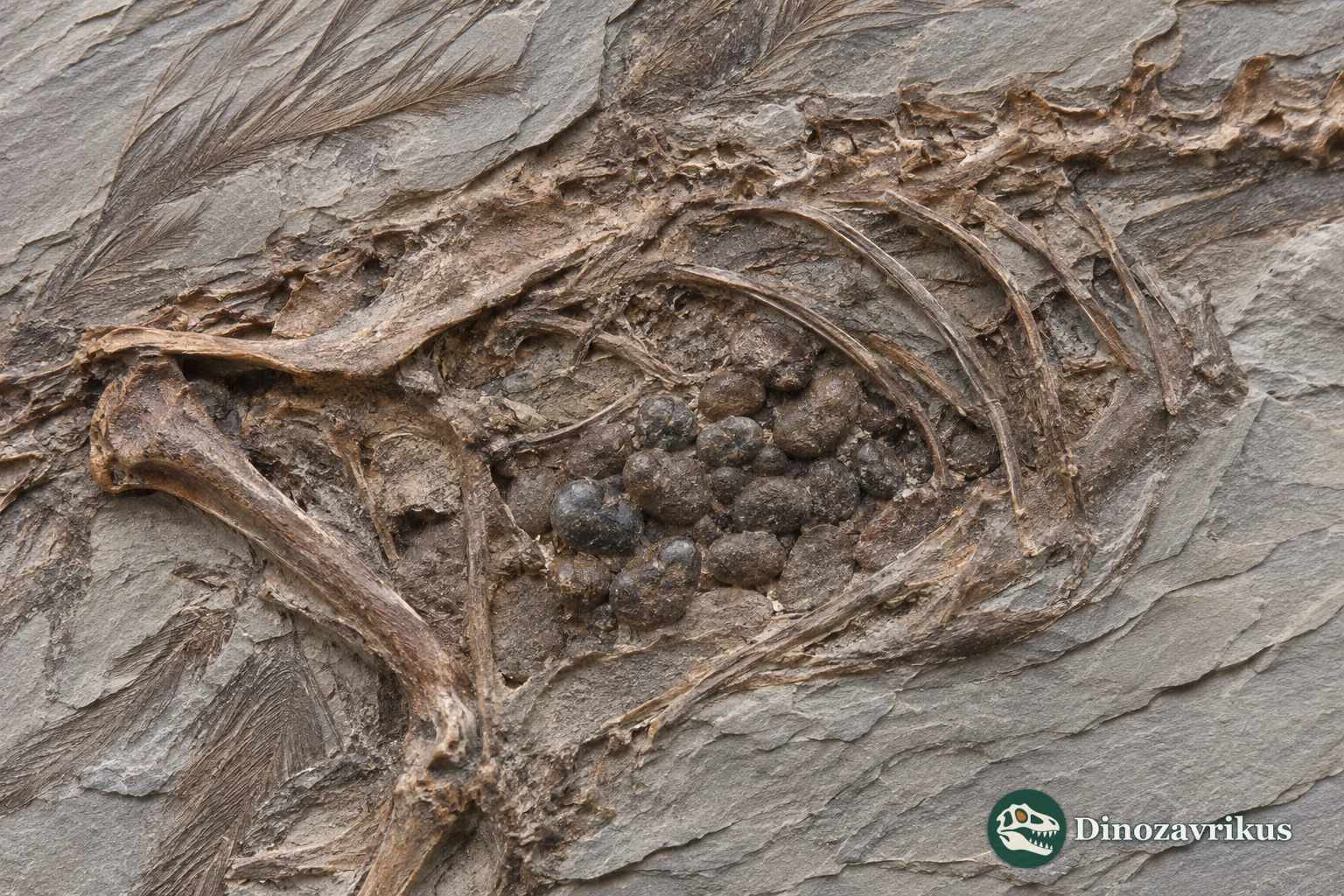
Several specimens retain clusters of swallowed stones. Plant remains in the gut of a probable juvenile give separate evidence of what that bird ate.
The light material occurs beside the ribs of STM7-11. Fine structures seen under magnification support a lung interpretation.
The first skeleton and the birds from Jiufotang
Zhou Zhonghe and Zhang Fucheng named the species in 2006 on the basis of IVPP V14287. The type preserves a skull and most of the postcranial skeleton. A detailed 2013 study assigned it to the Yixian Formation. The articulated specimens IVPP V17075 and IVPP V17091 came from the Jiufotang Formation and revealed more of the feet, wings and sternum.
The jaws carry no teeth. The breastbone has a keel, and the wing bones are long relative to the hindlimbs. Comparisons of these and other bones place Archaeorhynchus near the early branches of Euornithes, the avian lineage that includes living birds.
Evidence from the digestive tract
Small rounded stones lie in dense clusters in the abdomen of several individuals. STM7-11 preserves about a hundred. They have been interpreted as gastroliths, swallowed stones that helped process food in the stomach. The stones give few clues to the ingredients of any single meal.
Specimen LNTU-WLMP-18 also preserves a small skeleton and plant material in its intestines. Researchers interpreted the remains as structures such as seeds or seed-bearing fruits. In 2021, a study of the bones identified Archaeorhynchus as the most likely genus for this young bird. The gut remains document plant consumption in the juvenile. Adult feeding is known less directly.
A distinctive tail and faint traces near the ribs
The most complete impressions of plumage occur on STM7-11. The tail combines a short fan with a pair of long central feathers. Other birds from northeastern China, including Confuciusornis, preserve different combinations of elongated tail feathers. The arrangement in STM7-11 gives one individual example.
Wang and colleagues described paired pale patches beside the ribs of the same fossil. Under the electron microscope, fine structures resembled features in the gas-exchanging tissue of living bird lungs. Their location supports this identification. The interpretation remains probable, and the patches leave details such as airflow through the respiratory system open.

Frequently asked questions
Did Archaeorhynchus have teeth?
The preserved jaws are toothless. The species name refers to the shape of the front of the beak.
What do the stomach stones show?
Their location and clustering are consistent with food processing in the stomach. Plant remains in a juvenile offer separate evidence about its diet.
What shape was its tail?
One specimen preserves a graduated fan with two elongated feathers in the centre. The finding does not establish the bird’s sex or the full range of tail forms.
Were fossil lungs found?
Two patches near the ribs preserve fine structures consistent with lung tissue. The published identification remains probable.