

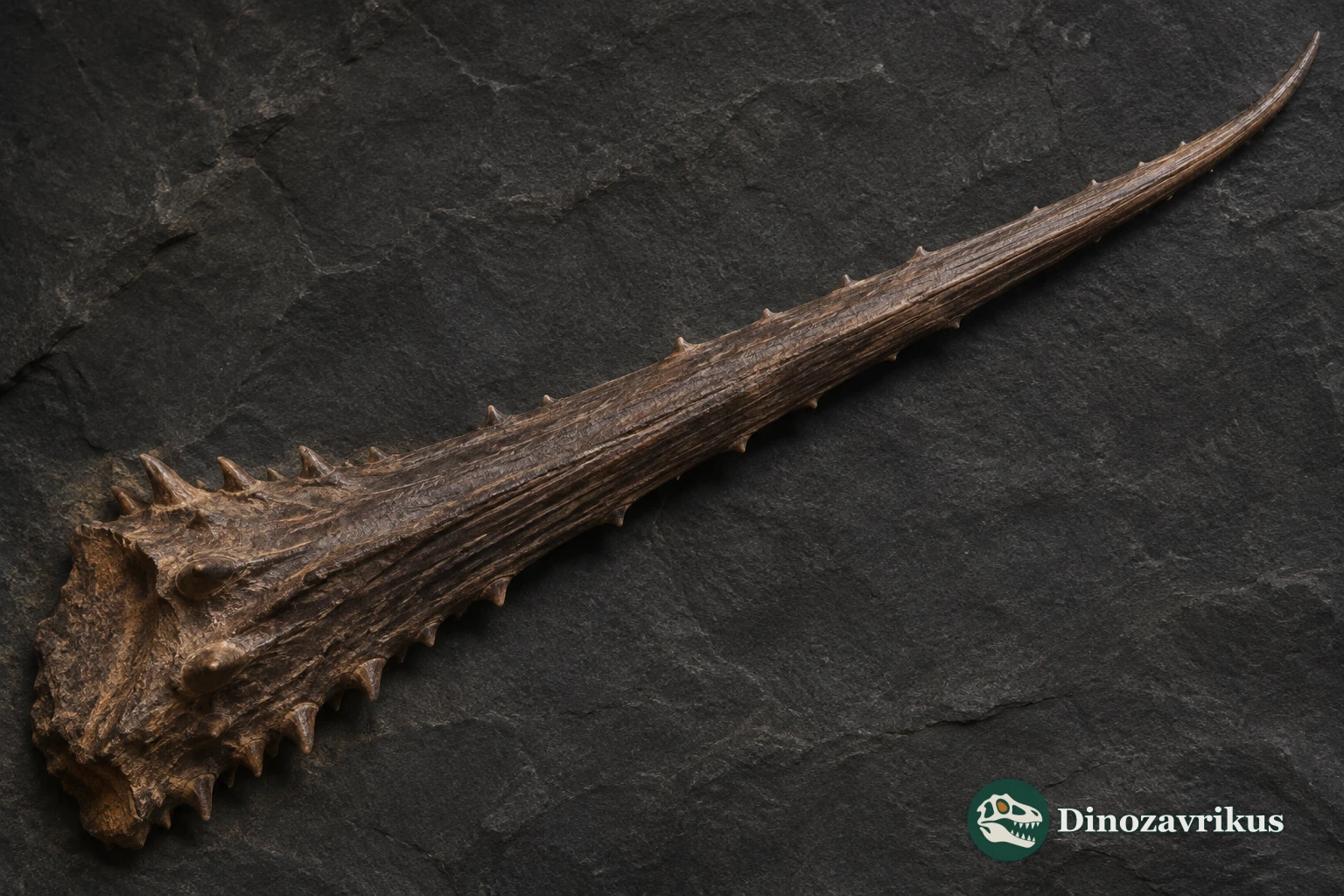
Arctacanthus is a cartilaginous fish named from isolated spines recovered from Permian rocks in East Greenland. The spines are decorated with pointed projections. Researchers have compared them with structures as different as teeth on the snout and spines on the head. A skeleton preserving one in place would help decide between those interpretations.
Quick facts
| Group | Cartilaginous fishes |
|---|---|
| Type species | Arctacanthus uncinatus |
| First description | Eigil Nielsen, 1932 |
| Type locality | Cape Stosch, East Greenland |
| Fossils | Isolated spines |
| Other records | Permian Wyoming and Triassic Japan |
What can the fossils tell us?
Small pointed projections extend in rows along the sides. An isolated spine does not show its original position on the body.
The general shape is similar, though the ornament differs. That comparison alone does not settle the affinities of the animal.
The Taho Limestone preserves isolated teeth from several groups. The collection does not tie a set of teeth to the animal that bore these spines.
The spines from Cape Stosch
Eigil Nielsen named Arctacanthus uncinatus in 1932. The original specimens come from late Permian marine rocks in East Greenland. Two specimens from the Cape Stosch section carry the field numbers 127 and 128. The Natural History Museum of Denmark includes Arctacanthus in its collection of marine vertebrates from the Foldvik Creek deposits.
A spine widens at the base and tapers towards the point. Small pointed tubercles cluster on the front surface near the base of the exposed part, then continue towards the tip in a row on each side. Those features survive in isolated specimens even when the anatomical context has disappeared.
How researchers interpreted the spines
Nielsen proposed a relationship with chimaeras. Charles Branson saw similarities to teeth on a shark’s snout in specimens from the Permian Phosphoria Formation of Wyoming. He assigned the Wyoming material to Arctacanthus wyomingensis in 1934.
Arthur Smith Woodward and Svend Bendix-Almgreen considered the fossils comparable to hybodont head spines. In 1982, John Maisey drew attention to their straighter crown and more pronounced backward-pointing barbs. A skeleton of Asteracanthus provides a comparison in which spines can be studied alongside other parts of the same animal. The Arctacanthus spines lack such an association.
The Triassic material from Japan
In 2004, Haruka Yamagishi named Arctacanthus exiguus from spines in the Taho Limestone of southwest Japan. The holotype, UMUT MV 28460-1, is held at the University Museum of the University of Tokyo. The limestone formed in a seamount setting in Panthalassa. Conodonts help date the section.
The rock also yielded teeth assigned to several kinds of shark, as well as placoid scales. The assemblage gives a view of the local fauna, but it does not identify the teeth of the spine-bearing animal. That missing association also limits comparisons between the Triassic and Permian material.
Frequently asked questions
How long was Arctacanthus?
An isolated spine gives no reliable estimate of body length.
What appears on the side of a Permian spine?
Rows of small pointed projections extend from a cluster near the base.
Do the Japanese finds show that the Permian species survived the extinction?
The Japanese specimens were named as a different species. Isolated spines cannot track a particular Permian species across the boundary.
Are the teeth of Arctacanthus known?
Teeth occur in the same rocks, but none can be confidently matched to the spines.