

Arctotherium was a South American genus of extinct tremarctine bears. Its early Pleistocene species A. angustidens included an exceptionally large individual from Argentina, but the five described species were not all giants. Fossils document skull and limb anatomy; a Chilean bone also yielded ancient mitochondrial DNA.
The North American Arctodus looks superficially similar. Yet a molecular study recovered Arctotherium closer to the living spectacled bear than to Arctodus. The giant bodies of the two extinct lineages may therefore have evolved separately.
Quick facts
| Group | Ursidae, Tremarctinae |
|---|---|
| Genus named | Arctotherium Burmeister, 1879 |
| Described species | Five in the cited revision |
| Large early species | Arctotherium angustidens |
| Time | Pleistocene, varying by species |
| Region | South America |
What can the fossils tell us?
An old male A. angustidens from Buenos Aires had unusually large bones and healed injuries. Its body mass was estimated with equations, not directly weighed.
A mitochondrial genome from a Chilean cave femur grouped Arctotherium with Tremarctos rather than Arctodus in a 2016 analysis. It is not a full nuclear genome.
Associated remains of three A. angustidens individuals prompted discussion of denning, family groups and torpor. Proximity alone proves none of those behaviours.
Species and type material
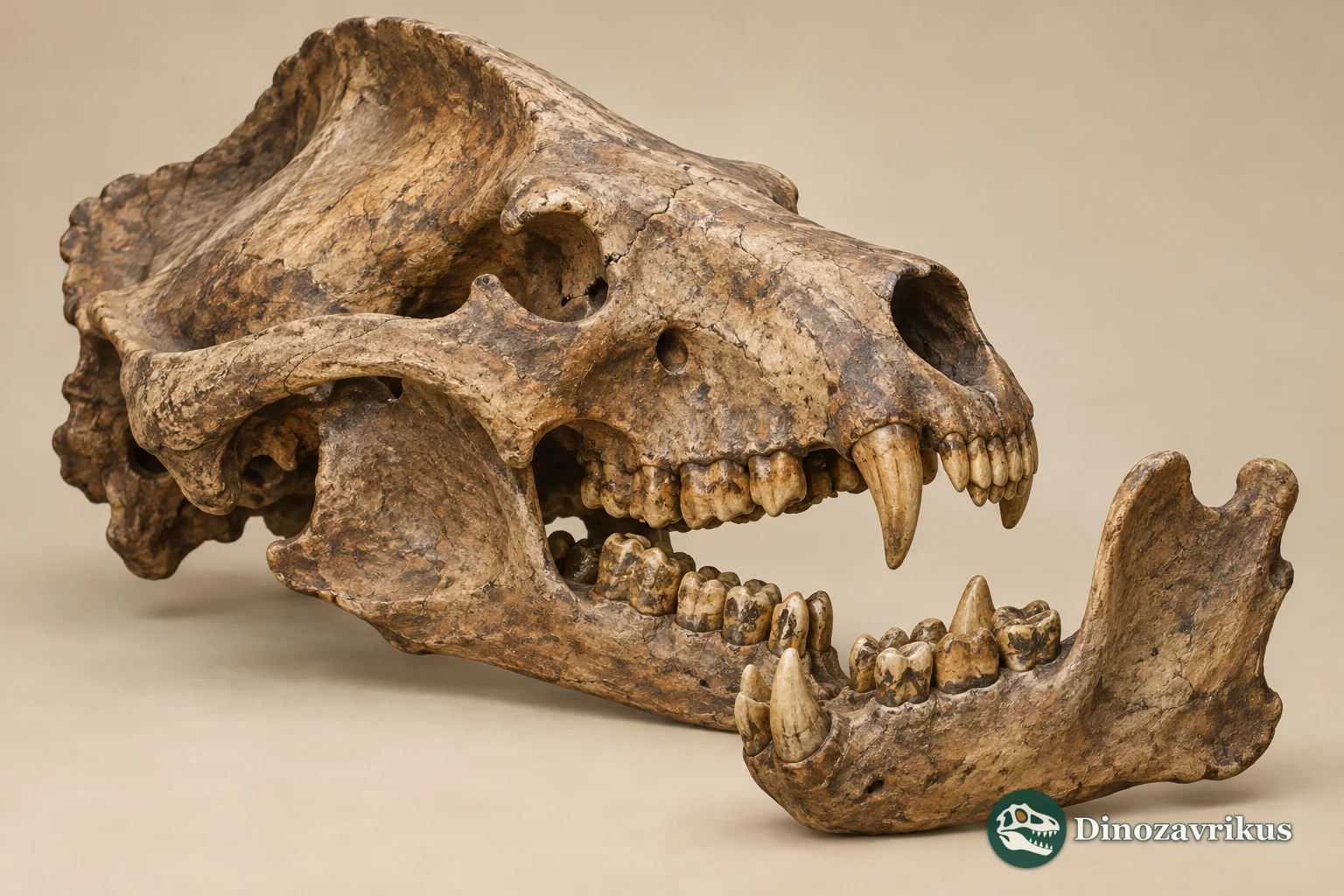
Hermann Burmeister proposed the genus name in 1879. The particularly large A. angustidens was named by Gervais and Ameghino in 1880. A systematic review lists historical type material NHM 32915–32974 from the Río de la Plata shore deposits of Buenos Aires. It differs from later species in a combination of skull and dental traits; 'short face' alone is not an adequate diagnosis.
A 2011 study refers to five described Arctotherium species. Their age ranges and body sizes differ, so a measurement from one fossil should never be presented as the typical size of every South American short-faced bear. The illustrated skull below represents comparative anatomy rather than the type series itself.
The unusually large male
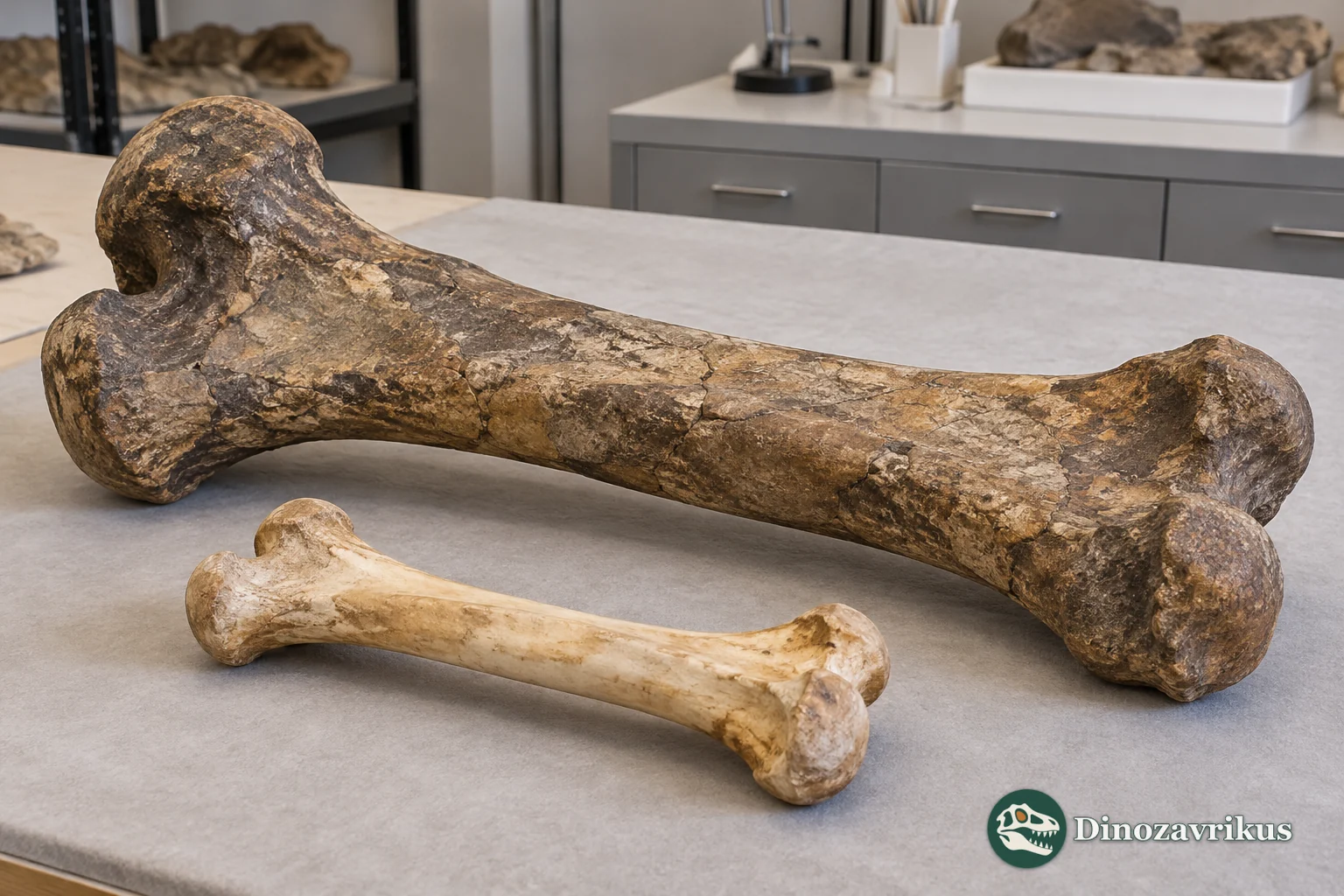
Schubert and Soibelzon studied an extraordinary A. angustidens from Ensenadan deposits in Buenos Aires Province. Fused limb-bone ends and pathologies supported identification as an old male that survived substantial injuries. Body mass was inferred with allometric equations calibrated on living bears. The authors considered it the largest bear specimen then recorded, a conclusion about one individual rather than the average of its species.
A separate comparison tested femoral, cranial, humeral and dental measurements for estimating extinct tremarctine mass. Different equations produce different answers. The femur illustration is a qualitative explanation of that method, not a measured pair of museum specimens. Healed injuries reveal survival after trauma; they do not identify an attacker or reconstruct a specific fight.
Three bears in a cave
A cave exposed during quarrying in Buenos Aires Province contained associated remains of three A. angustidens individuals. Researchers raised possibilities of a family group, den use and winter torpor. A single association is not direct evidence that all three entered together or hibernated. The sequence of burial and ages of the individuals matter to those interpretations.
The bear shared the broader regional faunas with large mammals such as Smilodon. Co-occurrence cannot prove that it routinely stole cats' kills. More carnivorous habits have been proposed for the early giant, but bear anatomy and ecological context allow plant foods too; no fossil provides its daily menu.
A Chilean bone changes the family tree
A 2016 study sequenced a mitochondrial genome from an Arctotherium femur recovered in a Chilean cave. In that dataset the South American lineage grouped with the living spectacled bear Tremarctos, rather than with North America's Arctodus. The result supports independent evolution of giant short-faced forms. As a maternal genetic marker, mitochondrial DNA does not describe every part of the nuclear genome.
The earliest secure South American occurrences belong to the Ensenadan interval. Molecular estimates of lineage divergence can predate the oldest known fossil; an absence of earlier bones is not a dated extinction or arrival event. The cover's fur colour, setting and pose are artistic reconstruction rather than preserved evidence.
Frequently asked questions
Are Arctotherium and Arctodus the same genus?
No. They are separate South and North American genera; mitochondrial DNA placed Arctotherium closer to spectacled bears.
Were all Arctotherium species gigantic?
No. The famous giant fossil belongs to the early species A. angustidens and does not describe all five named species.
How was the giant's mass estimated?
Researchers measured preserved bones and applied equations calibrated on living bears. The result is an estimate with model uncertainty.
Does the cave prove hibernation?
No. Three associated bears prompted the hypothesis, but their proximity alone cannot demonstrate torpor or a family group.