

Argentinonectes calafatensis is a large elasmosaurid plesiosaur from the Maastrichtian Calafate Formation of southern Patagonia. Its holotype preserves much of the postcranial skeleton, including a long vertebral series, ribs and girdle elements. The skull and most of the neck are missing, so the animal's head, exact total length and diet cannot be established from this specimen.
Quick facts
| Type species | Argentinonectes calafatensis |
|---|---|
| Group | Plesiosaur; elasmosaurid |
| Age | Maastrichtian, Late Cretaceous |
| Formation | Calafate Formation |
| Locality | Lake Argentino area, Santa Cruz Province, Patagonia, Argentina |
| Holotype | MPM-PV 10.004, a partially articulated postcranial skeleton |
| Known material | Vertebrae, ribs, girdle elements and parts of the limbs |
| Body length | No published measurement of a complete animal |
Evidence guide
MPM-PV 10.004 includes the last four cervical, two pectoral, eighteen dorsal, three sacral and twenty-eight caudal vertebrae, plus ribs and girdle and limb elements. The skull and most of the neck are absent.
The close-set terminal vertebrae document a relatively stiff distal tail. Bone geometry does not directly measure swimming speed or the animal's exact stroke.
The authors described a flattened thoracic profile and variation among gastral elements. They proposed a link to different movement during breathing, a functional interpretation rather than a preserved action.
The skeleton covered about five square metres and was partially articulated. Its orientation and displaced belly elements inform the burial history, not the cause of death or a live encounter with a predator.
A fossil beneath Lake Argentino's waterline
The fossil was first noticed in 2009 near Lake Argentino in Santa Cruz Province. Local residents alerted researchers, and a team associated with the Bernardino Rivadavia Natural Sciences Museum investigated the bones. The find lay only a few centimetres below the water level, so the crew built an enclosure and pumped water away before excavating the specimen in blocks.
Preparation and study continued for years. The holotype is catalogued as MPM-PV 10.004 and was formally described as a new genus and species in 2026. Earlier reports sometimes used a different collection number while the specimen was being studied; the formal description's holotype number is used here.
A partially articulated body
The skeleton was spread over roughly five square metres and preserved with its back down. The paper lists the last four cervical, two pectoral, eighteen dorsal, three sacral and twenty-eight caudal vertebrae, along with several articulated ribs, girdle elements and portions of the limbs. The skull, most of the neck and distal limb elements are missing.
The belly was disturbed by natural processes before final burial. Even so, the articulated sections preserve meaningful relationships among bones. Reconstruction of the absent head and neck relies on comparison with other plesiosaurs, not on bones from this individual.
Thoracic shape and a breathing hypothesis
The thoracic region is flattened from back to belly, and the shape of the gastralia – slender bones in the abdominal wall – varies between rows. The authors proposed that this arrangement may have allowed different parts of the trunk to move differently during breathing.
That interpretation follows from skeletal geometry and comparative anatomy. The fossil does not preserve soft tissues or a breathing cycle, so the proposed mechanism remains a functional inference rather than a directly observed behaviour.
A stiffened distal tail
The final eight caudal vertebrae form a stiffened distal section of the tail. Their arrangement is part of the preserved anatomy and gives the new species a useful point of comparison with other plesiosaurs. It does not by itself reveal how forcefully or frequently the tail moved.
The authors also described internal canals and subcentral foramina along the postcervical vertebrae. These structures provide additional characters for anatomical and phylogenetic comparisons; their presence alone does not establish a specific physiological function.
Age, relationships and associated shark teeth
The skeleton comes from the Maastrichtian Calafate Formation in southwestern Argentina. Regional sedimentological work describes marine deposits and changing coastal conditions within the formation, but that broader record does not give the exact water depth at the moment this animal died.
Phylogenetic analyses place Argentinonectes among elasmosaurids in Weddellonectia. The result reflects a comparison of coded anatomical characters and may change as taxa and data are revised. Kawanectes and Aristonectes offer comparisons with other southern South American plesiosaurs, not direct ancestors of this species.
Several shark teeth were found close to the skeleton. Their association is consistent with a shared marine depositional setting, but does not prove that a shark attacked the living plesiosaur. No stomach contents or prey remains tied directly to the holotype establish its diet.
Size and what is not preserved
The formal description calls the animal a large elasmosaurid but does not provide a measured total body length. The missing skull, most of the neck and the ends of the limbs prevent a direct measurement of the complete animal. Any precise length would depend on how those absent parts were reconstructed.
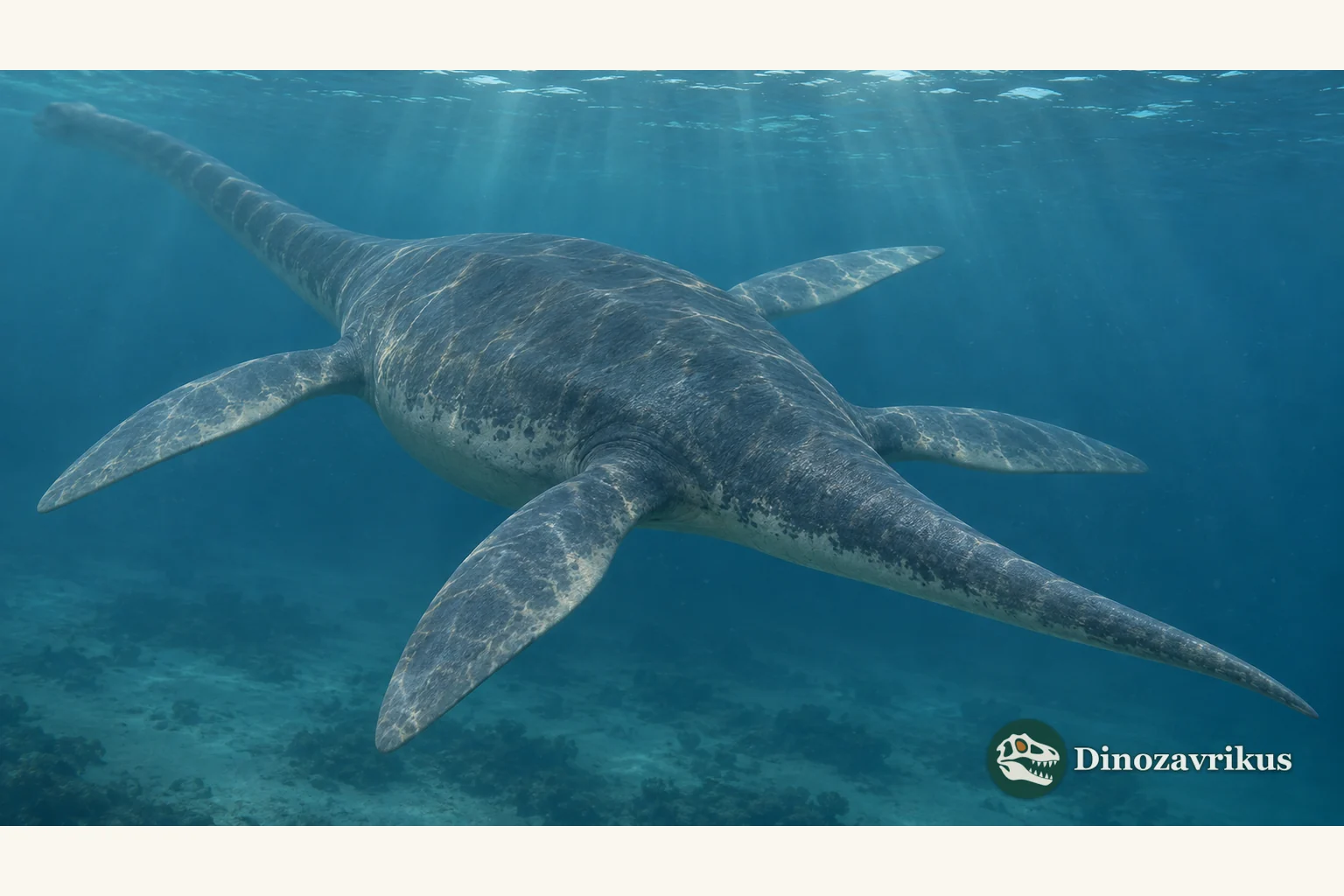
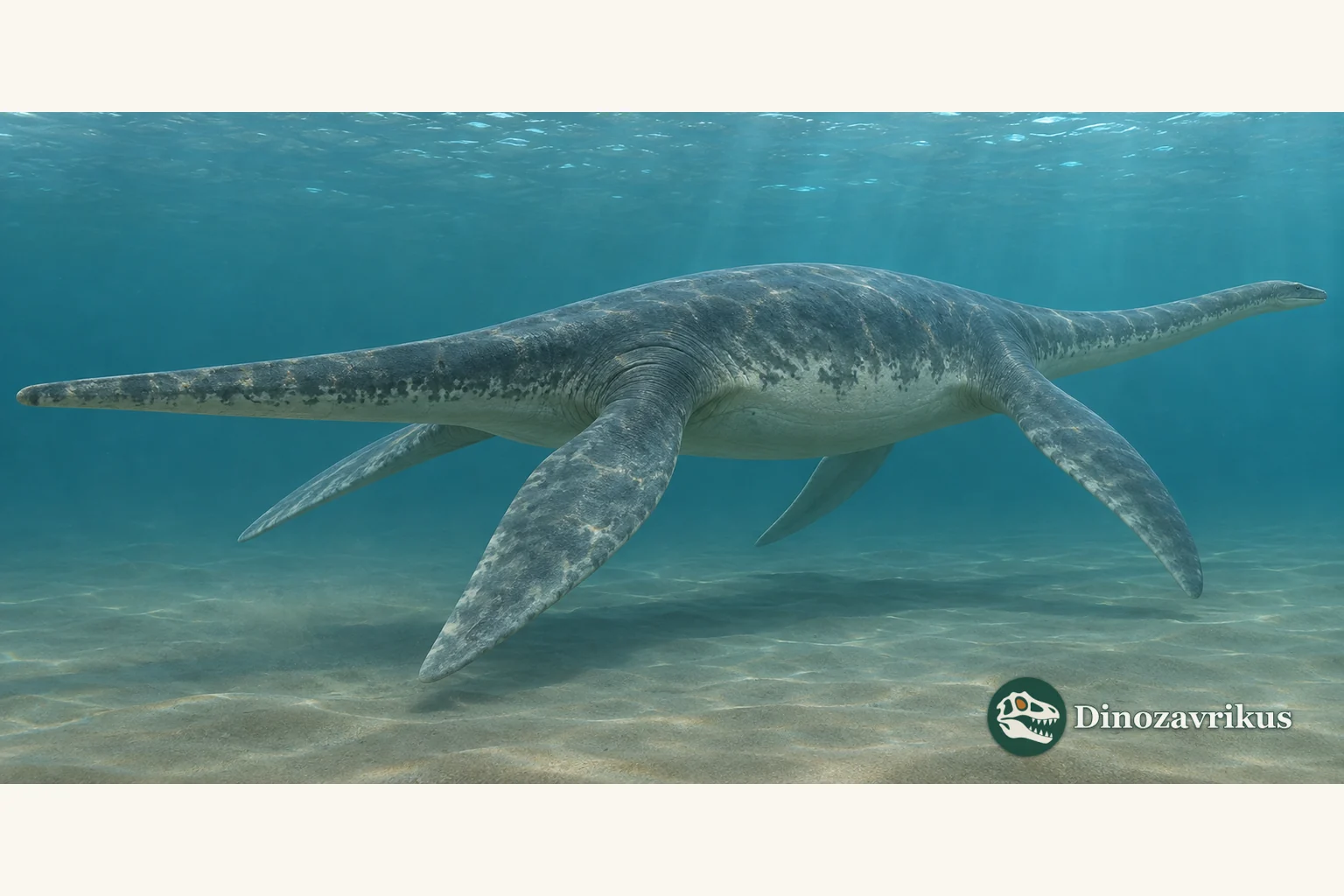
The fossils document bones, their arrangement and a burial history. They do not establish colour, skin, soft tissues, body mass, exact swimming style, prey choice or reproductive biology. A full-body illustration can communicate a plausible plesiosaur shape, but cannot stand in for the incomplete holotype.
Frequently asked questions
Where was Argentinonectes found?
The holotype came from the Lake Argentino area in Santa Cruz Province, Patagonia. It was recovered from Maastrichtian marine rocks of the Calafate Formation.
Why was the fossil excavated below the waterline?
The bones lay a few centimetres beneath the lake's water level. The team enclosed the site and pumped water away before removing the fossil in blocks.
What is unusual about its tail?
The final eight caudal vertebrae form a stiffened distal section. This is an anatomical observation, not a direct measurement of swimming speed or style.
How long was Argentinonectes?
Its complete length has not been measured. The holotype lacks the skull, most of the neck and distal limb elements, so a precise total would require substantial reconstruction.