

Astrapotherium was a large South American mammal of the order Astrapotheria, living during the Miocene. Its massive head and long tusk-like canines are striking, but the familiar short-trunked portrait remains a reconstruction: bone preserves neither the soft tissues nor the exact shape of a mobile upper lip.
The genus is included in the ancient mammal catalogue. Its named species come from different Miocene localities and are represented by fossils of unequal completeness, so details from one nearly complete skeleton should not automatically be generalized to all of them.
Quick facts
| Scientific name | Astrapotherium Burmeister, 1879 |
|---|---|
| Type species | A. magnum (Owen, 1853) |
| Group | Astrapotheria; family Astrapotheriidae |
| Age | Early to middle Miocene; species come from separate intervals |
| Range | South America, especially Patagonia |
| Best-known skeleton | FMNH P14251, a nearly complete A. magnum from the Santa Cruz Formation |
| Diet | Herbivory is supported; exact foods remain inferred |
| Open question | How much a mobile upper lip can be reconstructed from bone |
What can the fossils tell us?
FMNH P14251 from the Santa Cruz Formation helped establish body proportions. The often-cited estimate of about 2.9 m long refers to this specimen, not every species or individual.
Astrapotherium had prominent tusk-like canines and low-crowned cheek teeth. This combination records feeding anatomy but does not identify a precise list of plants.
A 2019 revision recognized A. magnum and A. burmeisteri among Santa Cruz forms and described A. guillei from the Collón Cura Formation using an almost complete skull and associated mandible.
The teeth and anatomy are consistent with herbivory. A grasping upper lip and feeding near waterways have been inferred from comparative anatomy and sediments, not directly preserved.
From the first species to a changing genus
Richard Owen named Astrapotherium magnum in 1853, initially in a different genus. Hermann Burmeister established Astrapotherium in 1879. Many classic fossils come from the Early Miocene Santa Cruz Formation of Argentine Patagonia.
In 2019, Alejandro Kramarz, Alberto Garrido and Mariano Bond revised the record and described A. guillei from the Collón Cura Formation near Comallo, Río Negro. Its nearly complete skull and associated lower jaw are among the most informative high-latitude Middle Miocene astrapothere remains. The authors recognized A. magnum and A. burmeisteri among the Santa Cruz species. Historical names and referrals have not all received the same treatment, so old species lists should not be read as a count of settled species.
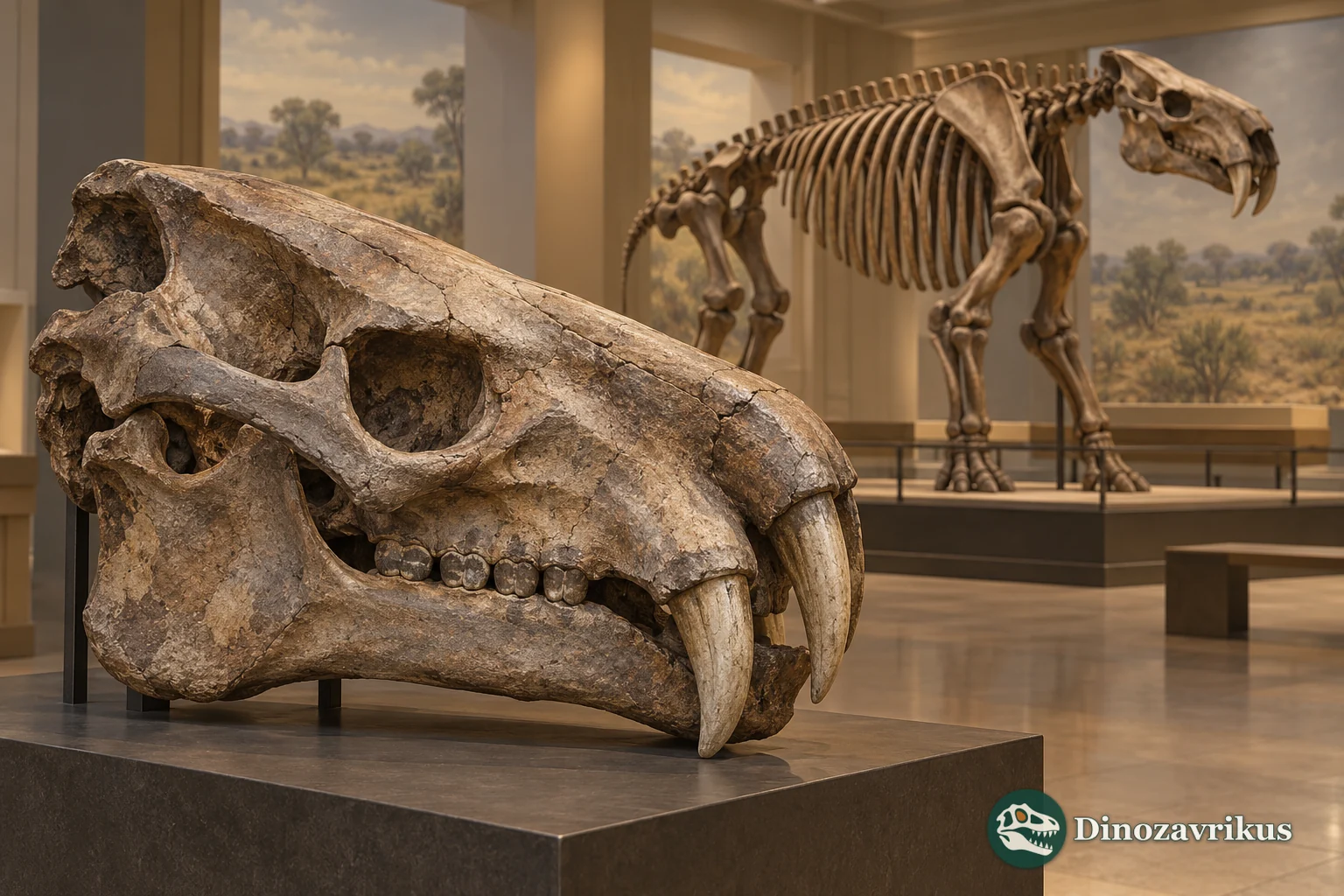
Skull, tusks and cheek teeth
The most recognizable feature is the pair of greatly enlarged canines projecting from the jaws. In some representatives, large canines were present in both upper and lower jaws. Their shape and position distinguish astrapotheres from living hoofed mammals, but their size alone does not prove that the animals fought or used them for defence.
The cheek teeth were low-crowned compared with those of animals adapted to grinding large quantities of abrasive grass. Their structure is consistent with soft plant foods, but it cannot identify a particular plant. Wear, associated fossils and sedimentary context provide additional clues; the conspicuous tusks do not reveal a complete diet.
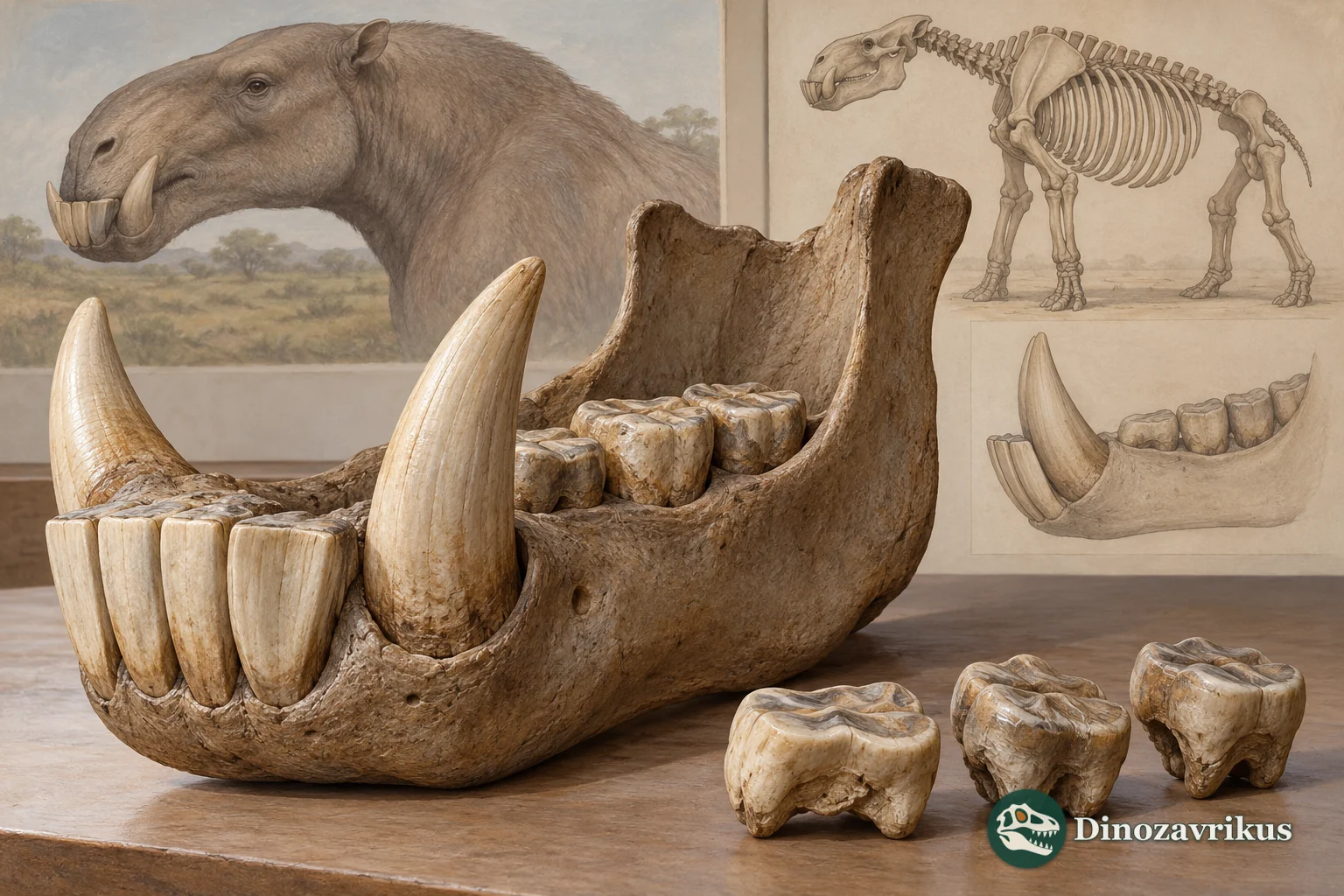
What the nearly complete skeleton tells us
The best-known nearly complete specimen of A. magnum is FMNH P14251, collected by Elmer S. Riggs for Chicago’s Field Museum. A 1935 museum account estimated this individual at roughly 2.9 m long and about 1.5 m tall. Those figures describe one reconstructed skeleton, not a species-wide range. Parts of the fossil remained embedded in rock, so preparation and mounting depended on the material that could be separated and restored.
The skeleton reveals a massive head, an elongated body and differences between the strong forequarters and comparatively lighter hind limbs. It does not directly provide body mass, running speed or an exact gait. Such estimates depend on reconstruction and comparison with living mammals that are not close anatomical equivalents.
The proposed trunk and feeding ecology
Astrapotheres had a broad nasal region, while the tusks and front of the jaws formed an unusual arrangement. Riggs proposed that a mobile upper lip could have helped grasp food. Later artwork often turned this into a short tapir-like trunk. Soft tissue has not been preserved, however, so a grasping lip is a cautious hypothesis rather than a proven trunk of a known shape.
Herbivory is supported by the cheek teeth and the overall jaw anatomy. The idea that Astrapotherium fed on lush plants along rivers or wetlands combines comparative anatomy with the depositional setting of the Santa Cruz Formation. It is plausible, but no preserved stomach contents or direct trace establishes a specific menu.
The later species and the limits of generalization
A. guillei shows that astrapotheres persisted in Patagonia into the Middle Miocene, as the group’s diversity was declining. Its Collón Cura skull and jaw differ from Early Miocene forms, including the absence of the third premolar. This diagnostic feature helped distinguish the species and shows why skull comparisons matter to taxonomy.
The genus is not represented by one “typical” skeleton. FMNH P14251 informs body proportions for A. magnum; the skull of A. guillei adds evidence about a later species; isolated teeth and fragments require more cautious assessment. Exact mass, colour, behaviour and the shape of the upper lip remain unknown. The illustrations here are artistic reconstructions, not fossil records.
Frequently asked questions
When did Astrapotherium live?
The genus is known from the Early and Middle Miocene of South America. Its species come from separate formations, so one exact age should not be assigned to the entire genus.
How large was Astrapotherium?
The nearly complete A. magnum specimen FMNH P14251 was estimated at about 2.9 m long and roughly 1.5 m tall. These figures describe that individual, not every species.
Did it have a trunk?
A mobile upper lip has been proposed from the nasal and jaw anatomy. Soft tissues are not preserved, so the short trunk shown in artwork remains hypothetical.
What did Astrapotherium eat?
Its teeth and jaw support herbivory. Soft plants in lowland or riverside habitats are plausible, but the exact diet is not directly known.