

Astroproetus was first described from Late Ordovician rocks in Scotland. The raised central area of the head, or glabella, tapers towards the front in a later species from North Greenland. Its long preglabellar field and fine ridges distinguish the Silurian material from the Scottish type.
Quick facts
| Group | Proetid trilobites |
|---|---|
| Age | Late Ordovician and early Silurian |
| Named by | J. L. Begg, 1939 |
| Type species | Astroproetus reedi |
| Records | Scotland, Sweden and North Greenland |
| Greenland holotype | Cephalon, University of Copenhagen collection |
What can the fossils tell us?
It takes up about a third of cranidial length in the Greenland species, a proportion of the head rather than the whole animal.
They are preserved in the Greenland species. In the Scottish type species the absence of such detail may reflect preservation.
The Scottish type species is Ordovician. The Greenland fossils are Silurian and do not show a continuous sequence between the two.
The Scottish type and Greenland head shields
J. L. Begg described Proetus (Astroproetus) reedi in 1939 from Lady Burn near Girvan, Scotland. He introduced the name as a subgenus of Proetus. It was later used at genus rank. The Boda Limestone of Sweden also preserves Late Ordovician Astroproetus.
Helen Hughes and Alan Thomas described A. franklini from North Greenland in 2014. Its holotype is a head shield. Other cranidia and free cheeks gave the authors additional specimens for comparing the shape and surface sculpture.

A tapering glabella and fine ridges
In the Greenland species the glabella narrows forwards and is longer than wide. The field in front of it accounts for about a third of the cranidium. The Scottish type species has a shorter field and a glabella about as wide as it is long.
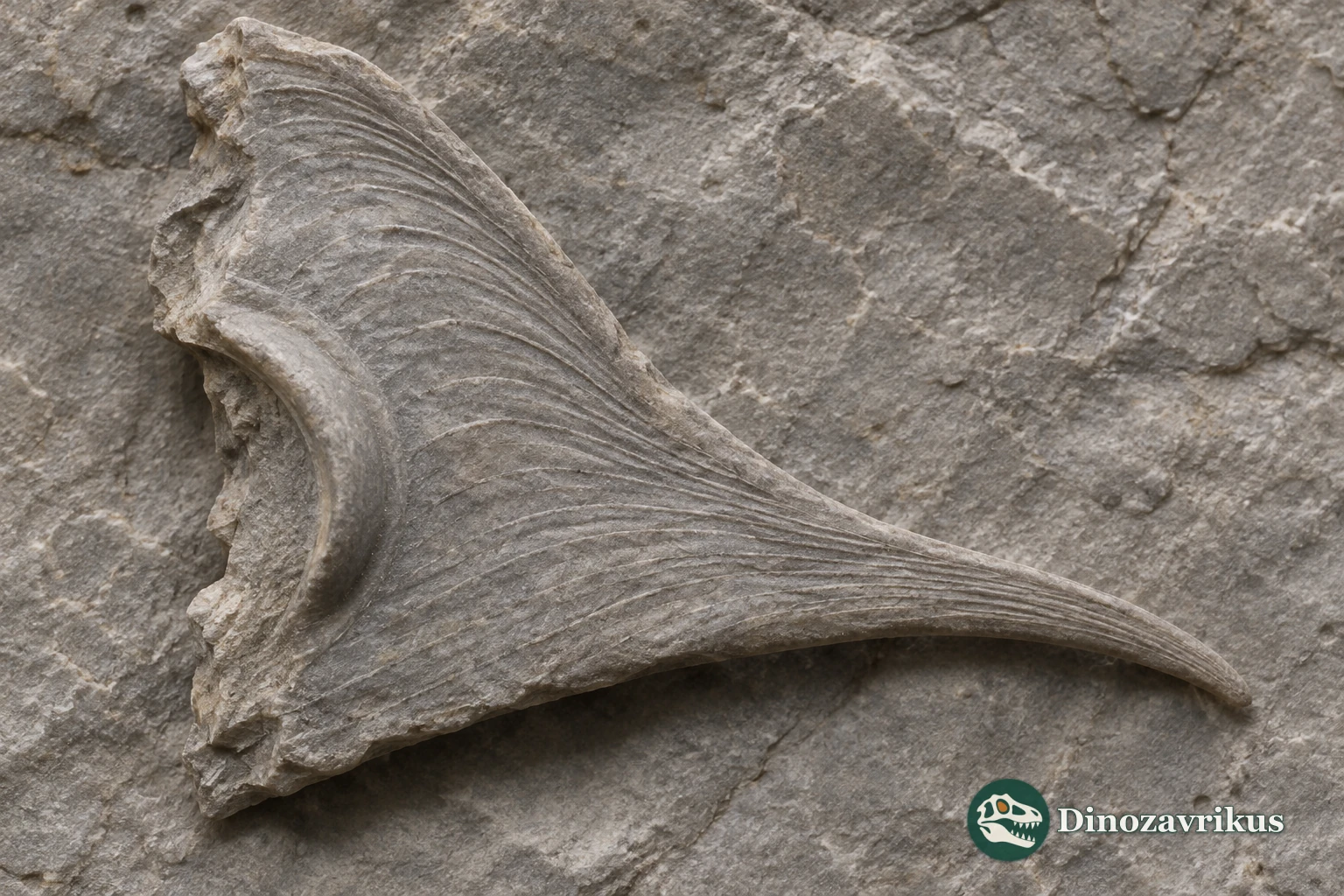
The Greenland material shows fine ridges on the front and side borders and along a cheek spine, with scattered granules elsewhere. One internal mould preserves impressions along the side of the glabella. The outer shell and the cast of its inner surface can preserve different details, so a missing ridge is not always an anatomical difference.
Where the genus ends
Tail shields are available for some members of the genus. In the generic diagnosis the axis is narrow and normally has seven or eight rings. There are five or six pairs of lateral ribs, with no broad separate rim.
Some Chinese trilobites were formerly grouped with Astroproetus. After studying well-preserved early Silurian material from Shaanxi, a later study recognised Chuanqianoproetus as distinct on a combination of characters of the head and tail. Older occurrence lists can therefore use Astroproetus in a wider sense.
Frequently asked questions
Where was the type species found?
At Lady Burn near Girvan, in Late Ordovician rocks of Scotland.
How does the Greenland species differ?
It has a relatively longer glabella and a longer field between the glabella and front border.
What is visible on the free cheek of the Greenland species?
Several fine ridges run along the lateral edge and onto the cheek spine.
How many rings occur on the tail axis?
The generic diagnosis gives seven or eight rings along the axis of the tail shield.