

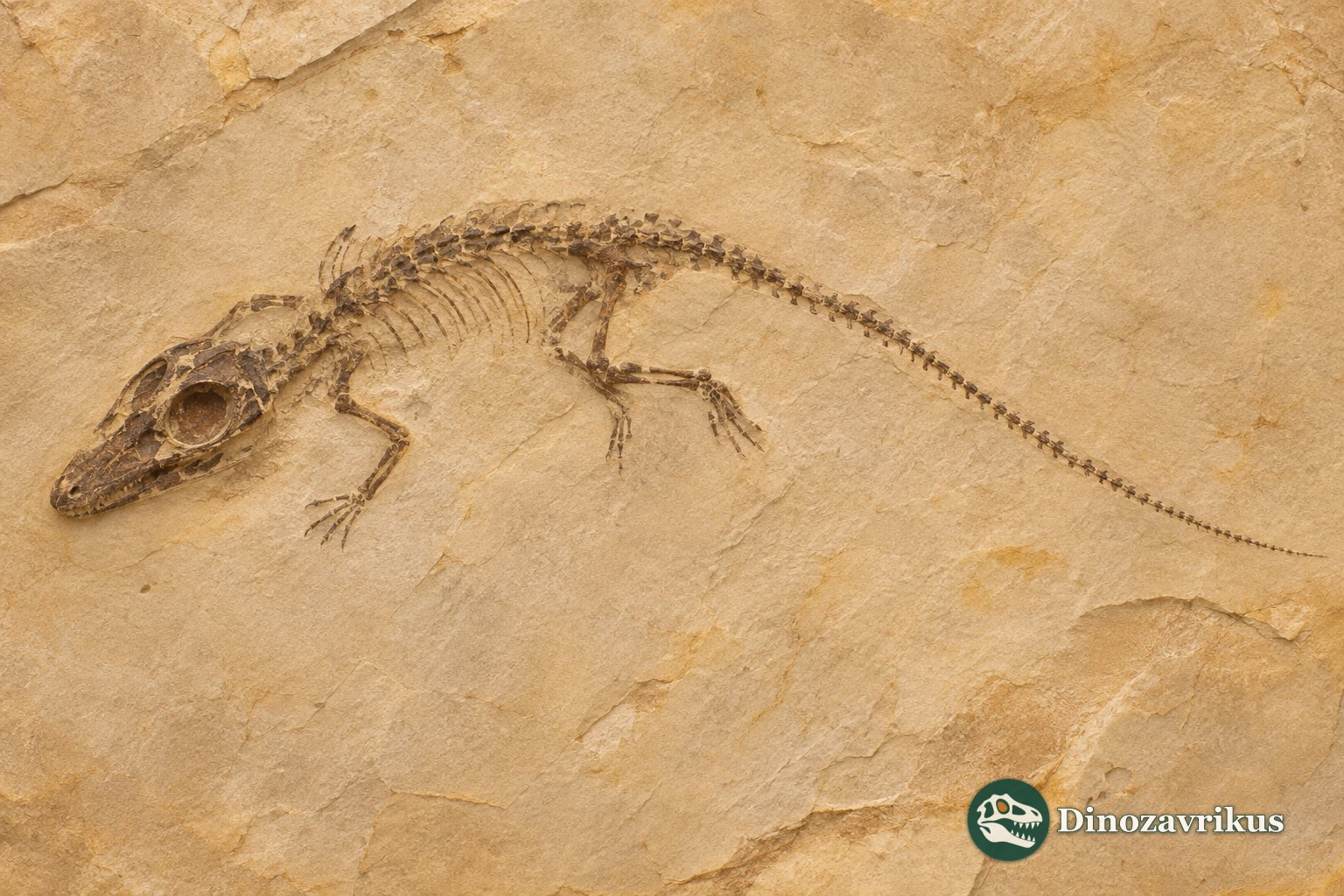
Atoposaurus was a tiny crocodyliform from Late Jurassic Europe. Its remains occur on limestone slabs from France and Germany. Some specimens preserve at least fifty tail vertebrae, a feature that supports a distinct genus even though the growth stages of the individual animals remain debated.
Quick facts
| Type species | Atoposaurus jourdani |
|---|---|
| Group | Atoposauridae, Neosuchia |
| Age | Late Jurassic, Kimmeridgian to early Tithonian |
| French type | MHNL 15679, articulated partial skeleton |
| German type | TM 3956, nearly complete skeleton of A. oberndorferi |
| Diagnostic feature | At least fifty tail vertebrae in countable specimens |
What can the fossils tell us?
Countable Atoposaurus tails have fifty or more bones, compared with about forty in Alligatorellus. The difference is informative even if the individuals’ ages cannot be determined.
In the French specimen MHNL 15680, vertebral arches are fused to their centra. This can indicate a more advanced stage of growth without giving an exact age.
The skull of the Cerin type was flattened from above. The German type lacks the skull roof. Comparisons depend on the surviving regions.
Slabs from France and Bavaria
Hermann von Meyer established Atoposaurus in the mid-nineteenth century. The type species, A. jourdani, comes from Kimmeridgian limestone at Cerin in eastern France. The 2016 revision identifies MHNL 15679 as the type. It preserves a partial articulated skeleton with a flattened skull. Another specimen from Cerin, MHNL 15680, preserves much of the rear of the body.
The Bavarian A. oberndorferi comes from younger, early Tithonian limestone. The type, TM 3956, is held by the Teylers Museum in Haarlem. It lacks the skull roof and the far end of the tail. The revision retained the second species tentatively because the two types preserve different features.
Why the tail count matters
In sufficiently complete specimens, the tail of Atoposaurus contains at least fifty vertebrae. Complete tails of Alligatorellus preserve around forty. Growth alone is unlikely to account for the difference in the number of bones.
The known skeletons lack clear bony armour. By itself, this could reflect a young individual in which skin bones had yet to develop. Fusion of the arches to the bodies of vertebrae in one Cerin specimen indicates a more advanced stage of growth. The combined evidence supports a distinct genus while leaving the age of individual specimens uncertain.
Reading the limestone record
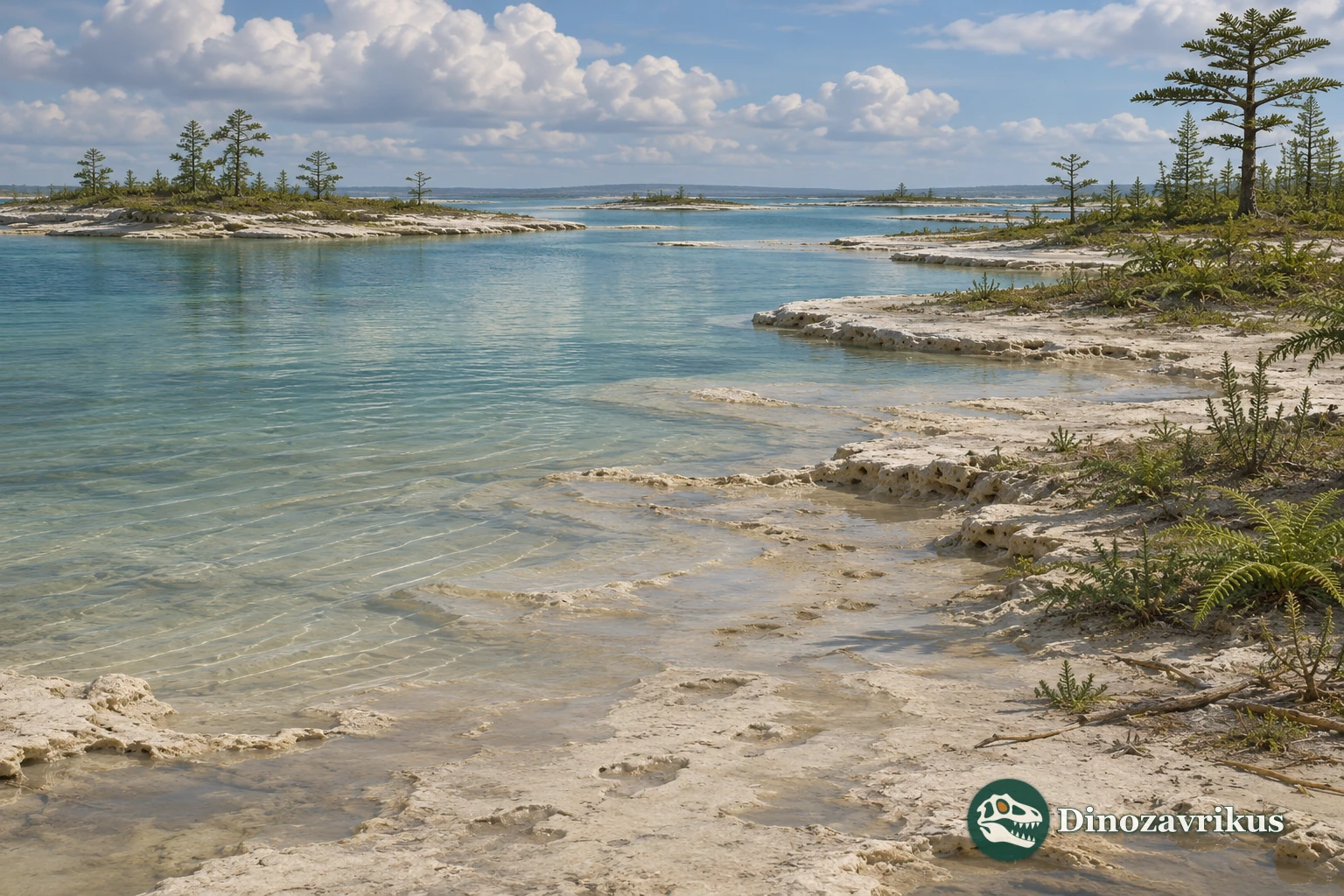
At Cerin, fine-grained limestone accumulated in a lagoon. Flattened skeletons preserve the positions of many bones but can obscure their three-dimensional shape. For that reason, some proportions of the French and German skulls can only be compared tentatively.
Large eye sockets and slender limb bones constrain the animal’s appearance. How often it entered the water and what it ate remain unclear. Lagoonal burial records a setting where the remains accumulated, which may represent only part of its habitat.
Frequently asked questions
Where was Atoposaurus found?
The French specimens come from Cerin and the German specimens from Upper Jurassic limestone in Bavaria.
How did its tail differ from that of Alligatorellus?
Countable Atoposaurus tails have at least fifty vertebrae, compared with around forty in Alligatorellus.
Does small size show that all the skeletons are juveniles?
Size alone is insufficient. Bone fusion in a Cerin specimen suggests it reached a more advanced stage of growth.
How many species are recognised?
A. jourdani from France and A. oberndorferi from Germany are usually distinguished. The 2016 revision retained the German species tentatively because of incomplete preservation.