

Attenborosaurus conybeari was an Early Jurassic plesiosaur from the Charmouth area of Dorset, southern England. A nearly complete skeleton was found in 1880 and described the following year. The original later perished when Bristol City Museum was bombed in 1940, but plaster casts preserve part of the anatomical record. A cast is valuable evidence of the lost specimen's outline, not a second fossil or a replacement holotype.
Quick facts
| Type species | Attenborosaurus conybeari |
|---|---|
| Age | Early Jurassic; a Sinemurian age is tentative |
| Locality | Charmouth, Dorset, England |
| Original type | Nearly complete skeleton, destroyed in 1940 |
| Surviving record | Museum casts, including NHMUK PV R 1339 |
| Total length | No reliable measurement of the complete animal |
Evidence guide
The nearly complete skeleton described by Sollas was held in Bristol and was lost in the 1940 bombing. Museum casts preserve a record of its form, but they are copies, not the original bones.
O'Keefe's 2001 revision identifies the original holotype as lost and treats BMNH R.1339, now NHMUK PV R 1339, as a cast. The copy can be studied, but it does not replace the destroyed specimen.
The original account places the fossil in Lower Jurassic strata near Charmouth. A later revision gives a possible Sinemurian age with a question mark, so the stage should not be stated as certain.
The preserved outline supports a long neck, a compact trunk and four paddles. Colour, skin, muscles, exact body length and swimming performance are not recorded by the cast.
A fossil found near Charmouth
The skeleton was discovered near Charmouth in 1880. William Johnson Sollas described it in 1881 as Plesiosaurus conybeari, comparing its bones with other species then placed in that broad genus. The description concerned a fossil animal; it did not imply that the plesiosaur changed its identity during life.
In 1993, Robert Bakker separated the species into the genus Attenborosaurus, honouring naturalist and broadcaster David Attenborough. The specific name conybeari remained attached to the same species. The change is a taxonomic revision, not the discovery of another skeleton. Other Early Jurassic plesiosaurs such as Eurycleidus show how comparisons among fossils can refine the boundaries of older genera.
A lost original and the surviving casts
The original skeleton was kept at Bristol City Museum and was destroyed when the building was bombed in 1940. Casts had been made before the loss. O'Keefe's 2001 revision records the type specimen as lost and identifies BMNH R.1339, now catalogued as NHMUK PV R 1339, as a cast. A museum account describes the cast as an important surviving record of the animal.
The distinction matters for taxonomy. A cast can preserve shape and the arrangement of bones visible on the mould, while details obscured or omitted in the copy must be checked against the original description and historical illustrations. It is not correct to call the surviving cast a second skeleton or a new holotype.
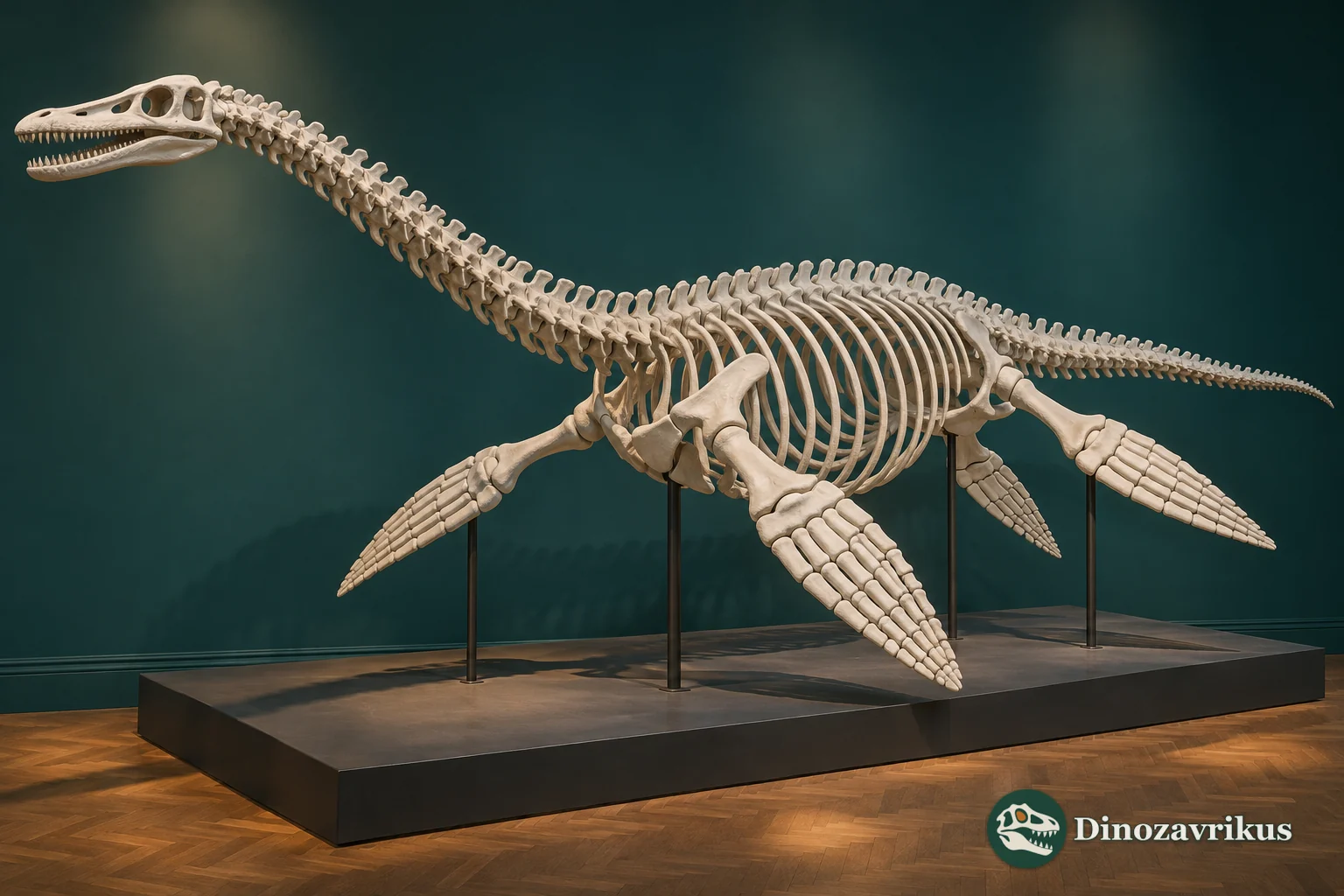
What the skeleton can show
The cast gives a broad view of a plesiosaur body plan: a long neck, a compact trunk and four paddle-like limbs. Those features allow comparison with other early plesiosaurs, but the reconstruction should not extend beyond the skeletal evidence. The fossil record does not preserve the animal's colour, skin, muscle outline or the exact motion of its paddles.
The museum scene below is a generated illustration of an imaginary plaster-cast display. It does not reproduce the actual NHMUK mount or a real gallery. The separate underwater artwork is likewise a general reconstruction informed by the skeletal outline, not a measured portrait of missing bones.
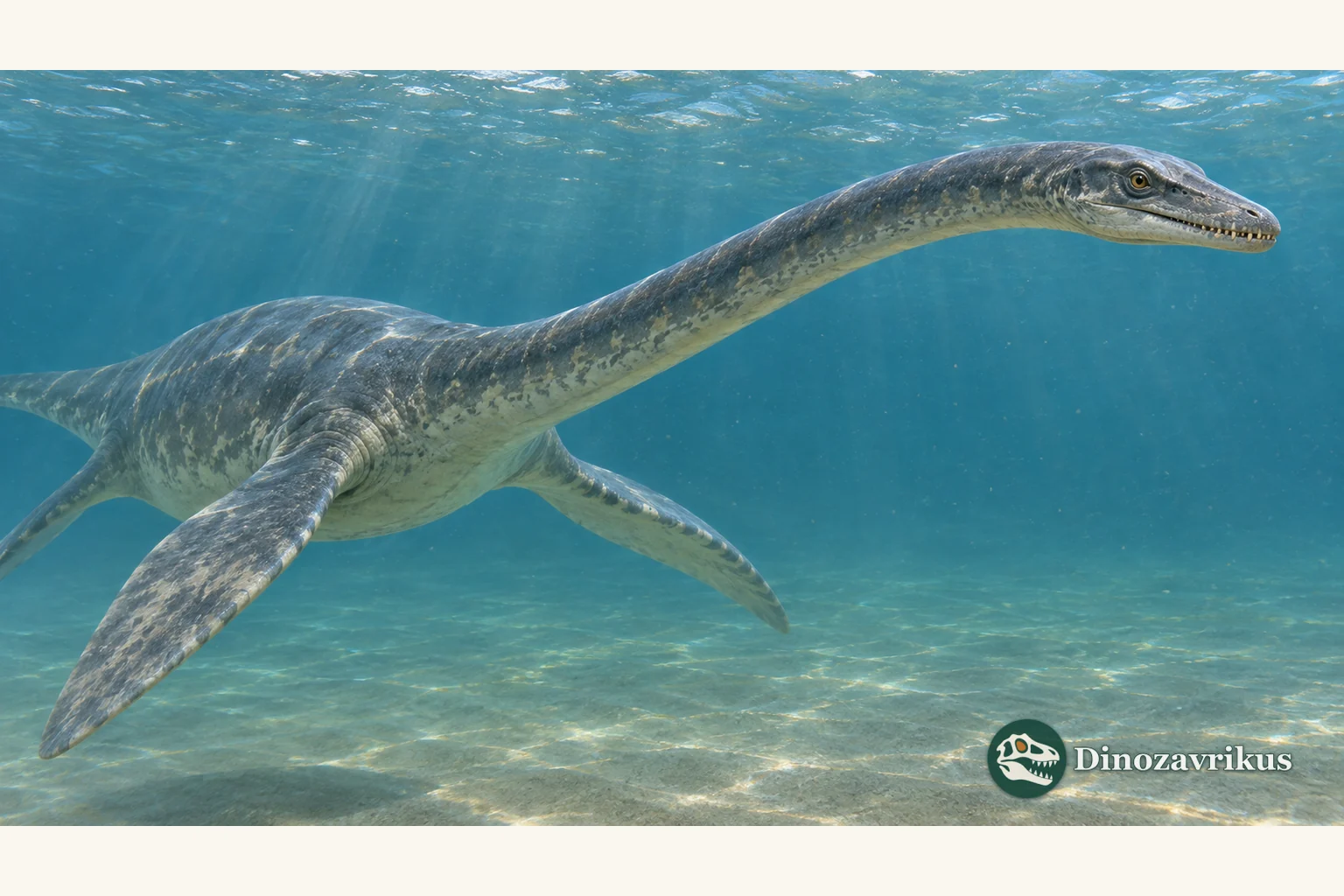
Age, size and biological limits
Sollas associated the specimen with Lower Jurassic strata near Charmouth. O'Keefe later listed the Sinemurian stage with a question mark. This qualification reflects the limits of the historical locality record: the broad region and period are clearer than the exact position of the lost specimen within a measured section.
A precise total length is not established by a complete surviving original that can be measured today. Numerical estimates depend on how missing proportions are restored and should name their method. The described material also does not directly identify a particular prey item, swimming speed, preferred depth, growth sequence or reproductive biology. The wider account of plesiosaurs and pliosaurs provides group context without filling those gaps with assumptions.
Frequently asked questions
When was the Charmouth skeleton found?
It was discovered near Charmouth in 1880 and described by Sollas in 1881.
Why is the original skeleton missing?
It was held at Bristol City Museum and was destroyed when the museum was bombed in 1940. Casts made before the loss preserve some of its form.
Is NHMUK R 1339 the holotype?
No. O'Keefe's revision identifies the holotype as lost and NHMUK PV R 1339 as a cast. A cast is not the original type fossil.
Why did the genus name change?
Sollas described the species as Plesiosaurus conybeari in 1881. Bakker used Attenborosaurus for it in 1993; the change reflects a taxonomic interpretation.