

Australosuchus clarkae was a crocodilian from the Late Oligocene and Early Miocene of South Australia. Its nearly complete type skull, from the Lake Palankarinna area, preserves a recess that received a large lower tooth. This feature helps distinguish it from other Australian crocodilians.
Quick facts
| Type species | Australosuchus clarkae |
|---|---|
| Group | Mekosuchinae |
| Age | Late Oligocene to Early Miocene |
| Localities | Lake Palankarinna and Lake Pinpa, South Australia |
| Holotype | QM F16788, skull, lower jaw and associated bones |
What can the fossils tell us?
The Queensland Museum specimen includes vertebral fragments, the shoulder blade, an upper arm bone and pieces of bony armour.
When the jaws closed, a large lower tooth fitted into a partly enclosed recess in the upper jaw. Other teeth varied in size.
Some specimens linked to the Mampuwordu Sands may have washed out of older beds. Their age cannot be read directly from the age of the sand.
Discovery at Lake Palankarinna
Michael Archer found the type specimen near Lake Palankarinna in 1975. Paul Willis and Ralph Molnar described the species in 1991 and named it in honour of Elaine Clark. The Queensland Museum holds the holotype as QM F16788.
Along with the nearly complete skull and lower jaw, the material includes parts of neck and back vertebrae, a scapula, a humerus and pieces of bony armour. Another skull, SAMA P42788, comes from the Lake Pinpa area and belongs to the South Australian Museum collection.
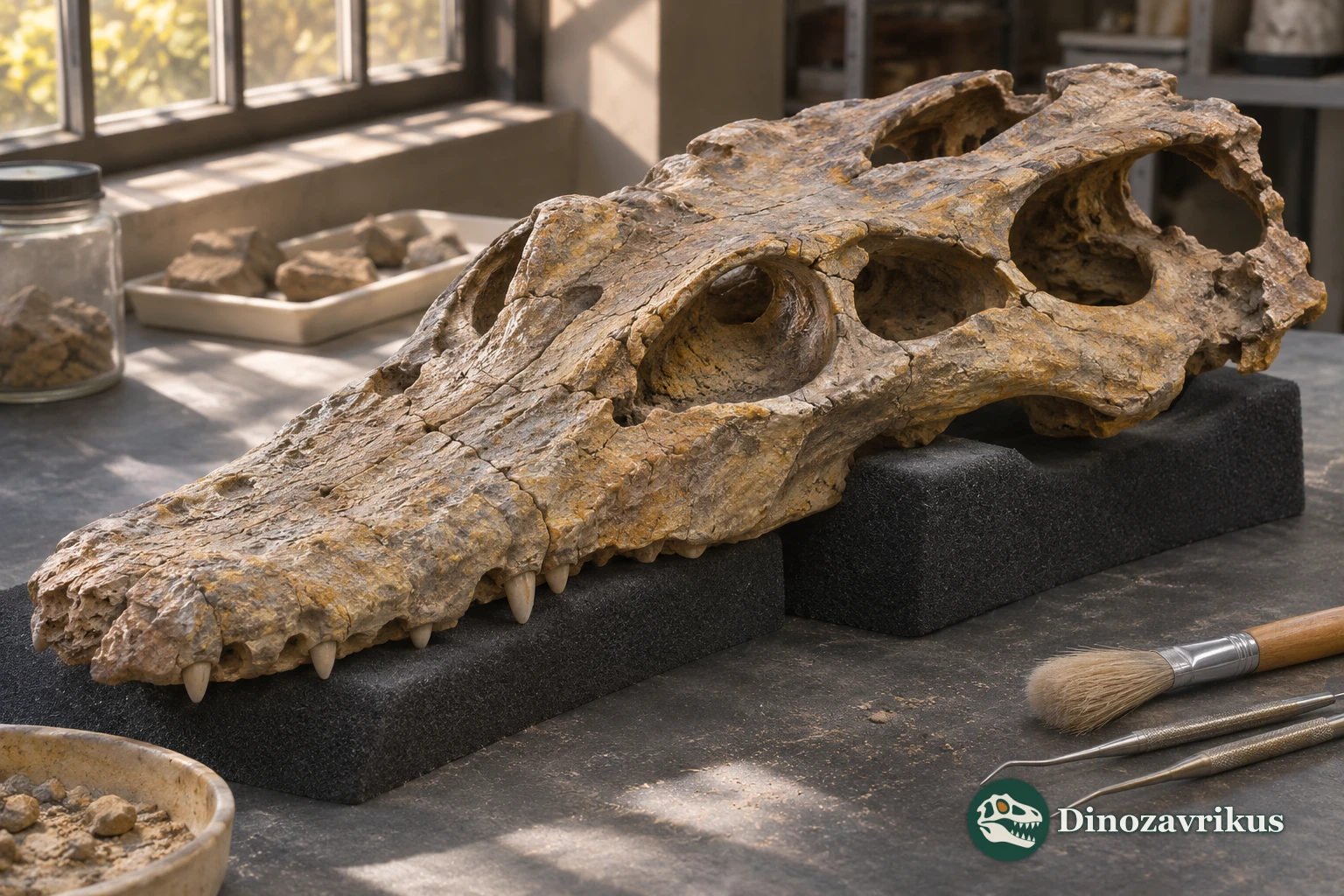
How the upper and lower teeth fitted together
The snout was moderately broad and flattened. On each side of the upper jaw, the description records five tooth sockets in the premaxilla and fourteen in the maxilla. Each side of the lower jaw had sixteen or seventeen sockets.
A partly enclosed pit at the edge of the snout received the fourth lower tooth on each side. The arrangement recalls the jaws of alligators. Other skull characters support placement in Mekosuchinae, an extinct Australasian group. The Australian genus Baru preserves a different combination of skull and tooth characters.
Freshwater environments and the age of the bones
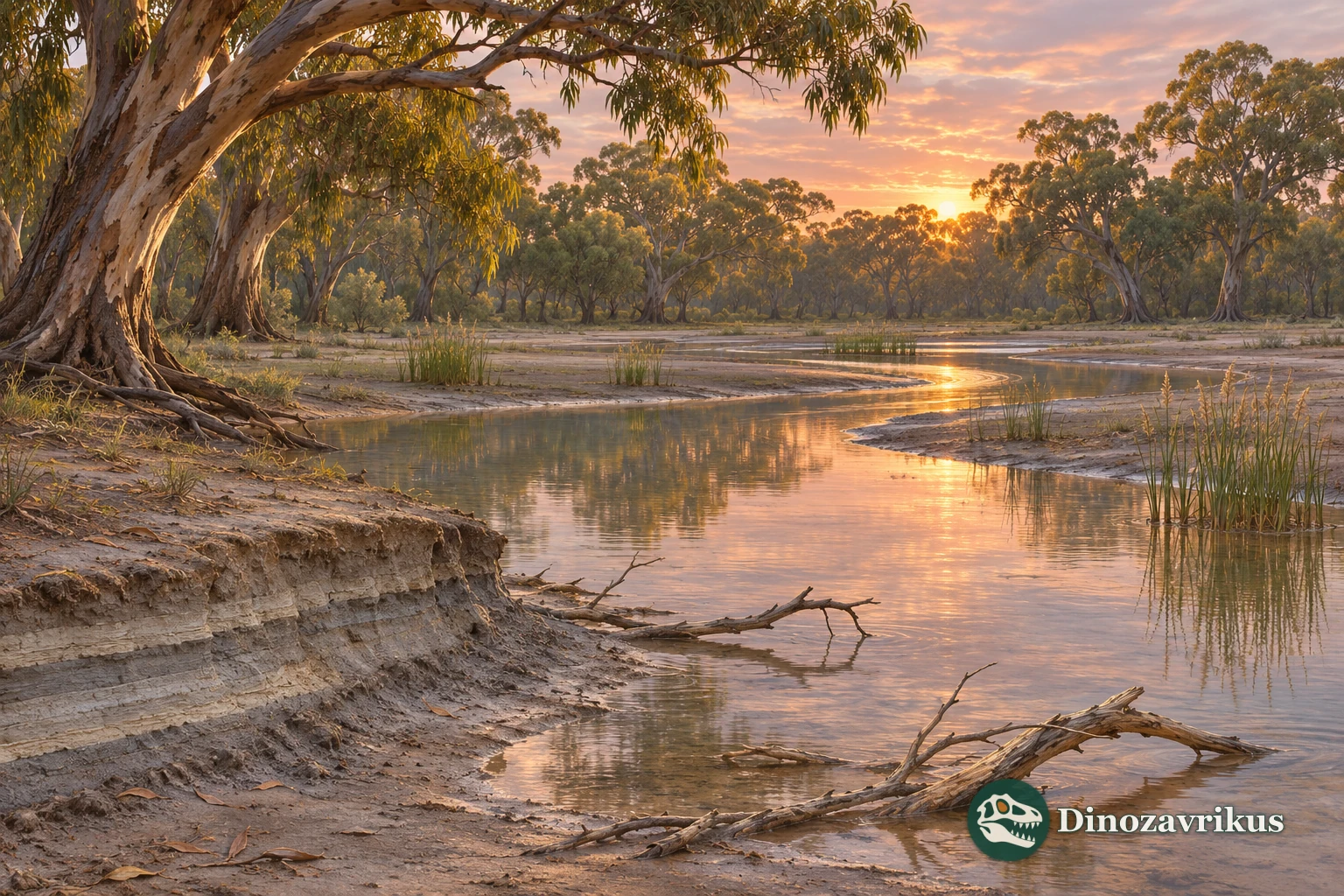
Fossils from the Etadunna Formation near Lake Palankarinna and the Namba Formation near Lake Pinpa place the animal in freshwater landscapes. Its teeth and jaws are consistent with a generalist predator. They provide no record of particular prey.
Some bones have been linked to the younger Mampuwordu Sands. A review of Australasian crocodilians found that remains in those sands could have eroded from older beds and been buried again. The secure record of Australosuchus spans the Late Oligocene to Early Miocene.
Frequently asked questions
Who found Australosuchus?
Michael Archer collected the holotype in 1975 near Lake Palankarinna. It was formally described in 1991.
What was the pit in the upper jaw for?
It accommodated the large fourth tooth of the lower jaw when the animal closed its mouth.
How do the two lake sites differ?
Lake Palankarinna yielded the type specimen. A different skull, SAMA P42788, came from the Lake Pinpa area.
Why is its youngest occurrence uncertain?
Bones recovered from younger sands may have washed out of older layers. In that case the younger deposit does not date the original animal.