

Austriadraco dallavecchiai is a small Late Triassic pterosaur known from one disarticulated skeleton in the Norian Seefeld Beds of Tyrol, Austria. Its fossil is spread across several broken limestone slabs, and repeated study has changed how some of its bones are identified.
The genus appears in the pterosaur catalogue alongside early forms such as Eudimorphodon. That comparison helps place Austriadraco in the diversity of Triassic pterosaurs, but it does not make the two genera interchangeable.
Quick facts
| Scientific name | Austriadraco dallavecchiai |
|---|---|
| Group | Early pterosaur; relationships remain analysis-dependent |
| Age | Late Triassic, Norian |
| Locality | Seefeld Beds, Tyrol, Austria |
| Holotype | BSP 1994 I 51, the only known specimen |
| Material | Disarticulated skull, trunk, wing and hindlimb elements |
What can the fossils tell us?
BSP 1994 I 51 preserves scattered bones from several parts of the skeleton. It is neither a complete articulated animal nor multiple individuals.
Dalla Vecchia’s 2021 revision described elements including the femur, premaxillae and maxillary teeth, and reconsidered a broad element once identified as a sternum.
The single disarticulated specimen supports anatomical comparisons but does not establish exact whole-body proportions, colour, diet or behaviour.
A specimen with a changing identity
Peter Wellnhofer described BSP 1994 I 51 in 2003 as Eudimorphodon cf. ranzii, a cautious comparison rather than a firm referral to the type species. Alexander Kellner later named Austriadraco dallavecchiai for the specimen. The species name honours Fabio Marco Dalla Vecchia, whose work on Triassic pterosaurs helped establish the comparison.
The holotype was collected near Seefeld in the Karwendel Mountains. Its bones are separated across several fragments of limestone and a counter-slab. Some parts remain grouped, but the specimen is not a fully articulated skeleton, and no second individual is known.
What the slabs preserve
The published material includes fragments of the skull and lower jaws, teeth, vertebrae, ribs, shoulder and wing elements, pelvis and hindlimb bones. A detailed revision by Dalla Vecchia in 2021 identified elements that earlier accounts had left uncertain, including the femur, premaxillae and maxillary teeth.
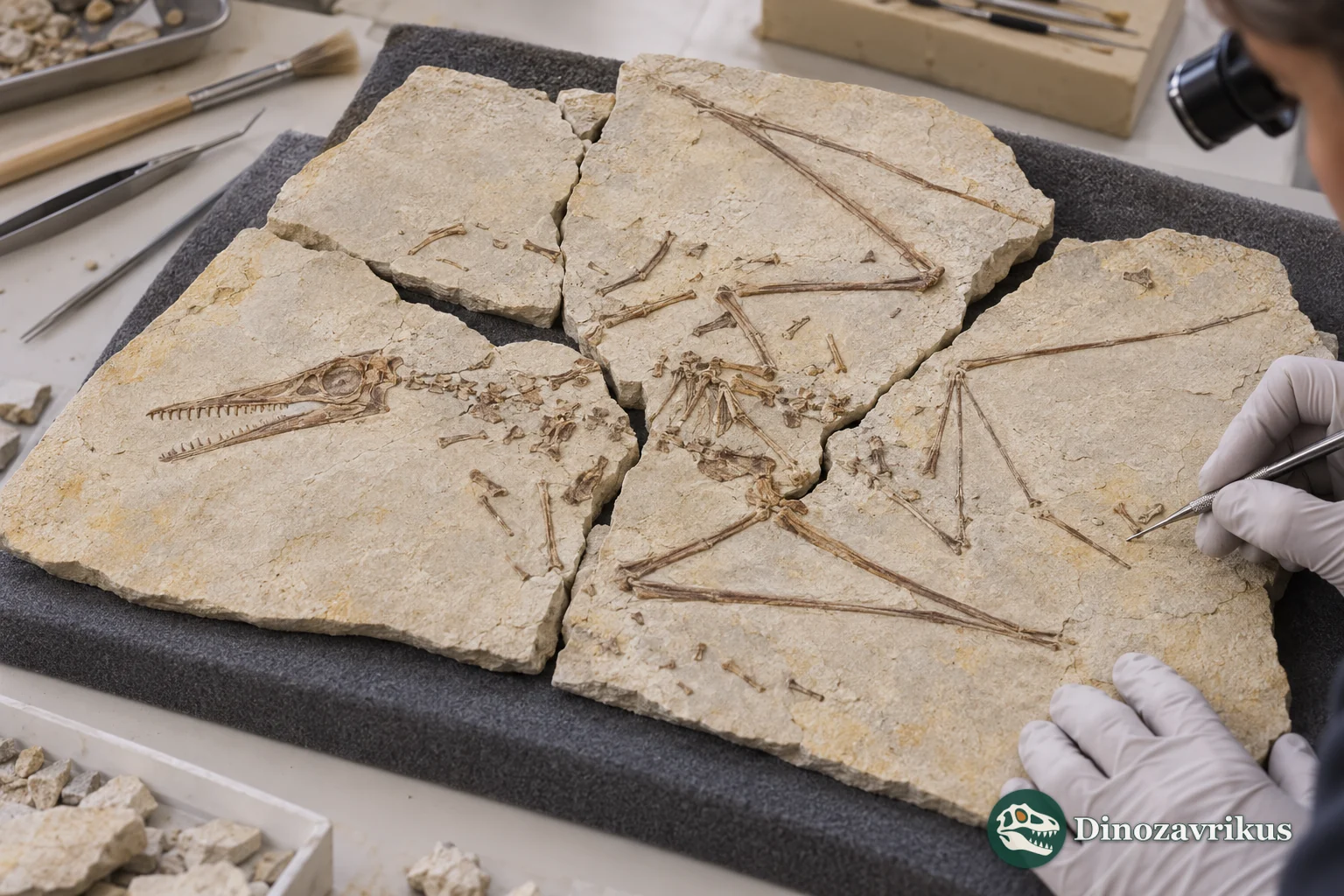
The revision also reconsidered a broad bone previously described as the sternum; it is plausibly formed by fused frontals of the skull. That correction matters because an anatomical identification can influence comparisons and phylogenetic coding.
Jaws, teeth and diagnosis
The small jaws carry multicusped teeth, a feature useful for comparison with other early pterosaurs. Teeth alone do not establish a precise diet. The revised diagnosis also gives weight to details of the jugal, including a slender elongated process, and to a combination of other cranial and postcranial characters.
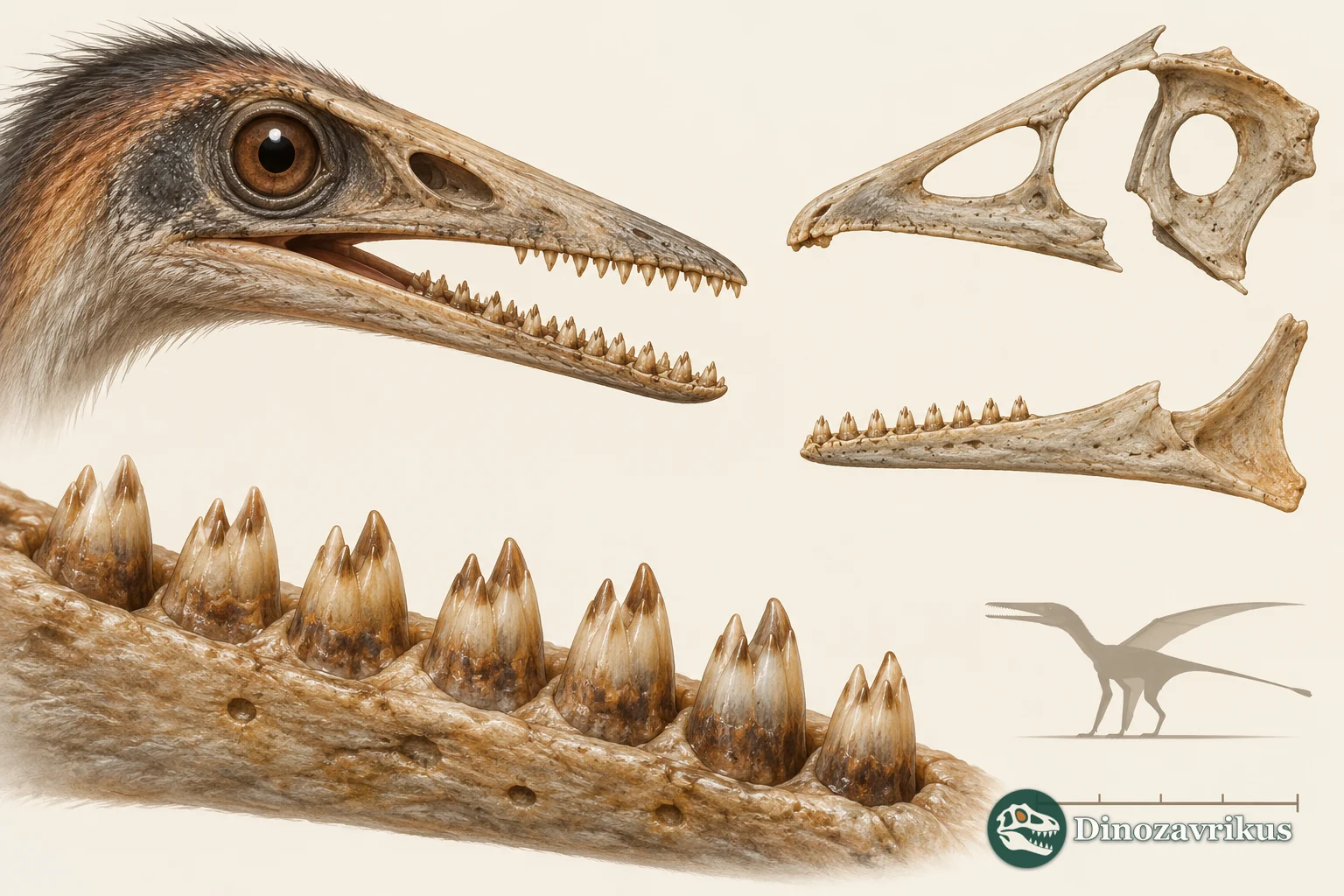
Dalla Vecchia noted morphological similarities with Seazzadactylus venieri from the Upper Triassic of northeastern Italy. This supports a comparative relationship worth testing; it does not demonstrate that the two names represent one species.
Age and Alpine setting
The fossil comes from the Norian Seefeld Beds of the Northern Calcareous Alps. Wellnhofer described the fossil-bearing succession as bituminous and calcareous layers deposited above a broad marine carbonate platform. That geology describes the region and sedimentary setting, not the pterosaur’s daily habits.
The exact phylogenetic position of Austriadraco depends on how characters are interpreted and which taxa are included in an analysis. It is treated as a distinct taxon, while proposed family-level groupings and close relationships are not universal across studies.
What remains unknown
Although the holotype includes parts of the wing and legs, its disarticulation and incompleteness do not provide a reliable measured wingspan. No complete skeleton, soft tissues, colour pattern or direct evidence of diet has been reported. The lake and shoreline atmosphere in a reconstruction is an artistic way to represent a broad regional setting, not a fossil observation.
Frequently asked questions
What is the Austriadraco holotype?
BSP 1994 I 51 is the only known specimen, a disarticulated skeleton preserved across limestone fragments.
Where was it found?
It comes from the Norian Seefeld Beds near Seefeld in Tyrol, Austria.
Why was it once compared with Eudimorphodon?
Wellnhofer used the cautious identification Eudimorphodon cf. ranzii in 2003; later anatomical work supported naming a separate genus.
Is its wingspan known?
No reliable wingspan has been established from the single incomplete, disarticulated specimen.