

Aymberedactylus cearensis was named in 2016 from one almost complete lower jaw from the Crato Formation of northeastern Brazil. The fossil retains much of its three-dimensional form rather than being only a flattened impression. It records a toothless beak and the joint region, but no skull roof, upper jaw, wings or soft tissues were found with it. A full-body portrait must therefore draw on relatives as well as the actual type specimen.
Quick facts
| Name | Aymberedactylus cearensis, Pêgas and colleagues, 2016 |
|---|---|
| Group | Tapejaridae, an early tapejarine |
| Age | Early Cretaceous, Aptian–Albian interval |
| Locality | Near Nova Olinda, Ceará, Brazil; exact coordinates unrecorded |
| Holotype | MN 7596-V, nearly complete 270 mm lower jaw |
| Teeth | Absent in the preserved jaw |
| Wingspan | About 2 m by comparison; no wing bones are known |
What can the fossils tell us?
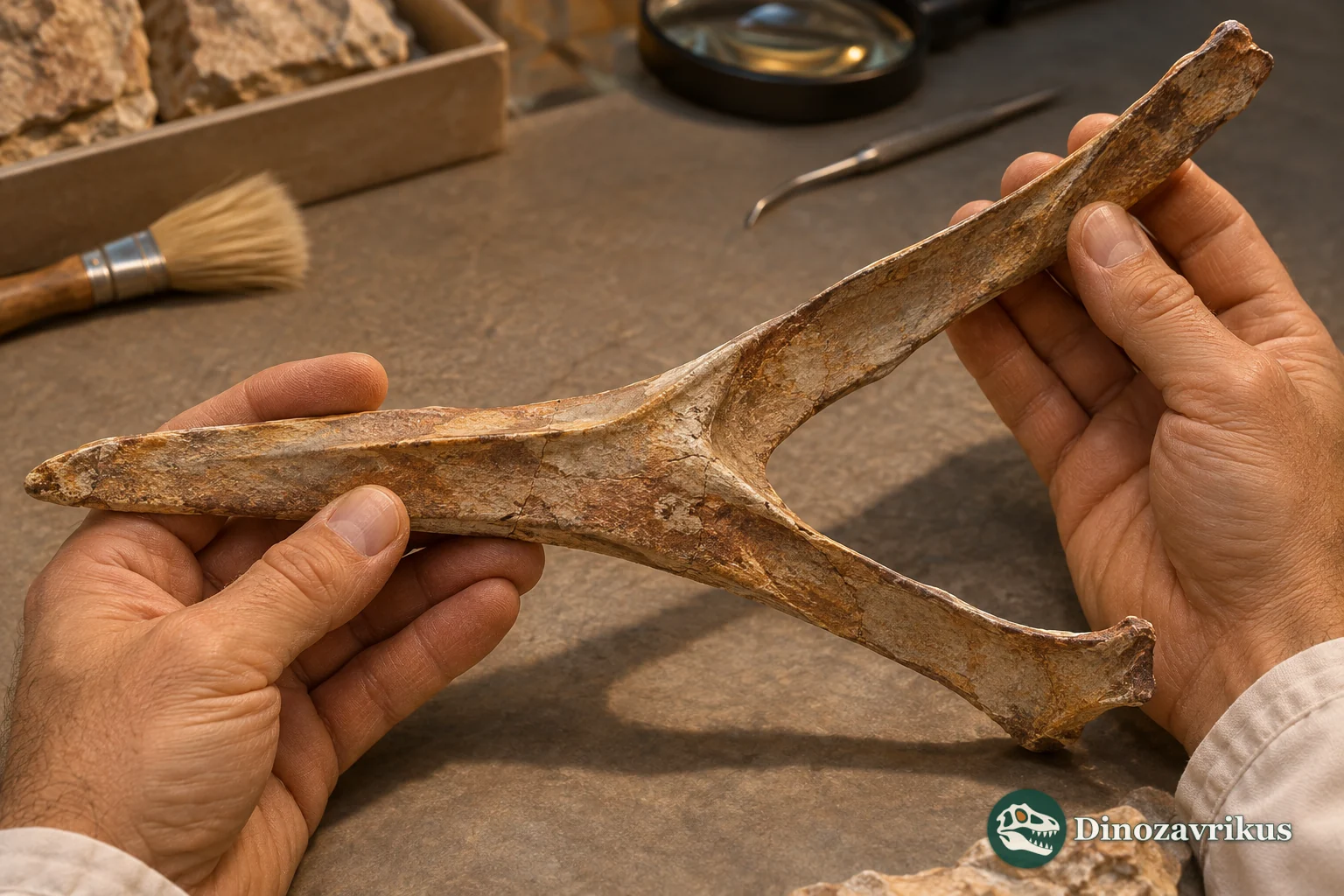
MN 7596-V is a three-dimensional, toothless jaw 270 mm long. Its left rear process and part of its lower crest are missing.
The long fused front takes up about half the jaw, while the branches diverge sharply behind it, making a Y-like outline in top view.
Some sutures remained visible although other bones had fused. The authors interpreted the type as a late subadult.
The roughly 2 m span scales jaw size against other tapejarines. It was not measured from Aymberedactylus wing bones, and adult size is unknown.
A jaw from the Araripe Basin
The specimen MN 7596-V was donated to the Museu Nacional at the Federal University of Rio de Janeiro. The describing team did not excavate it. The available locality is near the quarries of Nova Olinda in Ceará, without coordinates or an exact bed. Its Crato Formation assignment supplies a broad Early Cretaceous context, but does not justify a precise excavation site or a narrowly dated horizon.
The genus name combines a Tupi term for small lizard with the Greek-derived pterosaur naming element meaning finger. The species epithet refers to Ceará. The name applies to the jaw in the museum collection, not to a skeleton assembled from other nearby pterosaur finds.
The anatomy preserved in the type
The 270 mm mandible is almost complete. Its two dentaries are fused at the front into a long symphysis, approximately half the total length. Farther back the two branches diverge sharply. From above the outline resembles a Y more than the gradual V seen in many comparisons. The specimen has no teeth, and the surface preserves details of the articular region and internal depressions.
The right retroarticular process extends for roughly seven percent of jaw length. A shallow textured fossa on the splenial was another diagnostic feature in the original description. The lower crest is damaged but was probably shallow. Compression may have altered the exact downward curve of the front. These are observations and cautious anatomical inferences, not a blueprint for every part of the living head.
Where it fits and how old it was
The toothless beak, long symphysis and other jaw features led the authors to place Aymberedactylus among tapejarines. Sinopterus preserves a more informative skull and skeleton within the broader group. It can help explain relationships, but its own crest and upper-jaw proportions must not simply be copied onto the Brazilian species. Afrotapejara shows another tapejarid known from different and more limited material.
The combination of fused areas and persistent sutures suggests that MN 7596-V was neither a young juvenile nor fully mature. The describers interpreted it as a late subadult. By scaling its mandible against related tapejarines they proposed a wingspan around two metres. That value is a comparison, not a measurement across fossil wings; the adult maximum cannot be read from this single jaw.
Diet and the setting
A toothless jaw is not a preserved meal. Fruit eating and other ways of using the beak have been discussed for tapejarids, but this specimen lacks stomach contents, feeding marks and associated prey. Even if a beak covering followed the neurovascular openings in the jaw, its exact extent and function would remain unobserved soft tissue.
Crato limestones preserve organisms from the ancient Araripe region. The burial setting shows where the bone entered the sediment, not every habitat the pterosaur used while alive. A jaw could have moved before burial. The fossil's strongest contribution is the rare three-dimensional shape of an early tapejarine lower jaw from South America.
What an illustration can show
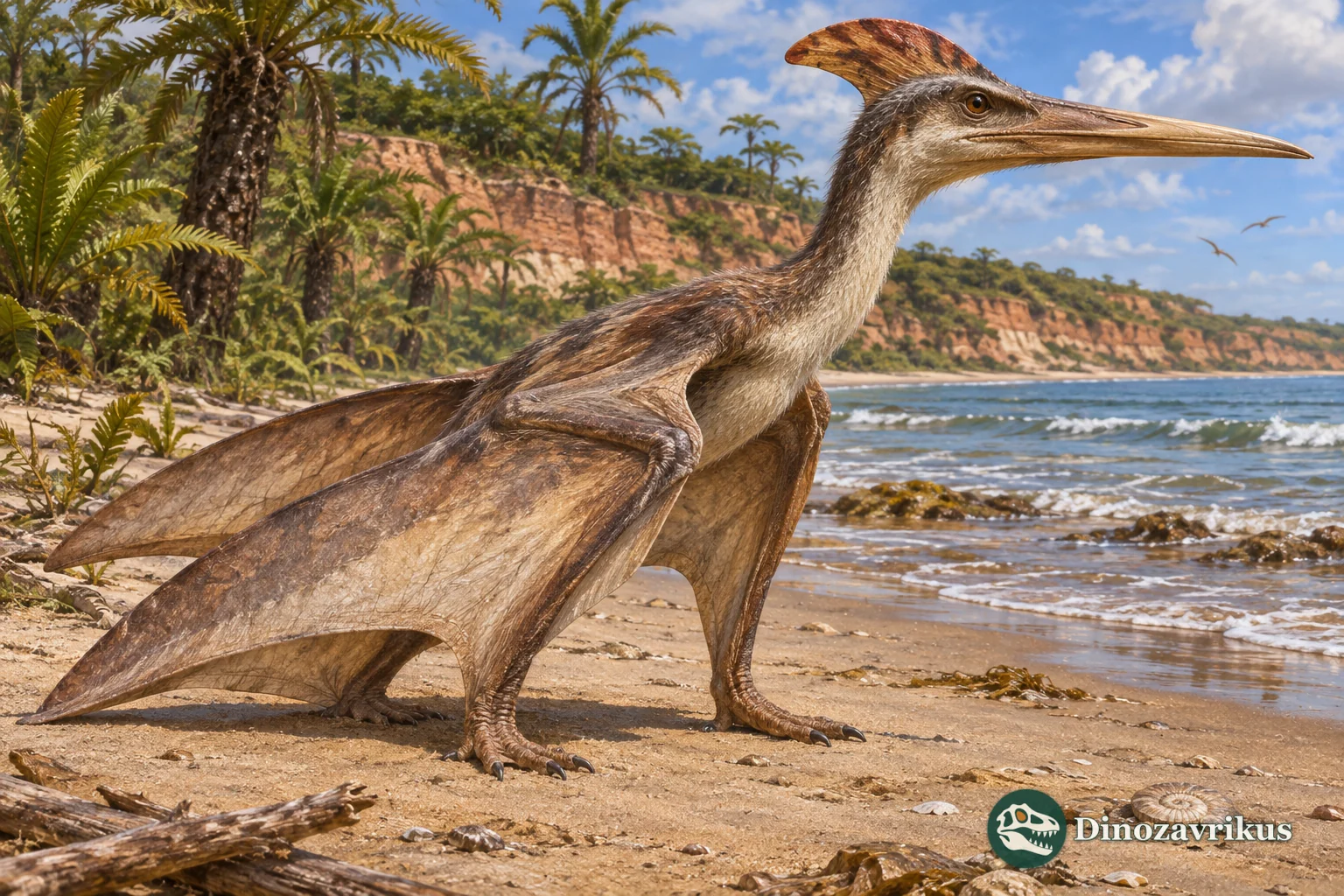
A reconstruction can retain a toothless, somewhat downturned lower beak and the broad tapejarine body plan. The missing upper jaw, large head crest, wing proportions, skin covering, colour and behaviour require comparisons or artistic choices. None is a direct observation of MN 7596-V.
This distinction also matters when estimating body size. A broad comparative span is useful as a guide, but it cannot become a precise measurement or a claim that every adult of the species was exactly that size.
Frequently asked questions
Is a complete Aymberedactylus skeleton known?
No. The type preserves a nearly complete lower jaw, but no associated skull roof, vertebrae or wings.
Did Aymberedactylus have teeth?
The preserved lower jaw is entirely toothless, one feature used to compare it with tapejarines.
Why is its wingspan approximate?
About two metres was inferred by scaling the jaw against relatives. No wings of this species were measured, and the type may still have been growing.
Where exactly was the type found?
The record points to quarries near Nova Olinda in Ceará and the Crato Formation; no precise collection coordinates survive.