

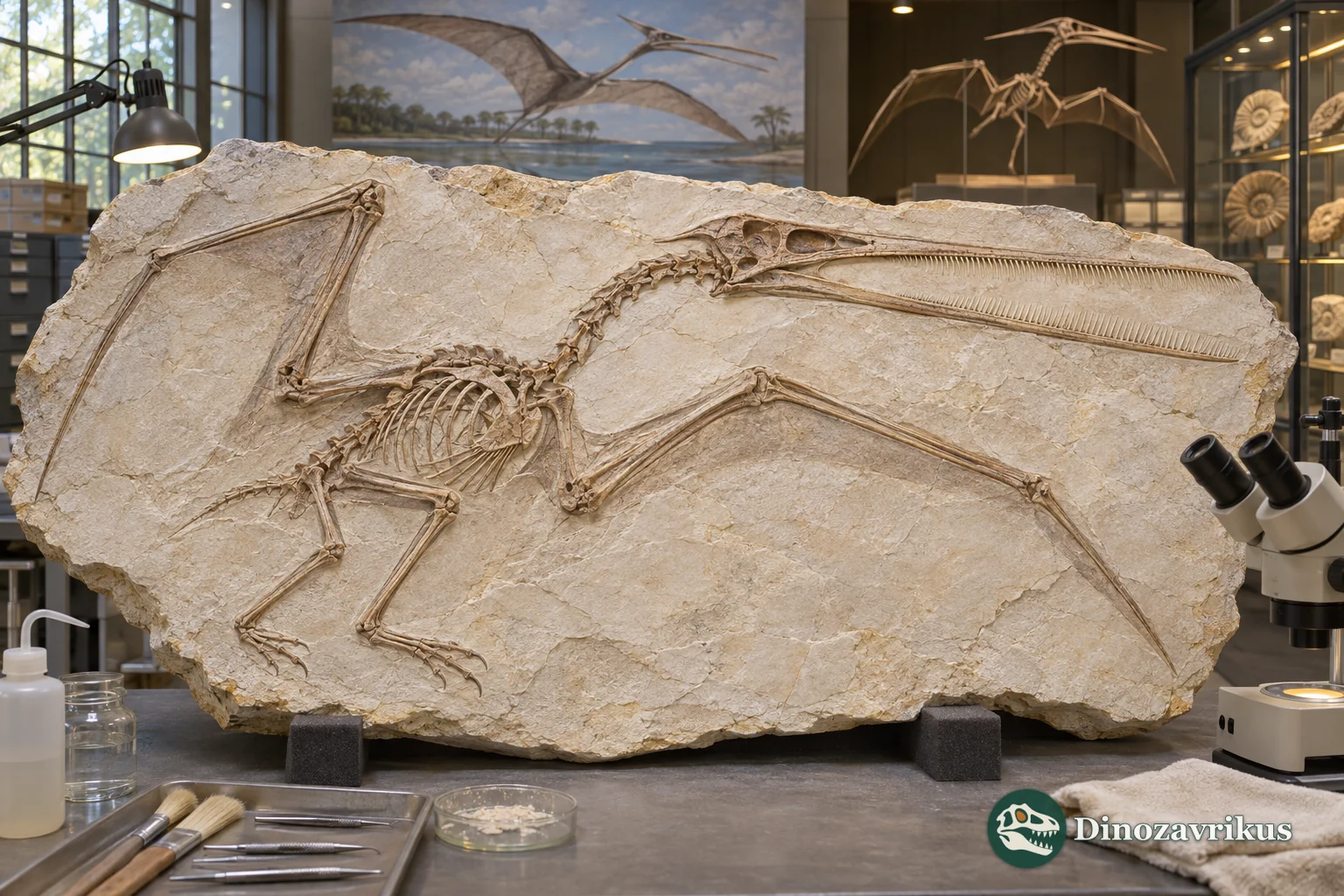
Balaenognathus maeuseri was described in 2023 from a nearly complete skeleton preserved in the laminated limestone of Wattendorf, Bavaria. Its long snout widens at the front, and hundreds of slender teeth line the jaws. Together they form a structure able to strain food from water. Unlike pterosaurs named from a small fragment, this fossil connects the unusual mouth with much of one animal's wings, trunk and legs.
Quick facts
| Name | Balaenognathus maeuseri, Martill and colleagues, 2023 |
|---|---|
| Group | Ctenochasmatidae, pterodactyloid pterosaurs |
| Age | Late Jurassic, late Kimmeridgian |
| Locality | Wattendorf, Bavaria, Germany |
| Holotype | NKMB P2011-633, almost complete articulated skeleton |
| Teeth | At least 480 thin teeth with small expanded tips |
| Wingspan | About 1.17 m calculated from skeletal elements |
What can the fossils tell us?
NKMB P2011-633 retains most of the skull, wings, body and legs. The slab broke, but the bones remained largely associated; a few parts are missing.
The authors counted at least 480 fine teeth. Their tiny hooked or swollen tips and the toothless front edge define an unusual filtering apparatus.
The estimated 1.17 m span sums preserved wing elements on both sides. A small patch near the left wing was interpreted as membrane.
Models of water flow through the beak include current, head movement and throat pumping. The fossil does not record one exact behavioural sequence.
Discovery and collection
The type was recovered from a quarry near Wattendorf. It was found outside its original position in the rock sequence, but the distinctive slab fabric allowed the authors to match it to bed 12 of the Wattendorf Plattenkalk within the Torleite Formation. Ammonite evidence places that bed in the late Kimmeridgian. This is a careful lithological attribution rather than a claim that the exact point of extraction was mapped in situ.
The limestone slab had broken into 17 pieces. Preparation nevertheless revealed an almost complete articulated skeleton. Some areas of the wing and pelvis are absent, while other small elements may lie beneath larger bones. The fossil is held by the Bamberg Natural History Museum as NKMB P2011-633. The species name honours coauthor Matthias Mäuser, who died while the paper was being prepared.
A broad tip and more than 480 teeth
The snout expands into a spatula-like tip. Its straight front margin lacks teeth, whereas the sides of both upper and lower jaws carry tightly spaced slender teeth. The researchers estimated roughly 130 on each upper side and 110 on each lower side. Damage prevents an exact total, so the secure minimum is 480. Many tooth crowns end in a small hook or knob.
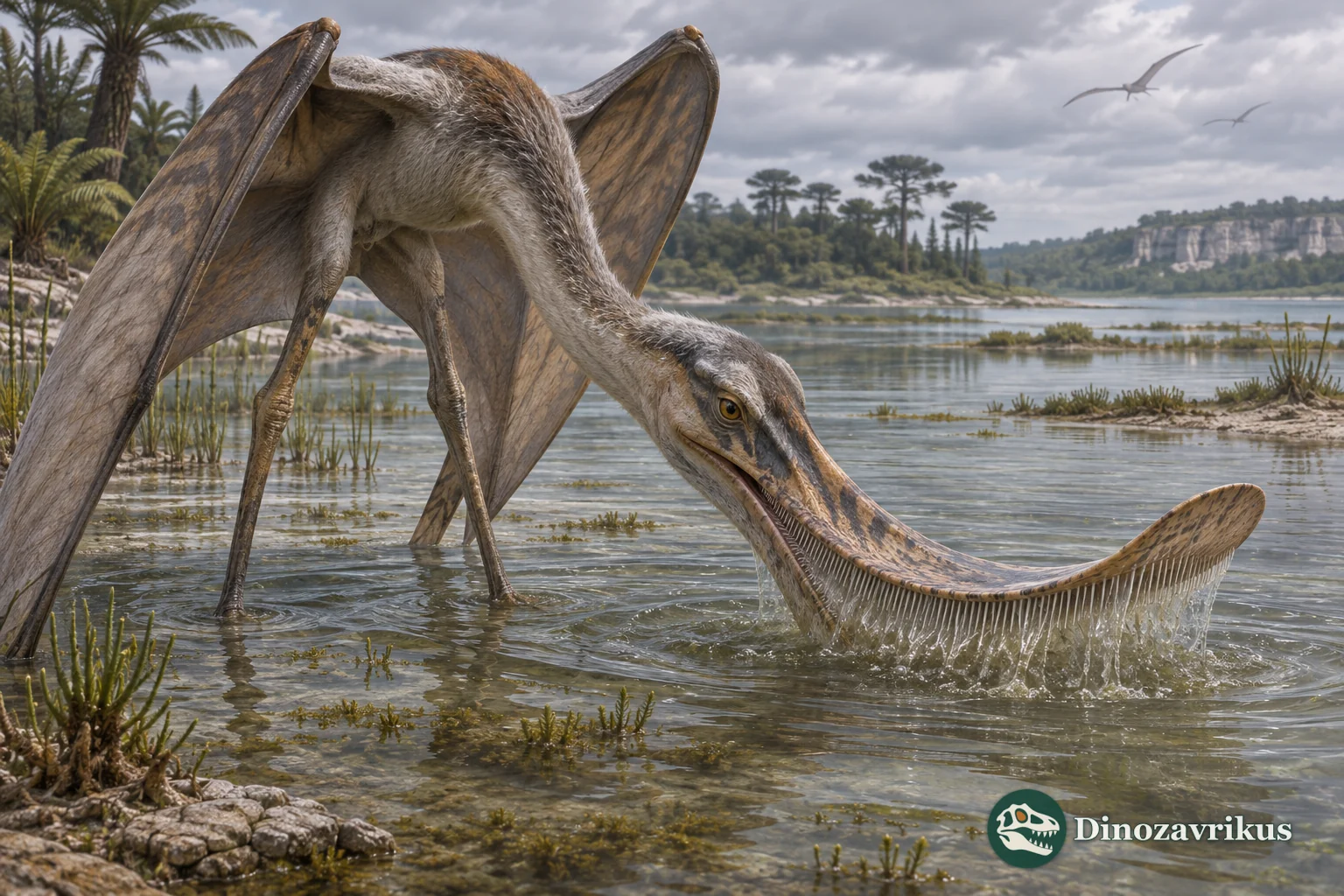
As the jaws approached one another, the teeth could interlock into a fine mesh instead of forming a bite for large prey. Water entering at the front could pass outward through this filter while food particles remained. That interpretation follows the bony geometry. The fossil does not preserve a particular meal or establish how often the animal fed this way.
Wings, legs and soft tissue
The estimated wingspan of about 1.17 metres comes from adding the measured shoulder, forearm, wrist, hand and wing-finger elements, then accounting for both sides. It refers to the known individual rather than a maximum for the whole species. Relatively long legs are compatible with wading, though leg length alone cannot prove a habitual feeding posture.
A small area beside the left wing phalanges retains fibres interpreted as part of the wing membrane. The patch is important direct evidence of soft tissue, but it does not give the complete wing outline or any body colour. Researchers studied the specimen under ordinary and ultraviolet light and with X-rays to document fine details.
Relationships and feeding hypotheses
The original analysis placed Balaenognathus within Ctenochasmatidae. Ctenochasma and Gnathosaurus also carried many slender teeth, while Balaenognathus combines a widened tip with distinctive tooth-end hooks. Pterodaustro represents another form of elaborate filtering teeth. Membership of the broader group does not mean all these animals ate the same food or used identical jaw motions.
The describers considered movement through water, passive use of a current and active pumping with soft throat structures. They argued against skimming with a submerged beak while flying because water drag would be too great. A filter-feeding adaptation is well grounded in the teeth; the exact hydraulic cycle and food particles remain functional hypotheses.
The Wattendorf environment
The thin limestone was deposited in a Jurassic carbonate-platform setting. Fine sediment helped preserve an unusually complete skeleton, but burial in this basin is not itself a record of every place where the pterosaur lived or fed. The fossil's associated bones make its anatomical interpretation much stronger than an isolated jaw would permit.
The cover and internal scene show one plausible shallow-water scenario. They should be read as reconstructions around a real skeleton, not as photographs of the animal or a direct view of its last meal.
Frequently asked questions
How many teeth did Balaenognathus have?
At least 480 were established in the type specimen. Damage to the front of the jaws prevents an exact total.
Was a complete skeleton discovered?
A nearly complete articulated skeleton survives, although small parts of the wing and pelvis are missing or hidden.
How was its wingspan estimated?
The authors added the measured lengths of wing elements for both sides and obtained about 1.17 metres for the type individual.
What did it eat?
Its teeth support filtering small food particles from water. A precise menu and feeding motion are not directly preserved.