

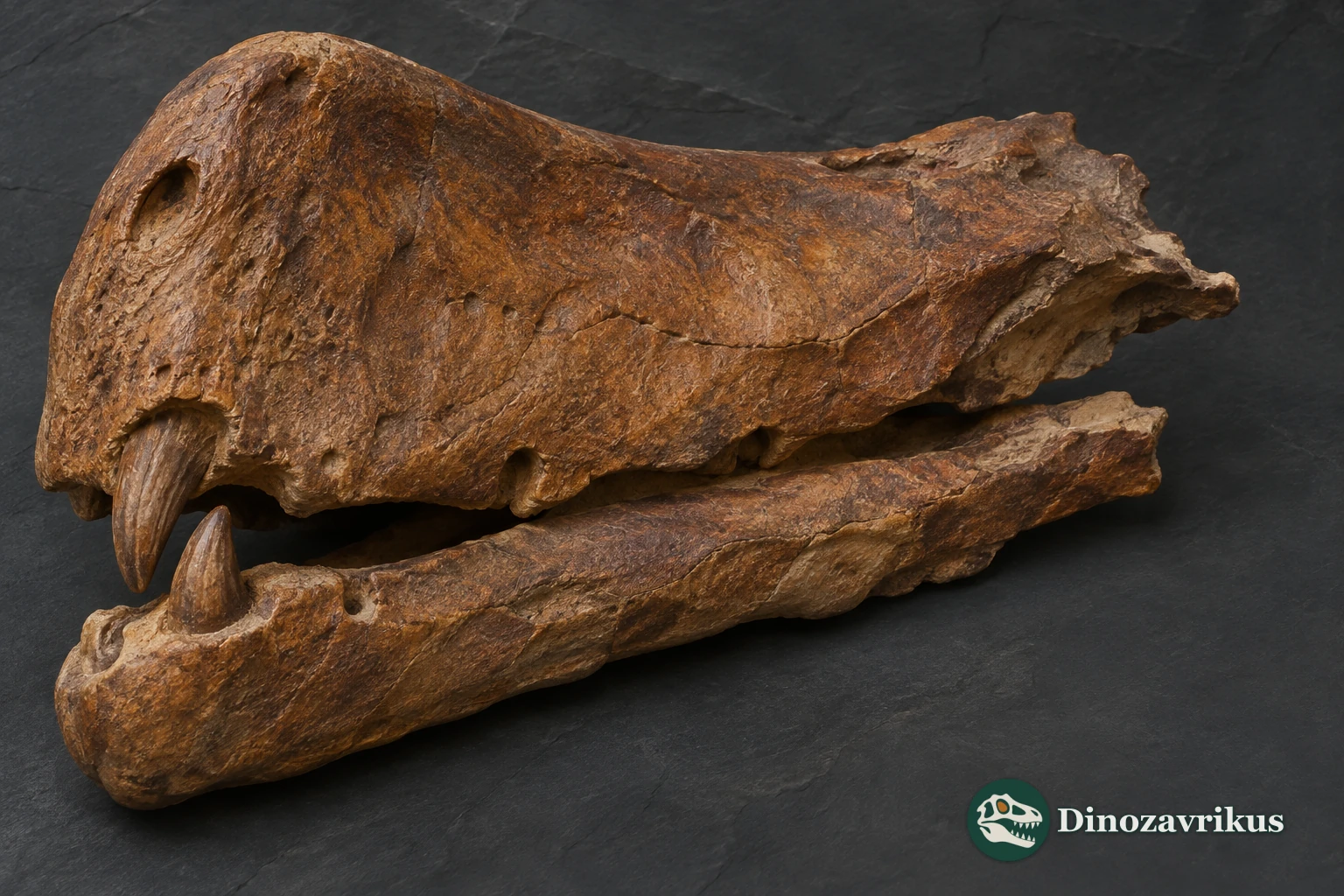
Barinasuchus arveloi was a large sebecid crocodylomorph from Miocene South America. Its Venezuelan type specimen preserves the front of the skull and lower jaw together. Their position shows how a particularly large lower tooth fitted against the upper jaw.
Quick facts
| Species | Barinasuchus arveloi |
|---|---|
| Family | Sebecidae |
| Age of the holotype | Middle Miocene |
| Type locality | Quebrada Socó, Barinas State, Venezuela |
| Holotype | MAAT-0260, articulated anterior skull and mandible |
| Preserved length | 70 cm |
What can the fossils tell us?
Fine-grained sandstone encased the fossil in the upper Parángula Formation.
The recess is near the junction of the premaxilla and maxilla. The jaws remained together, preserving the tooth’s position.
The front of the head spans 70 cm. A reliable body length would require more skeletal material or a tested estimate of its proportions.
The fossil from Quebrada Socó
Local residents collected the fossil near Barrancas in 1982, in a tributary of the Masparro River. Alfredo Paolillo and Omar Linares named the genus and species in 2007. The type specimen, MAAT-0260, comes from the upper Parángula Formation, which the authors assigned to the middle Miocene.
The surviving portion measures 70 cm long and up to 41 cm high. It preserves a deep, relatively narrow snout. The back of the skull and the rest of the skeleton are missing from the specimen.
The fit between the jaws
The fourth tooth of the lower jaw was especially large. When the jaws closed, it fitted into a deep recess near the seam between the premaxilla and maxilla. With both jaws preserved together, the position of the tooth helps distinguish the recess from a socket for an upper tooth.
The maxillary teeth are compressed from side to side, particularly towards the rear of the row. The deep snout and tooth shape fit a predatory interpretation. Sebecus provides a comparison within the same family. The original description of the Barinasuchus holotype did not document serrations on the teeth.
A separate record from Peru
The original authors also referred a skull fragment from the Ipururo Formation of Peru to Barinasuchus. That fossil had previously been tentatively compared with Sebecus huilensis. Its published account describes a separate specimen, so the observations and measurements for the Venezuelan holotype apply only to MAAT-0260.
Frequently asked questions
Where was Barinasuchus found?
The holotype comes from Quebrada Socó in Barinas State, western Venezuela.
What measured 70 cm?
That is the length of the preserved front of the head, including the lower jaw.
How did the large lower tooth fit?
The fourth lower tooth fitted into a recess near the junction of two upper jaw bones.
Do fossils show what it hunted?
The teeth support a predatory diet. The type specimen preserves no evidence identifying particular prey.