

Bathyurus is an Ordovician genus of bathyurid trilobites named by Elkanah Billings in 1859. Its type species is Asaphus? extans, described by James Hall from New York. The genus is recognised through combinations of features on the head shield, free cheeks, thorax and tail shield, but many specimens preserve only one or two of those parts.
That fragmentary record matters for classification. A 2015 analysis of Upper Ordovician relatives found that separating Raymondites from the traditional broad concept of Bathyurus left the latter paraphyletic in its sample. The authors treated Raymondites as a subgenus, while leaving the type species and many eastern North American forms in need of further revision. Bathyurus is included in the ancient arthropod catalogue among trilobites whose names depend on careful comparison of incomplete fossils.
Quick facts
| Scientific name | Bathyurus Billings, 1859 |
|---|---|
| Type species | Asaphus? extans Hall, 1847 |
| Group | Trilobita, Bathyuridae |
| Age | Ordovician; species records span more than one interval |
| Type record | Black River Group, New York State |
| Typical material | Separate cranidia, free cheeks, thoracic parts and pygidia |
| Main uncertainty | The broad traditional genus may not represent one complete clade |
What can the fossils tell us?
Billings named Bathyurus in 1859 and designated Asaphus? extans Hall, 1847 as its type species. Its Black River Group record in New York fixes the name; it does not make every later Bathyurus identification equally secure.
Described material includes cranidia and pygidia. A Geological Survey of Canada treatment records a semicircular to subtriangular pygidium with deep axial furrows, commonly four interpleural furrows and flattened borders in the species it reviewed.
Named species and referred specimens occur in Laurentian strata from New York, Ontario, Quebec, the Mackenzie Mountains and other regions. Incomplete material and uneven preservation make a single continuous range misleading.
A 2015 revision recovered Raymondites within the broader Bathyurus grouping and treated it as a subgenus, Bathyurus (Raymondites). This is a phylogenetic result for the sampled species, not a settled revision of every name assigned to Bathyurus.
A name tied to a New York trilobite
Hall described Asaphus? extans in 1847. Billings introduced Bathyurus in 1859 and designated Hall's species as the type. The question mark in the original combination reflects uncertainty about its first placement; it does not mean that the later genus itself is informal. In modern usage, the type species supplies the reference against which the genus name must be tested.
The type record comes from the Lowville Formation of the Black River Group in the Mohawk Valley, New York, part of the Ordovician carbonate succession of Laurentia. Later authors described other species from formations in Canada and the United States. These are separate occurrences with their own stratigraphic positions, not a single population extending unchanged across the continent.
Older collections often contain isolated cranidia or pygidia. An old label is valuable evidence of how a fossil was identified, but it does not settle whether the specimen belongs in the genus as currently understood. The type species has itself been noted as poorly known and in need of revision, so broad claims about all Bathyurus material deserve qualification.
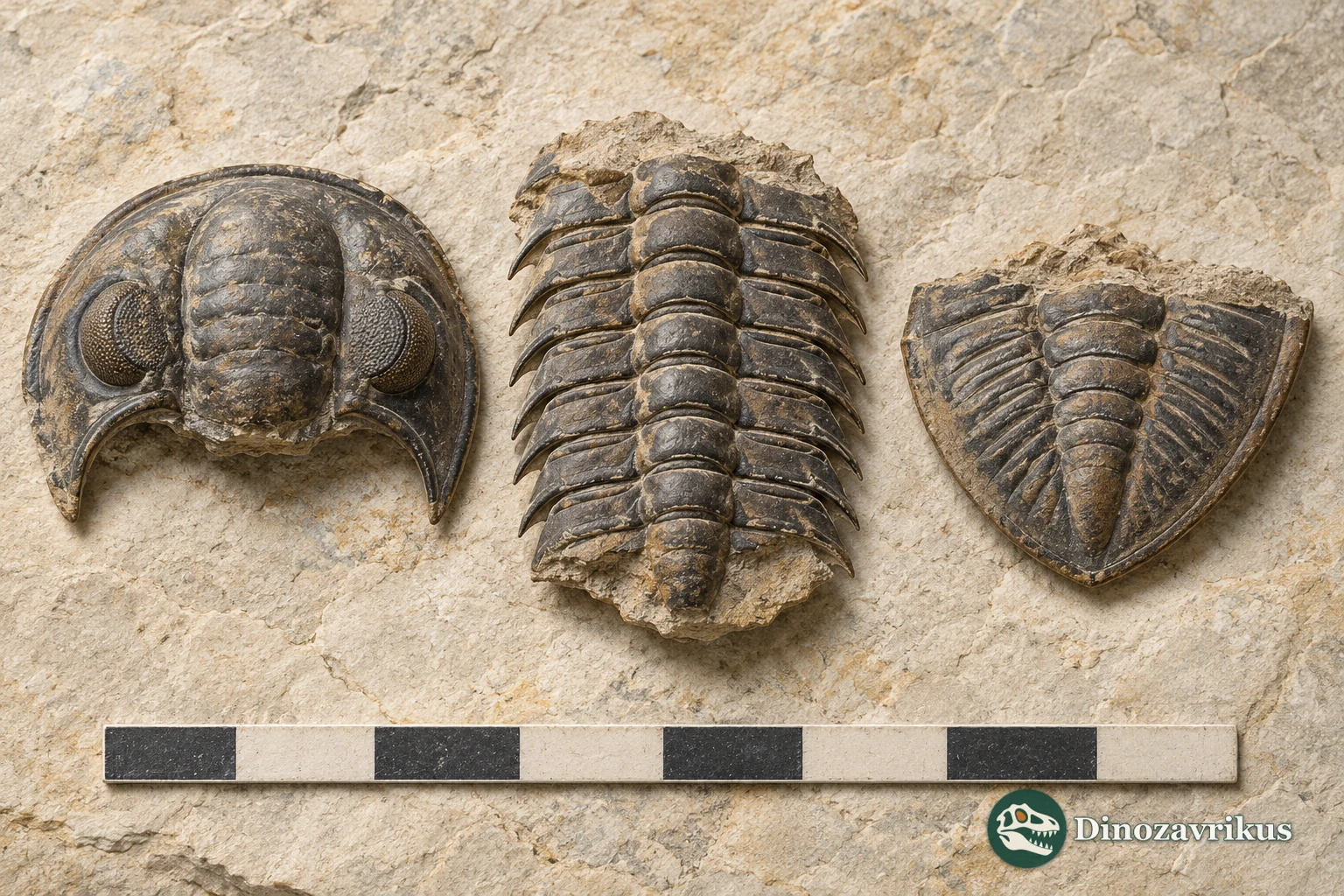
What the preserved shields show
The trilobite body was divided into a cephalon, a jointed thorax and a pygidium. Bathyurus diagnoses rely on details such as the glabella, the position and length of the palpebral lobes, the frontal area, and the outline and furrows of the pygidium. Those features are not all visible in a fossil that preserves only the head or only the tail.
A Geological Survey of Canada description of Bathyurus species from silicified material records pygidia ranging from semicircular to subtriangular, with deep axial furrows, usually four interpleural furrows and flattened borders. The study also notes variation among species in the glabella, eye furrows and hypostome. These are taxonomic observations from particular samples, not a universal checklist that can be applied to every fragment.
Silicification in some northern Canadian deposits preserved small skeletal details that are hard to see in weathered or compressed material. In other localities, the ventral anatomy remains uncertain. A reconstruction can show the general trilobite body plan, but exact limb arrangement and soft tissues are not documented equally well for every Bathyurus species.
Many places, separate geological records
Species assigned to Bathyurus have been reported from Ordovician strata in New York, Ontario, Quebec, the Mackenzie Mountains and parts of the western United States. Their ages are not identical. A genus-level map combines occurrences across formations and species; it should not be read as the range of one animal or one unchanging ecosystem.
Middle Ordovician material from the Sunblood Formation in the Mackenzie Mountains includes several named Bathyurus species and has been studied in the context of carbonate-platform biofacies. Other records come from the Black River and younger successions. Differences in fossil abundance may reflect water depth, substrate, preservation and collection effort, as well as the animals' original distribution.
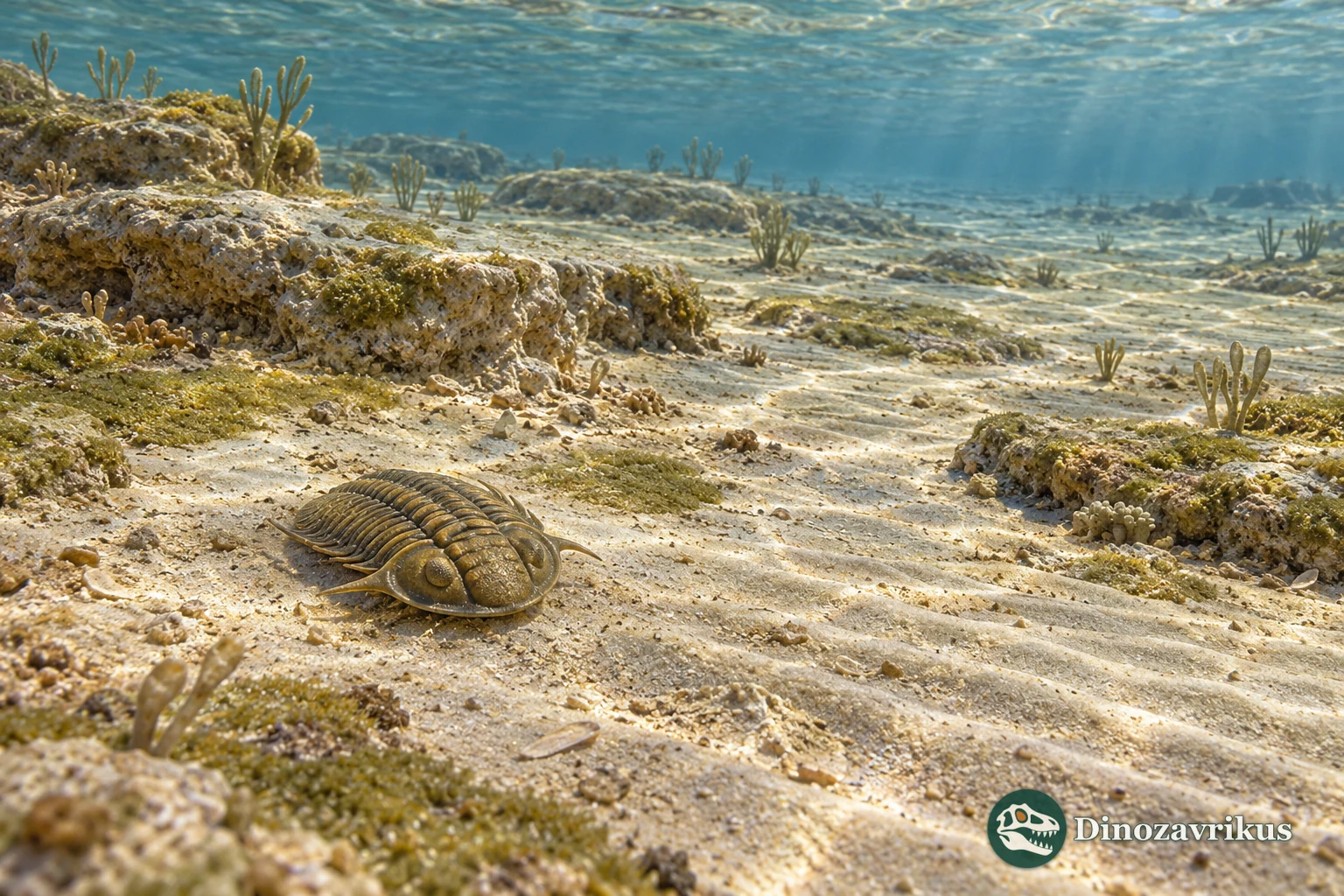
The shelf illustration below is a reconstruction of a shallow marine carbonate setting. It is not a claimed photograph or the exact locality of every specimen assigned to the genus.
Why the genus boundaries are debated
In 2015, Robert Swisher, Stephen Westrop and Lisa Amati revised the Upper Ordovician genus Raymondites using new and archival collections from Missouri, Ontario, Illinois, Wisconsin and New York. Their phylogenetic analysis supported a monophyletic Raymondites, but that result made the traditional broader Bathyurus paraphyletic in the sampled tree.
The authors treated Raymondites as the subgenus Bathyurus (Raymondites) and used Bathyurus sensu lato for the traditional broader set. This naming choice preserves the inferred nesting relationship while signalling that the broad genus does not describe a single complete branch in that analysis. The study also said that the type species B. extans and several eastern forms remained poorly known and outside the scope of its revision.
That conclusion should not be simplified to “Bathyurus has been abolished.” The paper revised a particular Upper Ordovician group and explicitly left many names unresolved. New specimens, better knowledge of the type species and broader character sampling could change the limits again.
These trilobites lived in the changing shallow seas of the Ordovician Period, but geological age alone cannot resolve their relationships. Classification depends on comparing homologous structures across carefully identified specimens.
Size, ecology and what is missing
There is no dependable single body length for the genus. Published material often consists of separate shields, and incomplete thoraces prevent a full measurement. A cranidium or pygidium can be measured directly, but converting that dimension to total length requires a complete specimen or a justified comparison with a closely related form.
The segmented exoskeleton and enrolled specimens in related bathyurids show the basic protective and flexible design of trilobites. Bathyurus fossils do not, by themselves, record a particular feeding event, swimming speed, reproductive strategy or social behaviour. A benthic or near-bottom setting is plausible for many carbonate-platform occurrences, but it should not be converted into one fixed lifestyle for every species.
Burial, mineral replacement and later weathering shaped what collectors found. Silicified fossils can retain fine surface characters, whereas incomplete moulds may lose them. Absence of a limb or ventral structure on a slab is therefore not evidence that the living animal lacked it.
Evidence, inference and reconstruction
| Level | What belongs here |
|---|---|
| Direct fossil evidence | Preserved cranidia, free cheeks, thoracic segments, pygidia and their surface sculpture |
| Research inference | Species diagnoses, formation-level ranges, biofacies and phylogenetic relationships |
| Unresolved | The full limits of Bathyurus, the anatomy of many species and genus-wide body size or ecology |
| Artistic reconstruction | Colour, soft tissues, exact limb posture and a specific living scene |
Frequently asked questions
When did Bathyurus live?
Species assigned to Bathyurus come from different Ordovician intervals. The type species, Asaphus? extans, is recorded from the Black River Group of New York.
What is the type species of Bathyurus?
It is Asaphus? extans Hall, 1847. Billings designated Hall's species when he named Bathyurus in 1859.
Why is Bathyurus classification debated?
A 2015 phylogenetic analysis found that recognising Raymondites separately left traditional Bathyurus paraphyletic in the sample. The authors treated Raymondites as a subgenus and noted that many other Bathyurus species still need revision.
How large was Bathyurus?
A reliable genus-wide length is not established. Many fossils preserve only part of the exoskeleton, so measurements of isolated head or tail shields cannot be treated as total body length.