

Bayfieldia was a Late Cambrian trilobite genus from North America. The type species is based on an incomplete head shield from a limestone clast in Quebec. Other finds show how features of the armour may survive even when the outside of the shell is lost.
Quick facts
| Group | Trilobites |
|---|---|
| Age | Late Cambrian, Furongian |
| Region | North America (Canada and United States) |
| Diet | Unknown |
| Type species | Bayfieldia tumifrons |
| Genus named by | Thomas Clark, 1924 |
What can the fossils tell us?
Holotype MCZ:IP:101229 came from Middle Ridge, Lévis. A partial central head shield leaves much of the armour unknown.
An Alaskan specimen with a smooth mould retains a small patch of the original shell with coarse granules.
The species once named B. binodosa was referred to Corbinia after comparisons of the head and tail shields.
The Lévis specimen
Thomas Clark named Bayfieldia tumifrons in 1924. The holotype from Middle Ridge is held by Harvard University’s Museum of Comparative Zoology. Franco Rasetti re-examined it for his study of Late Cambrian trilobites from the Lévis conglomerate.
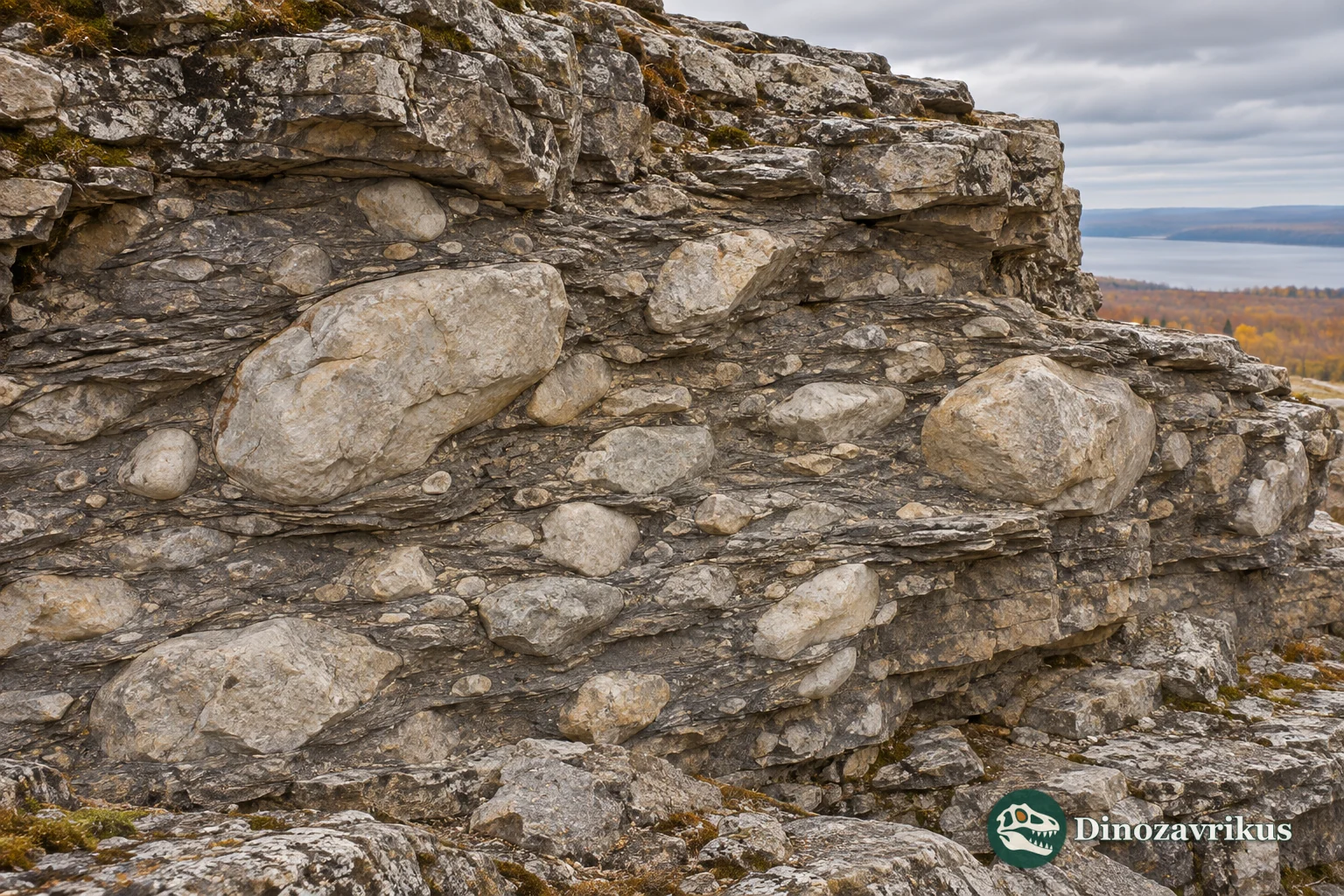
The specimen came from a limestone clast. The shell was preserved in limestone before a piece of that rock became part of a younger conglomerate. To use an occurrence for dating, geologists therefore need to establish which part of the deposit supplied the fossil.
Alaskan moulds and the limits of the genus
Allison Palmer identified cranidia of at least two forms referable to Bayfieldia in Alaska. In both, the eye lobes sit close to the glabella, slightly behind its midpoint. The frontal area is narrow, but its precise shape is often difficult to see because the outer shell remained attached to the surrounding rock.
Bayfieldia is placed in the same family as Eurekia. In comparing such trilobites, palaeontologists consider which surface the specimen preserves. Stephen Westrop restricted B. tumifrons to its incomplete holotype and proposed moving the species previously known as Bayfieldia binodosa to Corbinia.
Frequently asked questions
Where is the Bayfieldia holotype held?
Harvard University’s Museum of Comparative Zoology, as specimen MCZ:IP:101229.
Does the type specimen preserve the whole animal?
It preserves an incomplete central portion of the head shield.
What shows that the Alaskan shell was granular?
One smooth internal mould retains a small patch of the original shell with coarse granules.
Why date the limestone clast separately?
The fossil-bearing piece of limestone existed before it was incorporated into the conglomerate.