

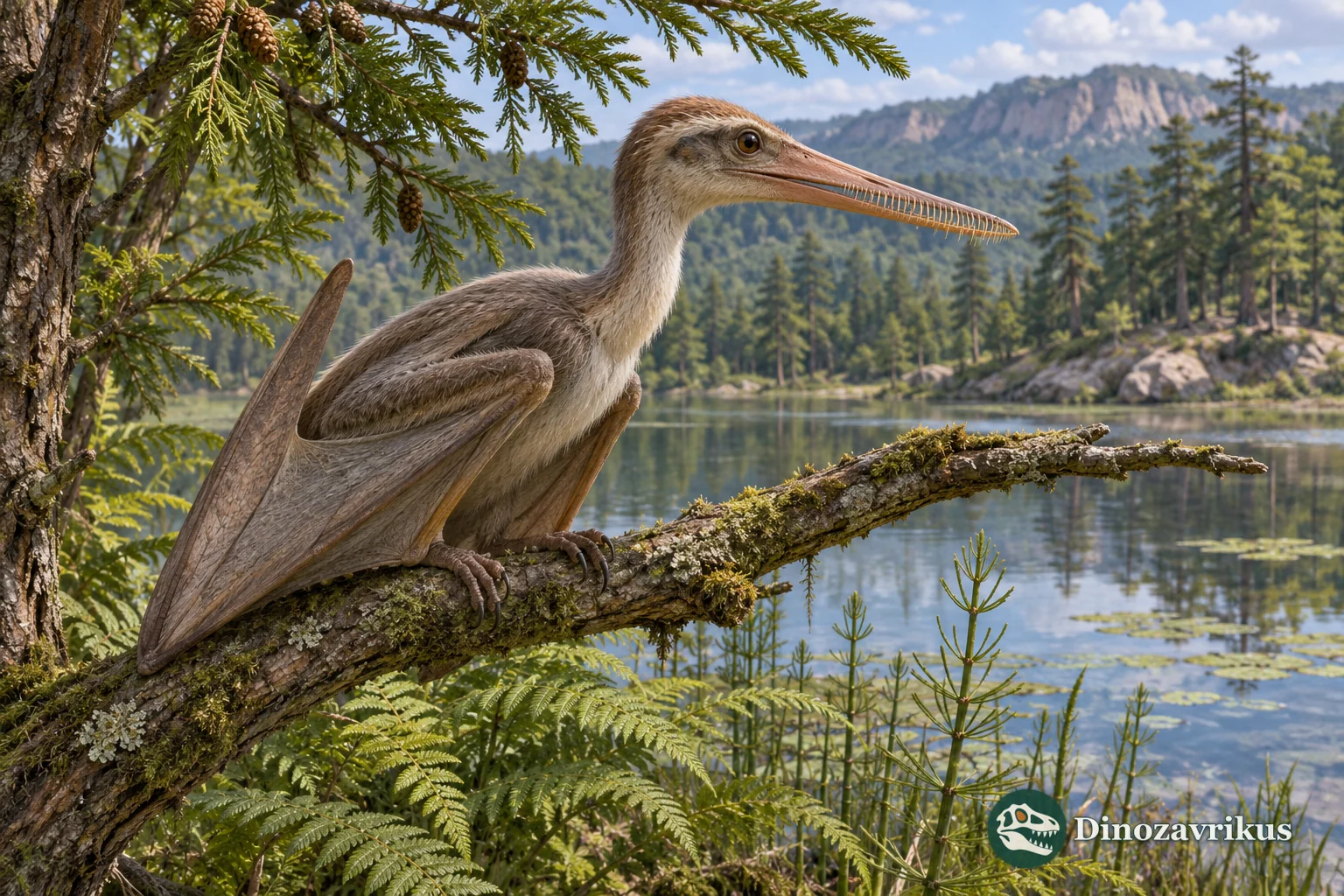
Beipiaopterus chenianus was named in 2003 from an incomplete Early Cretaceous skeleton in western Liaoning. Parts of its wing and surrounding soft tissue survived in a flattened slab. These remains provide direct information about the elongated wing finger and patches of membrane, but the specimen lacks a skull. Any pictured head, dentition or feeding method is reconstructed from comparison rather than observed in the type.
Quick facts
| Name | Beipiaopterus chenianus, Lü, 2003 |
|---|---|
| Group | Pterodactyloidea; assigned to Ctenochasmatidae in the original description |
| Age | Early Cretaceous; middle Barremian in the original description |
| Locality | Sihetun near Beipiao, Liaoning, China |
| Holotype | BPM 0002, incomplete skeleton without skull |
| Soft tissue | Patches of integument and wing membrane |
| Wing | Three preserved phalanges; the first measures 183 mm |
What can the fossils tell us?
BPM 0002 preserves vertebrae, ribs and parts of the limbs. The jaws, teeth and any head crest are absent.
Three wing finger phalanges lie in natural position. The first is 183 mm long and accounts for about 53% of their combined length in the 2003 measurements.
Wing membrane traces occur near the left wing tip and elsewhere. A later microscopy study interpreted internal structures as blood vessels.
Without a skull, the shape of its beak, tooth arrangement and particular feeding mode cannot be established from this type specimen.
The Sihetun specimen
The holotype BPM 0002 is held by the Beipiao museum. Lü Junchang named the genus for Beipiao and the species for palaeontologist Chen Peiji in 2003. The fossil comes from the Yixian Formation near Sihetun. Its original paper gave a middle Barremian age, a stratigraphic interpretation rather than a date measured from the fossil slab itself.
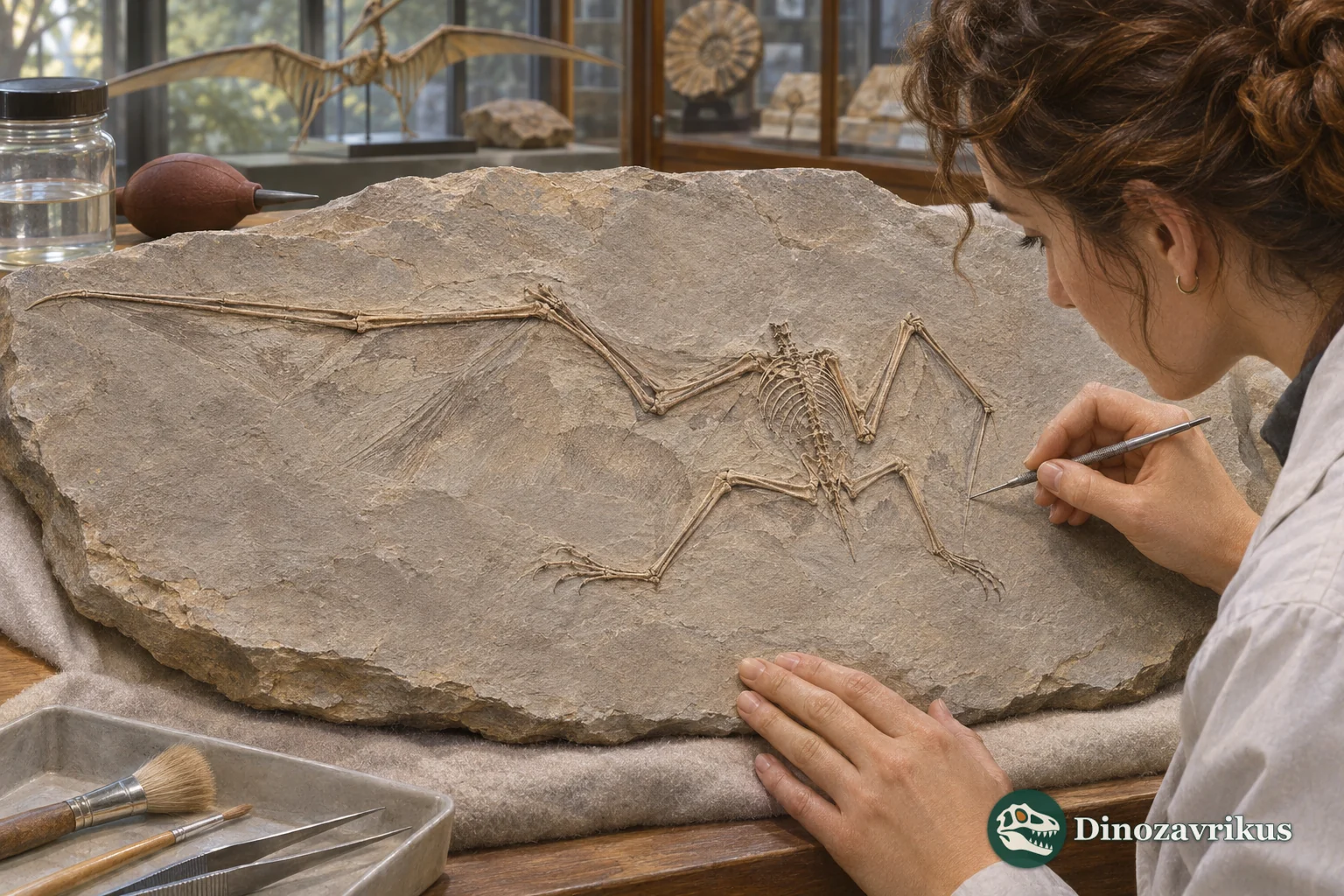
The skeleton lies on a plane of fine sediment and has been flattened. The description lists four cervical, fourteen dorsal, three sacral and nine small tail vertebrae, ribs, a nearly complete left forelimb and parts of both hind limbs. The skull, right forelimb and pelvis are missing. That distribution of remains is why a detailed wing account is possible while the head cannot be described.
A long first wing bone
Three phalanges of the elongated fourth digit are preserved in natural position. Their reported lengths are 183, 85 and 77 mm. The first therefore makes up roughly 53% of the measured finger. The wing metacarpal and ulna are approximately equal in length, and the original author also compared proportions of the hind limbs. These observations supported the original ctenochasmatid assignment.
Ctenochasma provides a comparison within that broad group, but Beipiaopterus does not preserve teeth that could be matched to it. Sinopterus lived in Early Cretaceous China too, yet belongs to another pterosaur lineage; shared geography does not imply the same skull anatomy.
Membrane and microscopic evidence
The original description recorded soft tissue near the neck, left wing tip and other limb regions. A later scanning electron microscopy study examined membrane sections and interpreted a dense network of structures as blood vessels. The authors suggested a role in heat exchange. The tissue traces are direct evidence; thermoregulatory function is an inference based on structure and comparison with living animals.
The patches do not make a complete aerodynamic outline. Flattening and incomplete preservation complicate the living shape and attachments of the membrane. Neither the skin colour nor a unique pattern of markings can be read from the slab.
What remains uncertain
No skull accompanied the type, so its diet cannot be selected from the habits of relatives with confidence. Membrane preservation supports the presence of a flying wing but does not directly measure manoeuvrability or flight height. The Yixian deposit records where this individual was buried, not every environment it visited in life. The specimen's lasting value lies in its combination of wing measurements and rare soft tissue preservation.
Frequently asked questions
Why is the head in Beipiaopterus art uncertain?
The type skeleton lacks a skull. Head shape and teeth are inferred from comparisons and are not observed in BPM 0002.
How many wing finger phalanges are preserved?
Three lie in natural position in the described left wing; the first is notably long at 183 mm.
Does the fossil preserve wing membrane?
Yes, patches were described near the left wing tip and elsewhere, but they do not preserve a complete living wing outline.
Does the membrane prove warm-blooded physiology?
A microscopy study interpreted structures as vessels and inferred a heat-exchange role. This is a physiological hypothesis, not a direct body-temperature measurement.