

Bellubrunnus rothgaengeri is based on a single articulated juvenile pterosaur from the Brunn limestone of Bavaria. The terminal phalanges of both wings curve forward, a feature that drew attention in its 2012 description. The specimen is informative about the anatomy of one young animal, but it cannot establish adult size, colour or flight performance.
Quick facts
| Name | Bellubrunnus rothgaengeri, Hone and colleagues, 2012 |
|---|---|
| Group | Rhamphorhynchidae |
| Age | Late Jurassic, late Kimmeridgian |
| Locality | Brunn quarry, Upper Palatinate, Bavaria |
| Holotype | BSP 1993 XVIII 2, articulated skeleton |
| Growth stage | Young juvenile; adult size unknown |
| Wing | Terminal phalanges curve forward on both sides |
What can the fossils tell us?
The type retains a skull, trunk, limbs and long tail on one slab. No second confirmed individual is known.
Unfused parts of the skeleton show immaturity. Its dimensions do not set the adult size of the species.
Both terminal wing phalanges curve anteriorly. The symmetry is notable, but the diagnostic status of this feature requires more specimens.
The bones do not directly measure speed, manoeuvrability, behaviour or colour. Aerodynamic effects remain hypotheses.
Discovery at Brunn
Monika Rothgaenger found the specimen at the Brunn quarry in 2002. Martin Kapitzke prepared the slab. David Hone, Helmut Tischlinger, Eberhard Frey and Martin Röper named it in 2012. The generic name alludes to the beauty of the Brunn specimen, and the specific name honours its discoverer. The holotype is BSP 1993 XVIII 2.
The Brunn Plattenkalk is assigned a late Kimmeridgian age. These coastal deposits are older than the classic Solnhofen beds, which provide useful comparisons but are not the source of this particular fossil. Burial in a coastal deposit does not identify every habitat the animal used in life.
Anatomy and age
The slab preserves a skull, vertebral column, long tail and limbs. The description reports 21 visible teeth and estimates about 20 to 22 in total, fewer than in well-known Rhamphorhynchus. Comparisons also include proportions of the humerus, femur, ulna and tibia and the structure of the tail vertebrae.
Incomplete fusion of skeletal elements shows that the individual was young. Some differences from adult relatives may therefore reflect growth. The lack of strongly elongated projections on parts of the tail, for example, needs interpretation in light of its juvenile stage. The adult wingspan cannot be derived from this one skeleton.
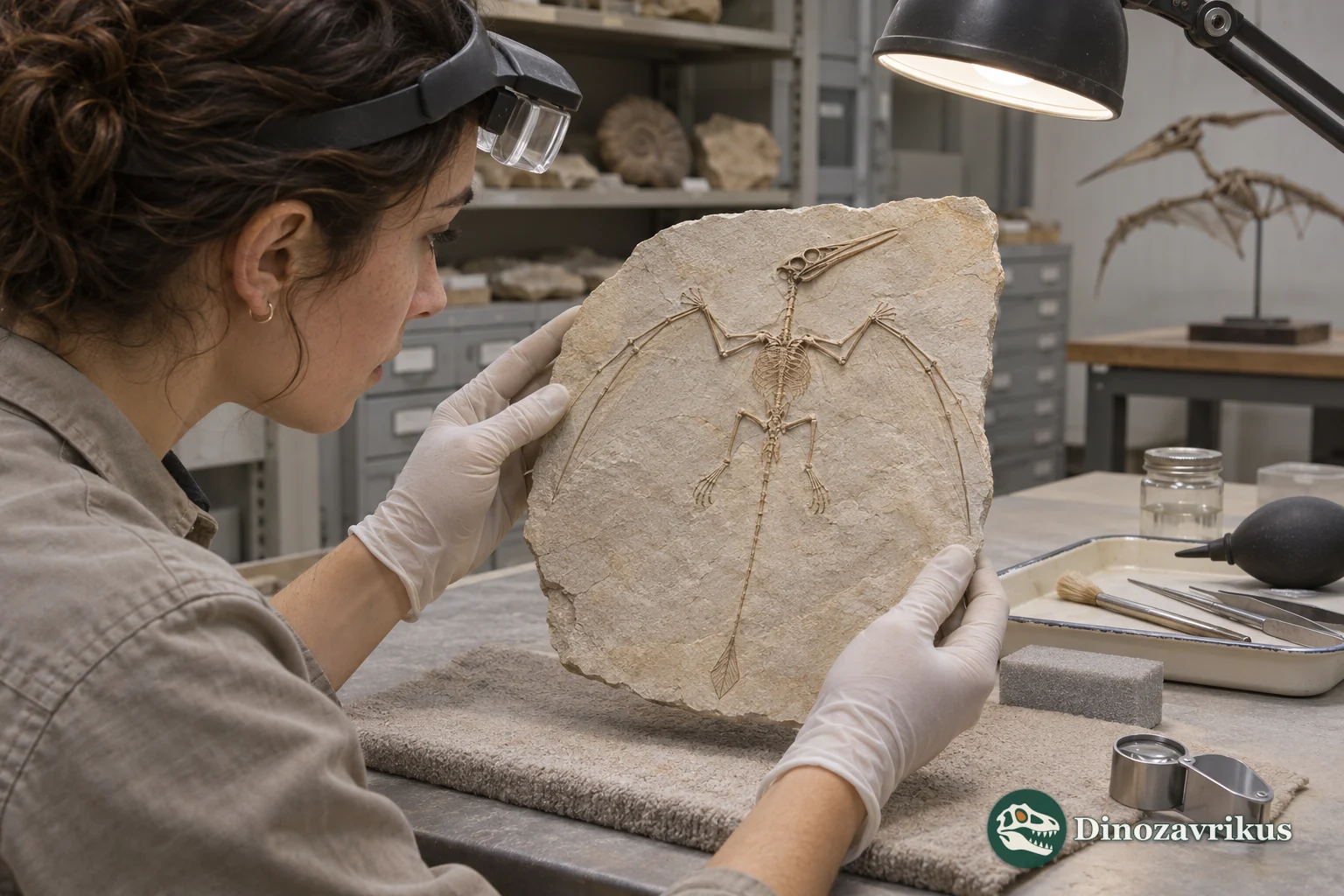
The curved wing tips
The last phalanges of both wings bend toward the front edge. The matching direction on both sides weakens a simple explanation by accidental breakage, although fossil deformation still needs scrutiny. The original authors did not treat the curve as a firmly established unique character without a second specimen. Suggestions about its aerodynamic effect are proposals rather than measurements of a living flight.
A long tail alone does not mean every early pterosaur had the same wing shape. Eudimorphodon lived earlier and offers a comparison of early pterosaur diversity, not a direct model of Bellubrunnus behaviour.
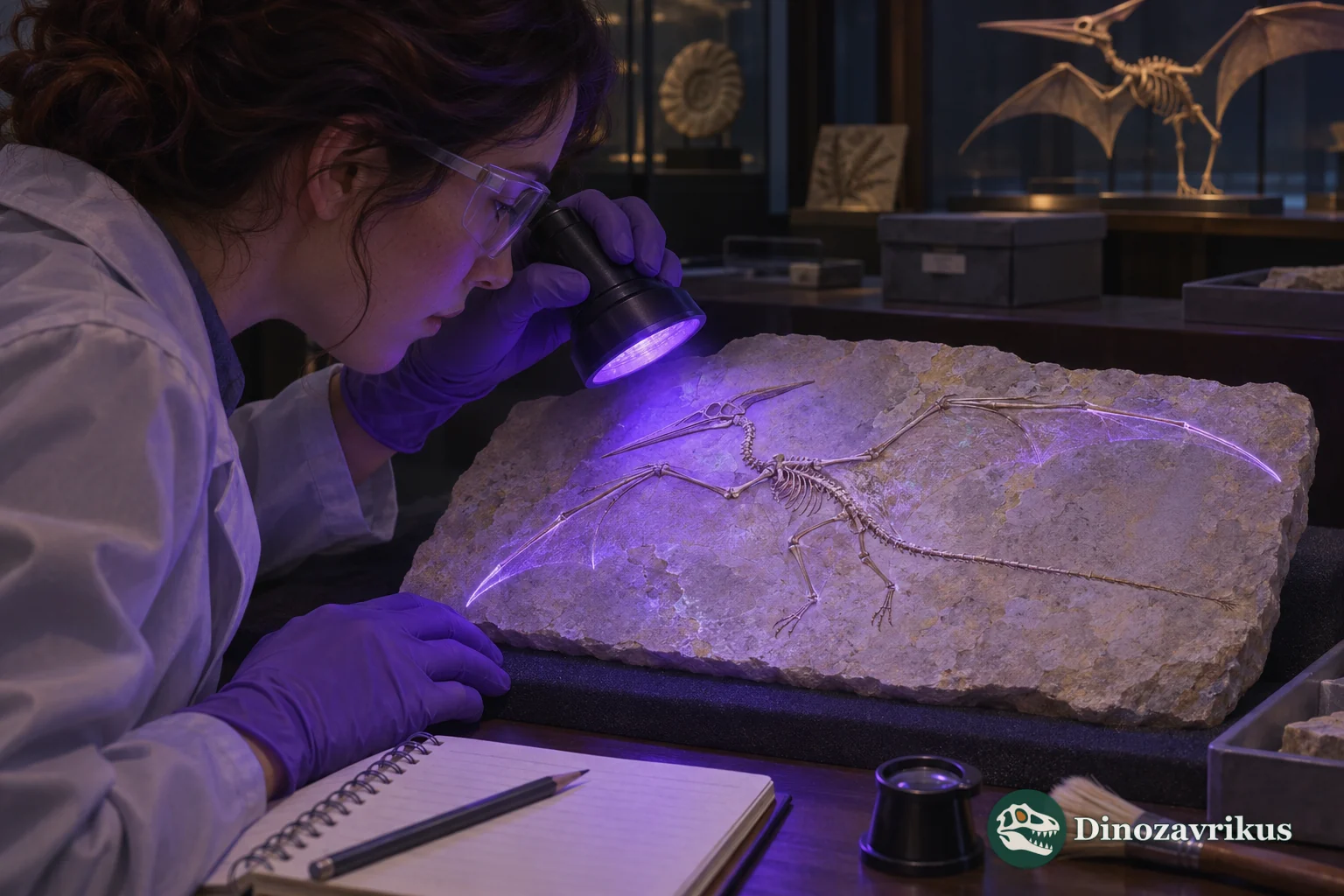
Limits of reconstruction
No meal or hunting trace is directly associated with this skeleton. Teeth support anatomical comparison but do not identify a particular prey species. Adult size, sex, colour and the duration of growth remain unknown. A lagoon scene is an artistic interpretation of geological context, not a record of observed behaviour.
Frequently asked questions
Why is Bellubrunnus not securely a dwarf species?
The holotype is a young juvenile. No adult specimen establishes the final body or wing size.
Where was the holotype found?
Monika Rothgaenger found it at Brunn quarry in Bavaria in 2002; the containing rock is late Kimmeridgian.
What is unusual about its wings?
The last phalanges on both sides curve forward. Their effect on flight has not been demonstrated.
Does the fossil include a skull?
Yes. A skull is part of the articulated skeleton, allowing comparisons of the jaws and teeth with relatives.