

Bergisuchus dietrichbergi was a crocodyliform from the middle Eocene of Germany. It is known from jaw remains that were buried at two separate sites. The compressed, serrated teeth are among the features that associate it with sebecosuchians.
Quick facts
| Species | Bergisuchus dietrichbergi |
|---|---|
| Group | Bergisuchidae |
| Age | Middle Eocene |
| Localities | Messel and Geiseltal, Germany |
| Principal evidence | Parts of the snout and lower jaw |
| Estimated length | About 1.5 m from comparison with other crocodyliforms |
What can the fossils tell us?
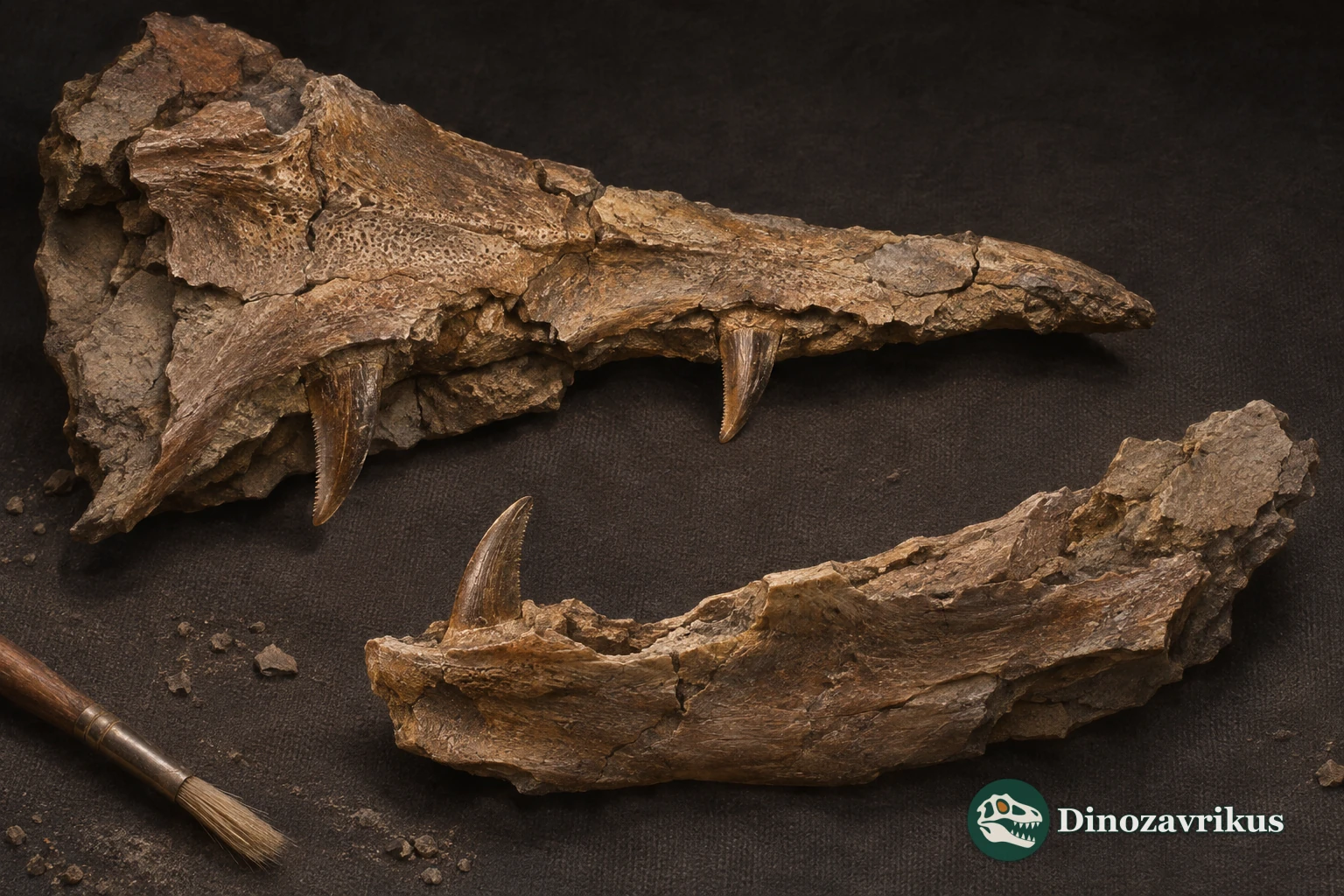
The specimen preserves a partial snout and part of the left lower jaw. It leaves the rear of the head and limb proportions unknown.
This fragment comes from younger middle Eocene deposits. It can be compared with the type jaw, but has no associated complete skeleton.
The blade-like crowns show how food could be cut. They cannot identify prey or establish where Bergisuchus hunted.
Jaw remains from two sites
Dietrich Berg reported the Messel fossil in 1966. Oskar Kuhn named the species in 1968, honouring Berg. The type, HLMD-Me 7003, is held at the Hessian State Museum in Darmstadt and preserves the front region of the snout and part of the left lower jaw.
GM XVIII-49, a separate lower-jaw fragment, comes from the Geiseltal lignite workings near Halle. It was buried later than the Messel specimen. Both finds date to the middle Eocene.
Cutting teeth and relatives
The front of the snout was deep, with narrow, pointed crowns and serrated cutting edges. Torsten Rossmann, Michael Rauhe and Francisco Ortega redescribed the remains in 2000 and established Bergisuchidae. These anatomical features help place Bergisuchus among the sebecosuchians, a group that includes South American Sebecus.
Habits and approximate size
The revising authors interpreted Bergisuchus as a predominantly terrestrial predator. The teeth could cut food, but the finds preserve no limb bones to test how it stood or moved. Burial at Messel also leaves open how much time it spent near water.
A comparison of the jaw fragments with proportions in other crocodyliforms gave an estimated body length of about 1.5 m. A skeleton with the body and tail preserved would be needed to refine that figure.
Frequently asked questions
Did Bergisuchus live in the Messel lake?
The remains were buried in lake deposits. Researchers consider terrestrial habits plausible, and the burial site does not show how much time the animal spent in water.
Who was Bergisuchus named after?
Both the genus and species names honour Dietrich Berg, who first reported the Messel fossil.
How long was Bergisuchus?
About 1.5 m is a comparative estimate based on jaw fragments. Complete body proportions are unknown.
What was distinctive about its teeth?
The crowns were compressed from side to side, with serrations along their cutting edges. This shape would have helped slice prey.