

Besanosaurus leptorhynchus is a late Anisian ichthyosaur known chiefly from a nearly complete skeleton found in northern Italy. Its unusually slender, elongated snout differs from the shorter skulls of some other marine reptiles in the same basin. In the decades after the type was described, researchers identified additional skulls and skeletons in museum collections and revised ideas about its anatomy, size and a foetus preserved inside the holotype.
Quick facts
| Type species | Besanosaurus leptorhynchus |
|---|---|
| Holotype | BES SC 999, near-complete skeleton; Milan Natural History Museum |
| Age | Late Anisian, Middle Triassic |
| Locality | Sasso Caldo quarry near Besano, Lombardy, Italy |
| Rock unit | Middle Besano Formation, Nevadites secedensis Zone |
| Holotype length | 5.07 m to the last preserved caudal vertebra |
| Largest estimate | About 8 m, inferred for incomplete specimen PIMUZ T 4847 |
Evidence guide
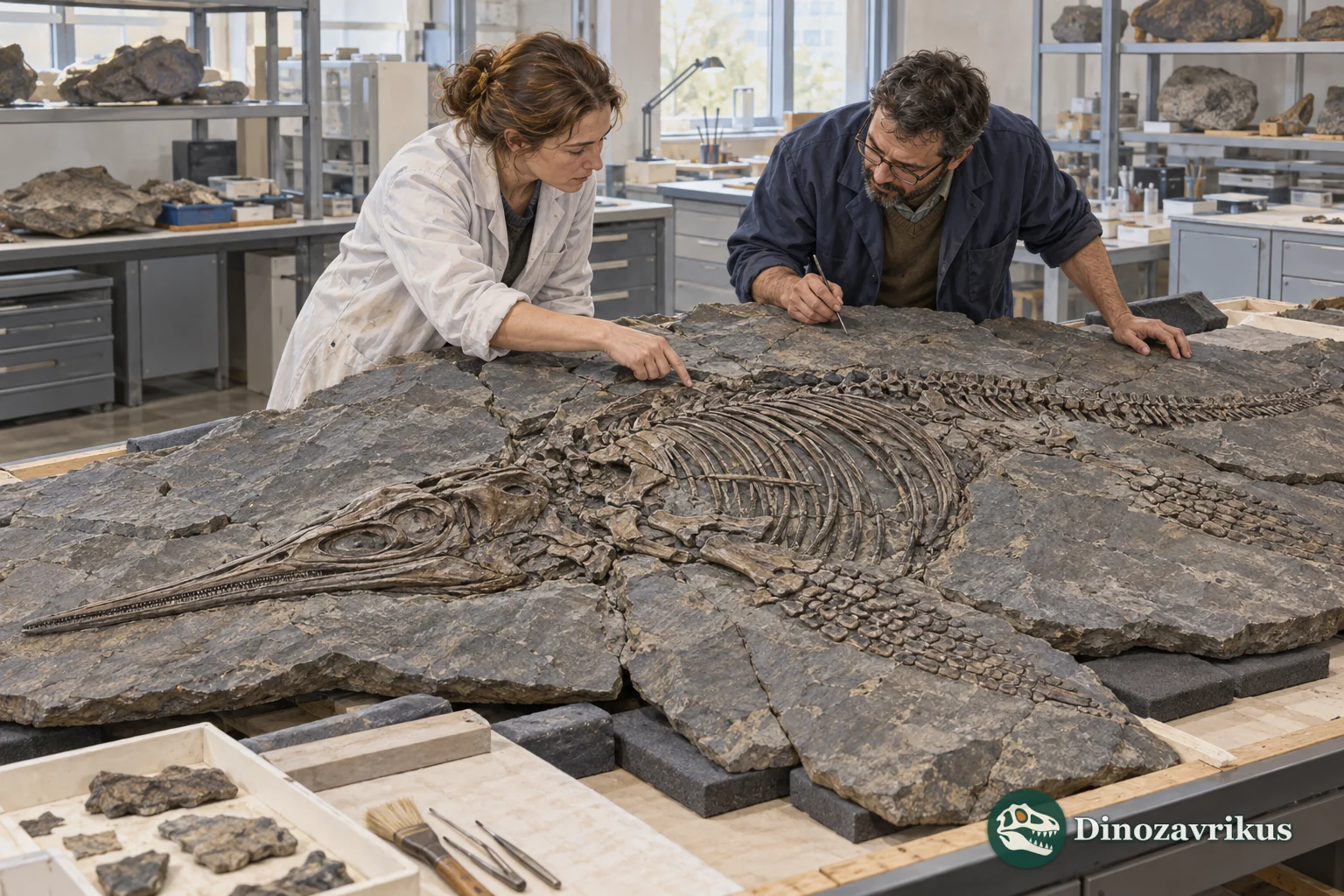
The type is spread across multiple slabs and some bones are displaced. Its preserved vertebral series can be measured, but soft tissue and exact fin outlines are not preserved.
Researchers compared five additional skulls and revised the diagnosis. They treated Mikadocephalus gracilirostris as a junior synonym of Besanosaurus leptorhynchus.
A 2024 description examined the vertebral column, girdles and fins. Strong flattening and variable preservation require caution in reconstructing motion.
The authors identified a single well-preserved late-stage foetus in the body cavity. Its position and anatomy do not reveal the full course of pregnancy or birth.
Discovery and name
The holotype BES SC 999 was unearthed in 1993 at the Sasso Caldo quarry near Besano. Work was carried out by specialists from the Milan Natural History Museum, and Cristiano Dal Sasso and Giovanni Pinna named the genus and species in 1996. The genus refers to Besano; leptorhynchus combines Greek words meaning ‘slender’ and ‘snout’.
The nearly complete skeleton is not an undisturbed three-dimensional body. It is divided among many slabs, flattened and locally displaced. The original is held in controlled conditions in the Milan museum collection; a reconstructed cast is displayed for visitors. The scientific specimen number remains BES SC 999.
More specimens and a revised diagnosis
The 1996 description was based on one skeleton. In 2021, Gabriele Bindellini and colleagues re-examined the skull and referred five additional specimens to Besanosaurus, including material not previously described in detail. They regarded the type of Mikadocephalus gracilirostris as the same species and treated Mikadocephalus as a junior synonym. That conclusion rests on shared diagnostic skull features, not simply on the fossils coming from the same area.
The revised diagnosis includes extreme longirostry, small conical teeth with deeply grooved roots, and several features of the skull roof and jaws. BES SC 999 preserves most of the axial skeleton, ribs, girdles and portions of the fore- and hindfins. Other specimens improve comparisons, although their completeness varies.
A 2024 study described postcranial material from four individuals. Computed tomography helped researchers examine parts of the holotype hidden by overlapping bones without damaging the slab. Strong flattening, especially in limb and girdle bones, still complicates reconstruction.
Measurements and size estimates
BES SC 999 measures about 5.07 m from the snout tip to the last preserved caudal vertebra. This is a measurement of a nearly complete fossil, not an estimate from a single bone. PIMUZ T 4847 preserves a 3.28 m presacral section but lacks much of the tail and most fins. Researchers inferred that the living animal may have reached about 8 m. That is an estimate from an incomplete specimen, not the measured length of a complete skeleton.
PIMUZ T 4376 is a smaller, nearly complete specimen measuring 2.12 m to its last preserved caudal vertebra; the far end of its tail is missing. A range of specimen sizes is useful for comparison, but it does not by itself establish growth rate or the exact age of any individual.
A narrow snout and possible prey
The long, slender rostrum and small teeth support a functional hypothesis that Besanosaurus pursued small, elusive prey. The skull study suggested small fish and soft-bodied cephalopods as possibilities. This is an inference from jaw and tooth form, not direct stomach contents from the holotype, and it does not prove an exclusive diet.
Other ichthyosaurs lived in the Besano basin, including the smaller Mixosaurus and the larger Cymbospondylus. Differences in their skulls may indicate different feeding roles, but exact hunting scenes remain reconstructions. Analyses place Besanosaurus among early Merriamosauria; the boundaries of the traditional Shastasauridae vary among studies, which have treated it as either a clade or a paraphyletic group.
The 2024 study used the tailbend and fin-bone arrangement to discuss possible manoeuvrability and tail movement. Bones do not preserve the soft outline of the fins or tail fluke, so speed and the exact swimming style cannot be measured directly.
A foetus inside the holotype
Small bones inside BES SC 999 were noted during earlier work. In 2026, Feiko Miedema and colleagues described them in detail as one well-preserved foetus. Based on cranial ossification, they compared its development with a late prenatal stage in the later ichthyosaur Stenopterygius. The foetus lay in the anterior part of the maternal body and, in the authors’ interpretation, was oriented for tail-first birth.
This is rare evidence of reproduction in a Middle Triassic ichthyosaur, but it has limits. The fossil does not preserve the process of birth, gestation length or the mother’s lifetime litter size. Bone position must also be interpreted in light of burial and preservation. The newer study supports one foetus in the type, not a complete account of its life cycle.
The Besano basin and fossil preservation
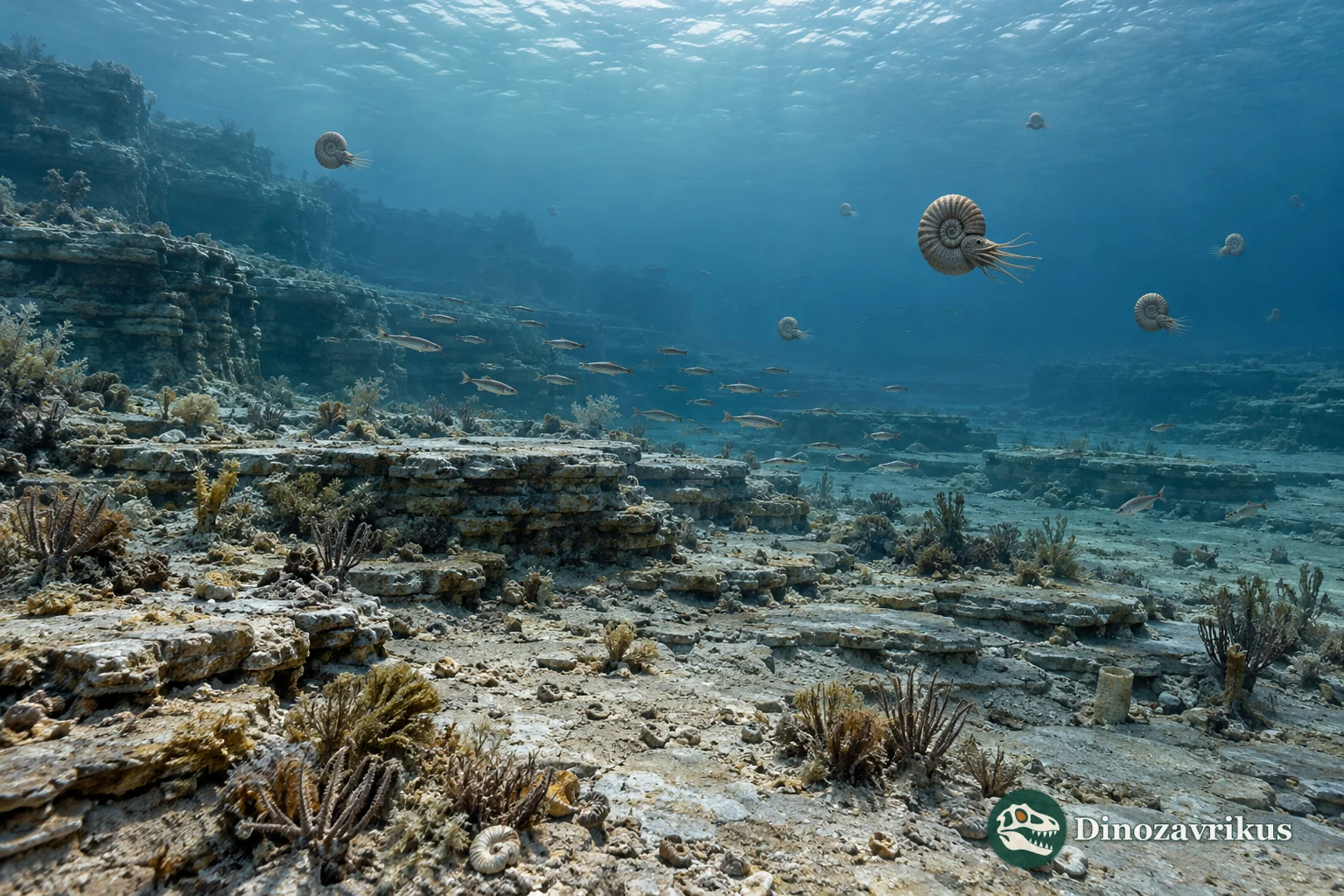
The Besano Formation crops out around Monte San Giorgio in Italy and Switzerland. Its middle portion includes thinly laminated bituminous shales and organic-rich dolomitic beds deposited in a marine intraplatform basin. Ammonoids and other index fossils correlate the holotype horizon with the Nevadites secedensis Zone of the late Anisian. The rock dates the burial layer, not an exact moment in the animal’s life.
Flattened bones, disarticulation and pyrite nodules are part of the taphonomic record of individual specimens. A large pyrite nodule in PIMUZ T 4847 was discussed as possibly associated with visceral tissue, but the mineral alone cannot identify an organ or food remains. The fossil record gives an unusual opportunity to compare skull, spine, fins and reproductive evidence; colour, soft tissues and behaviour remain unknown.
Frequently asked questions
Where was the Besanosaurus holotype found?
BES SC 999 was unearthed in 1993 at Sasso Caldo quarry near Besano, Lombardy, Italy, in the middle portion of the Besano Formation.
How large was Besanosaurus?
The holotype measures about 5.07 m to the last preserved tail vertebra. An incomplete specimen, PIMUZ T 4847, was used to infer a possible living length of about 8 m.
What did it eat?
Its narrow snout and small teeth support a hypothesis of small, agile prey, perhaps fish or cephalopods. No direct stomach contents establish a specific diet.
What was found inside the holotype?
A 2026 study described one late-stage foetus inside BES SC 999. This supports reproductive evidence for the species but does not reveal the whole process of gestation or birth.