

Bonnia was an Early Cambrian trilobite known from North American marine rocks. Several species have a pair of short spines near the front corners of the tail shield. Palaeontologists compare the shape and fine sculpture of the head and tail to identify individual species.
Quick facts
| Group | Dorypygid trilobites |
|---|---|
| Age | Early Cambrian |
| Genus named by | Charles Walcott, 1916 |
| Type species | Bonnia parvula |
| Type locality | Forteau Formation, Labrador |
| Nevada species holotype | Tail shield USNM 144283 |
What can the fossils tell us?
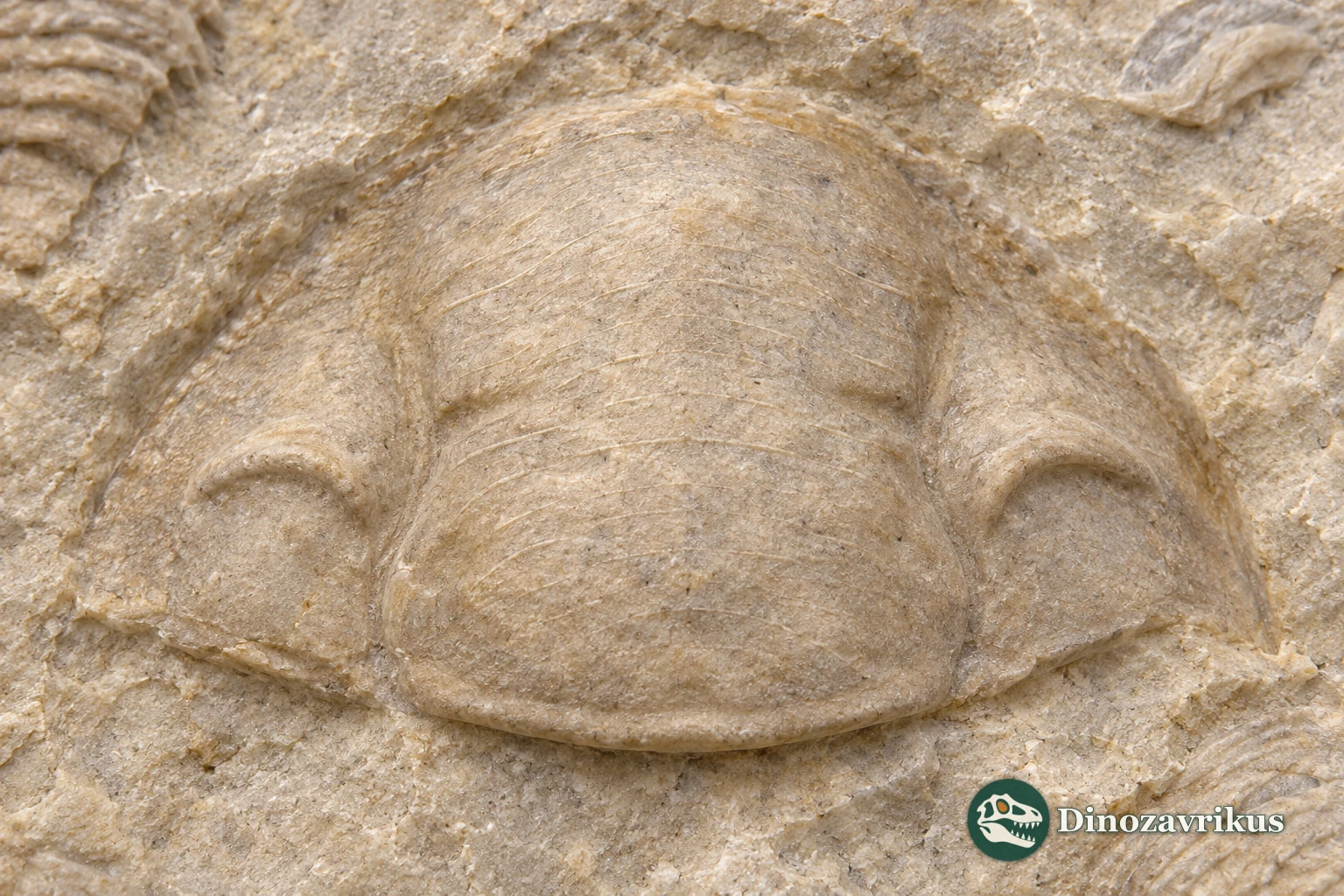
Specimen 433 belongs to the Canadian collection. Its head has a simple central lobe with nearly parallel sides.
The strength of these lines varies. The course of the grooves and the shape of the rim also help identify the species.
Such assemblages help correlate marine beds from the late part of the Early Cambrian.
A name from historical collections
Charles Walcott introduced Bonnia in 1916 as a subgenus of Corynexochus. Its type is Bathyrus parvulus, which Elkanah Billings named in 1861. Bonnia was later raised to genus rank. Charles Resser clarified that specimen 433 from the Forteau Formation of Labrador belongs to the type species. Some other material once grouped with it represents different species.
Shields from Nevada and Canada
Allison Palmer described Bonnia caperata from Nevada. Holotype USNM 144283 is a tail shield with two short spines at its front corners. Its first pleural furrows stop at the border furrow. In some related species they reach the outer edge. Fine terrace lines mark the raised parts of the shell.
In Canada's Sekwi Formation, Bonnia columbensis is represented by eighteen cranidia, twenty-two tail shields and two ventral plates from the head. Its tail axis has two clear rings, three faint rings and a terminal piece. This sample provides several features for comparison across specimens.
The Bonnia and Olenellus beds
Bonnia gives its name jointly with Olenellus to a North American biozone. In the Sekwi Formation and elsewhere, this interval belongs to the late part of the Early Cambrian. Identification of the genus depends on shields that retain features for comparison.

Frequently asked questions
What is the type species of Bonnia?
Bonnia parvula, first described by Billings under the name Bathyrus parvulus.
What is the holotype of the Nevada species Bonnia caperata?
It is the separate tail shield USNM 144283, with a pair of short spines at its front corners.
How are Bonnia species distinguished?
Researchers compare features of the head and tail, including the central head lobe, shell sculpture and the paths of the tail furrows.
When was the Bonnia–Olenellus Biozone?
It represents a late Early Cambrian interval in North America.