

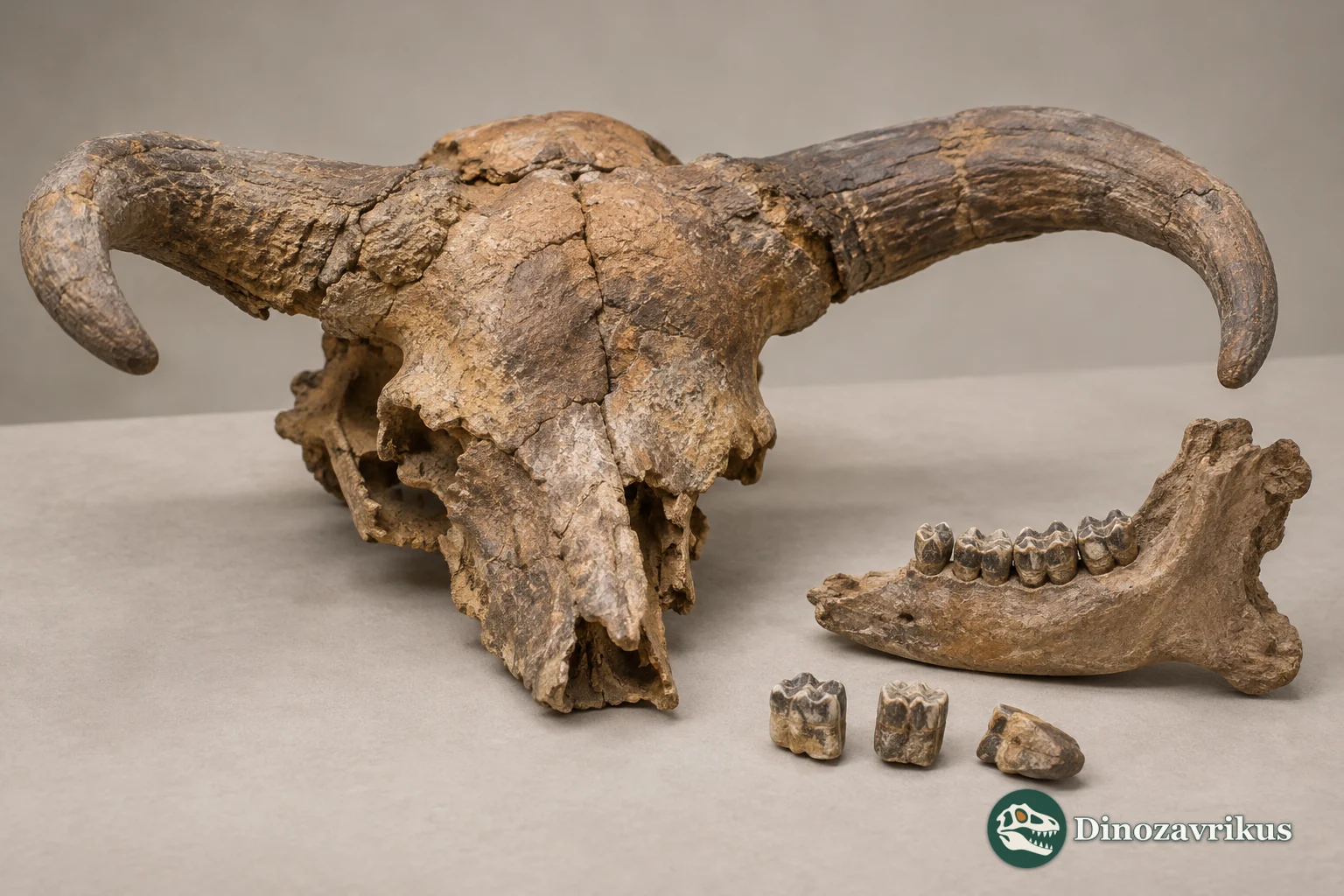
Bootherium bombifrons was a North American Pleistocene muskox relative. Its most conspicuous fossils are skulls with sweeping horn cores. They vary so greatly that large and smaller forms were once given different genus names. Later skeletal comparisons and ancient DNA make a single, sexually dimorphic species the better-supported account.
The animal belongs in the ice-age animal catalogue. It shares North American Ice Age landscapes with other large herbivores, but no one skull describes the whole geographic range or exact way of life.
Quick facts
| Species | Bootherium bombifrons (Harlan, 1825) |
|---|---|
| Genus | Bootherium Leidy, 1852 |
| Family | Bovidae, tribe Ovibovini |
| Age | Middle to late Pleistocene |
| Type locality | Big Bone Lick, Kentucky |
| Evidence | Skulls, postcranial bones and ancient DNA |
What can the fossils tell us?
The skull from Big Bone Lick preserves massive horn cores. Harlan named the species in 1825 under Bos; Leidy later created Bootherium. A type skull cannot describe all ages and sexes.
Large fused horn bases and smaller separated ones were once assigned to different genera. Morphological revision and ancient DNA support one variable species with sexual dimorphism.
Mitochondrial and nuclear results link the helmeted forms and place Bootherium close to living Ovibos. They do not show that it was the direct ancestor of today's muskox.
The Kentucky skull and changing names
Richard Harlan named Bos bombifrons in 1825 from a skull with horn cores associated with Big Bone Lick, Kentucky. Joseph Leidy erected Bootherium in 1852. The type skull is held by the Academy of Natural Sciences of Philadelphia. The old placement in Bos records a historical classification, not a second fossil species.
The names Symbos cavifrons and Gidleya were later applied to other helmeted muskox skulls. McDonald and Ray's 1989 revision brought the forms together as B. bombifrons. Broad fused horn bosses are more frequent in skulls interpreted as males; smaller, separated horn bases fit females. Individual growth and preservation also need attention.
Genetics and relatives
A study of seven mitochondrial genomes and nuclear sex data from six specimens supported joining the forms formerly called Bootherium and Symbos. Independent mitochondrial work places Bootherium near the living muskox Ovibos. Sister-lineage evidence is not a record of direct ancestry.
Neither a DNA sequence nor a horn core fixes a complete fur pattern or the size of a herd. The cover depicts a plausible heavily horned individual. Its coat, posture and exact horn outline remain artistic reconstruction, not a portrait of the type skull.

Range, habitat and a late fossil
Fossils occur widely across Pleistocene North America. One skull from Wally's Beach, Alberta yielded a radiocarbon age of 10,980 ± 80 years before present, reported as an uncalibrated value. This date belongs to that specimen and is not an exact species extinction date.
The Alberta geological setting has been interpreted as dry, windswept steppe-grassland with low shrubs. Other occurrences need separate environmental evidence; the species should not be assigned one uniform habitat throughout its range. Teeth support plant feeding, but the cited skulls do not reveal every plant eaten or how feeding changed through seasons.
Frequently asked questions
Which species belongs to Bootherium?
The reviewed genus is treated as monotypic, with B. bombifrons; Symbos cavifrons and Gidleya are historical synonyms.
Why were two horn forms named separately?
Some skulls have large fused horn bosses and others smaller separated bases. Skeletal review and ancient DNA support sexual dimorphism within one species.
Does the Alberta date mark its extinction?
No. The uncalibrated 10,980 ± 80 radiocarbon BP date belongs to one fossil, not necessarily the final living animal.
Was it the ancestor of the living muskox?
Genetic evidence supports close relationship with Ovibos but does not establish direct ancestry.