

Borvocarbo is an extinct relative of cormorants and anhingas, established from a shoulder-girdle bone found in late Oligocene France. Other fossils have been assigned to it with reservations. Its history illustrates a practical problem in fossil identification: two birds can be difficult to compare when different parts of their skeletons are preserved.
Quick facts
| Relationships | Cormorant and anhinga relatives |
|---|---|
| Type material | A coracoid from Créchy, France |
| Type-species age | Late Oligocene |
| Possible second species | Early Miocene of Germany |
| Genus named | Mourer-Chauviré, Berthet and Hugueney, 2004 |
What can the fossils tell us?
The type species is based on a coracoid. It preserves shoulder anatomy, not a complete body outline or direct evidence of food.
A shin bone and two incomplete wing bones underpin a possible second species. The missing coracoid prevents a direct comparison of the same element.
New anatomical evidence did not support the Enspel bird’s referral to Borvocarbo. It cannot serve as an unquestioned complete skeleton of this genus.
The French foundation of the genus
Cécile Mourer-Chauviré, Didier Berthet and Marguerite Hugueney named Borvocarbo guilloti in 2004 from the Créchy quarry in Allier, France. Its type material is a coracoid, the strut-like bone connecting the shoulder region to the sternum. This record belongs to the late Oligocene mammal reference level MP30.
The shoulder anatomy links the bird with cormorants and anhingas. Yet a coracoid alone cannot establish the shape of its bill, the length of its neck or its complete body proportions. A relationship with living diving birds also does not show that Borvocarbo was the direct ancestor of any particular modern species.
A tentative Miocene species
In 2010 Ursula Göhlich and Cécile Mourer-Chauviré described ?Borvocarbo tardatus from the early Miocene of Rauscheröd in Bavaria. The question mark was part of their identification. The holotype, BSPG 1990 IV 16, is an almost complete left tibiotarsus, the main lower-leg bone. The additional material consists of the proximal half of a left ulna and the proximal third of a right radius. These specimens are held in the Bavarian State Collection of Palaeontology and Geology in Munich.
The tibiotarsus measures 107.1 millimetres without the projecting upper crest. The authors compared the bird’s size with that of living European shags and great cormorants, placing it between them. This is a skeletal comparison, not a measured body mass. The ulna lacks a hook-shaped ending on one articular process; features of the shin bone also differ from those in living cormorants.
No coracoid is known from the Rauscheröd material. The very bone on which the type species rests is therefore unavailable for comparison. The generic referral remains provisional. The name tardatus refers to the younger geological occurrence, rather than demonstrating an exact last-survival date for the genus.
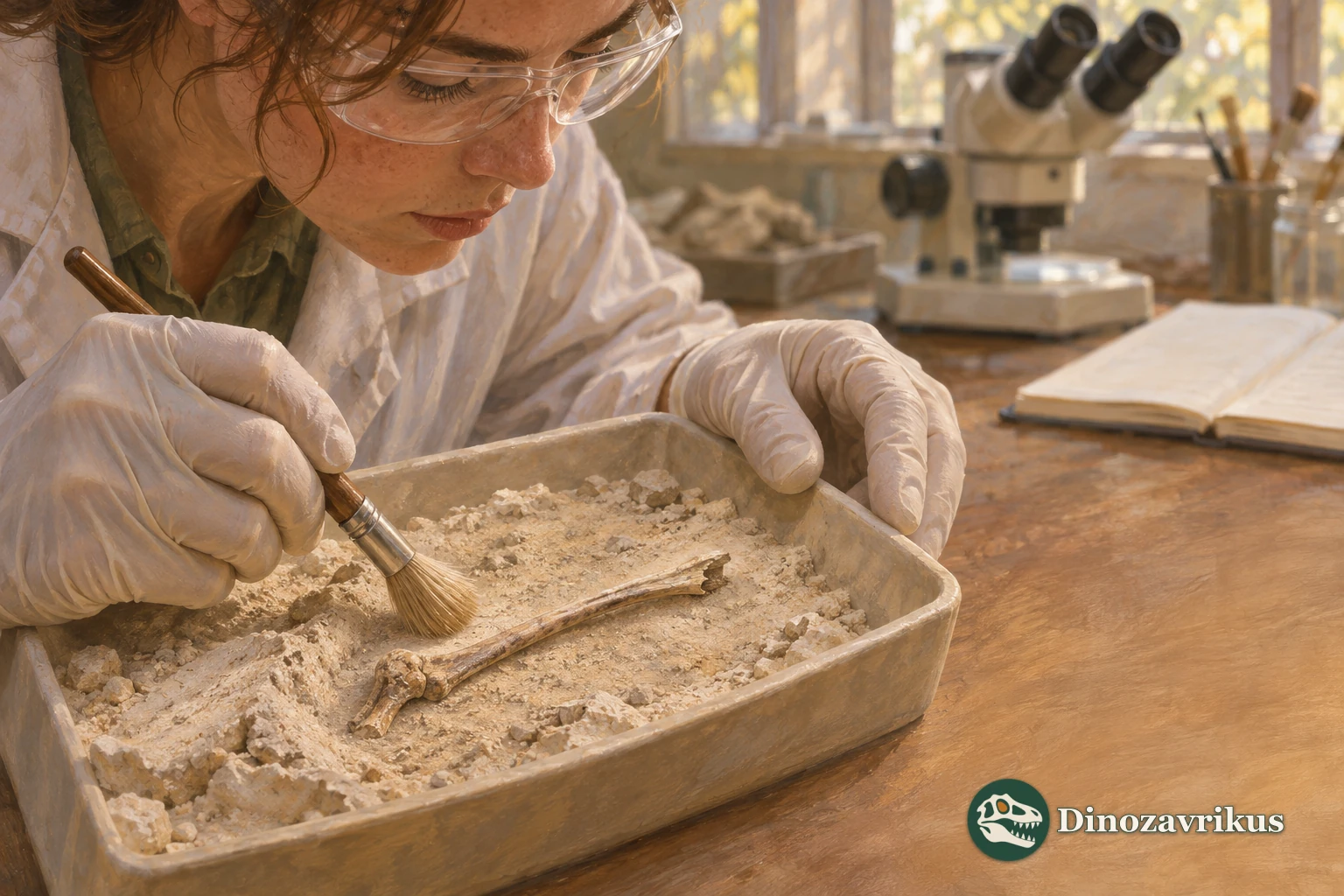
Why the Enspel skeleton cannot settle the question
Gerald Mayr described a much more complete late Oligocene skeleton from Enspel in 2007 as ?Borvocarbo stoeffelensis. Its poorly preserved coracoid prevented a secure generic identification. Other parts of this bird later provided useful comparisons for the Rauscheröd fossils.
A subsequent Enspel specimen revealed previously unknown features. In a study published online in 2014 and in a 2015 journal issue, Mayr found that these did not support referral to Borvocarbo. He tentatively returned the species to Oligocorax. Its skull outline and near-complete skeleton must consequently not be transferred automatically to the French type species. The Australian Nambashag offers another early cormorant comparison, supported by a broader fossil sample.
Depositional setting and reconstruction
The Rauscheröd bones came from brackish sediments low in a gravel-pit section. These deposits have been interpreted as part of a delta system along the Paratethys. Fossil wood helped researchers infer a warm coastal forest. That evidence describes the burial environment of the possible second species; it does not establish one habitat for every fossil ever called Borvocarbo.
An aquatic lifestyle and fish-eating are plausible by comparison with related birds, but preserved prey has not been described for these specimens. Plumage, nests and eggs are likewise undocumented. An illustration of the environment or the study of isolated bones is therefore more defensible than a supposedly precise portrait of the animal.
Frequently asked questions
Was Borvocarbo a modern cormorant?
It was a relative of cormorants and anhingas. The precise position of this sparsely represented genus cannot be established merely by resemblance to living birds.
Why is the second species written with a question mark?
The Rauscheröd bird lacks a known coracoid. Without that element, direct comparison with the type species is limited, so its original authors kept the generic referral tentative.
Is a complete Borvocarbo skeleton known?
A near-complete Enspel skeleton was once tentatively assigned to the genus. Later evidence contradicted that placement and the bird was provisionally transferred to Oligocorax.
How large was the Rauscheröd bird?
Its shin bone measures 107.1 millimetres without the upper crest. Skeletal size was compared with living European shags and great cormorants; no reliable body mass follows from that alone.