

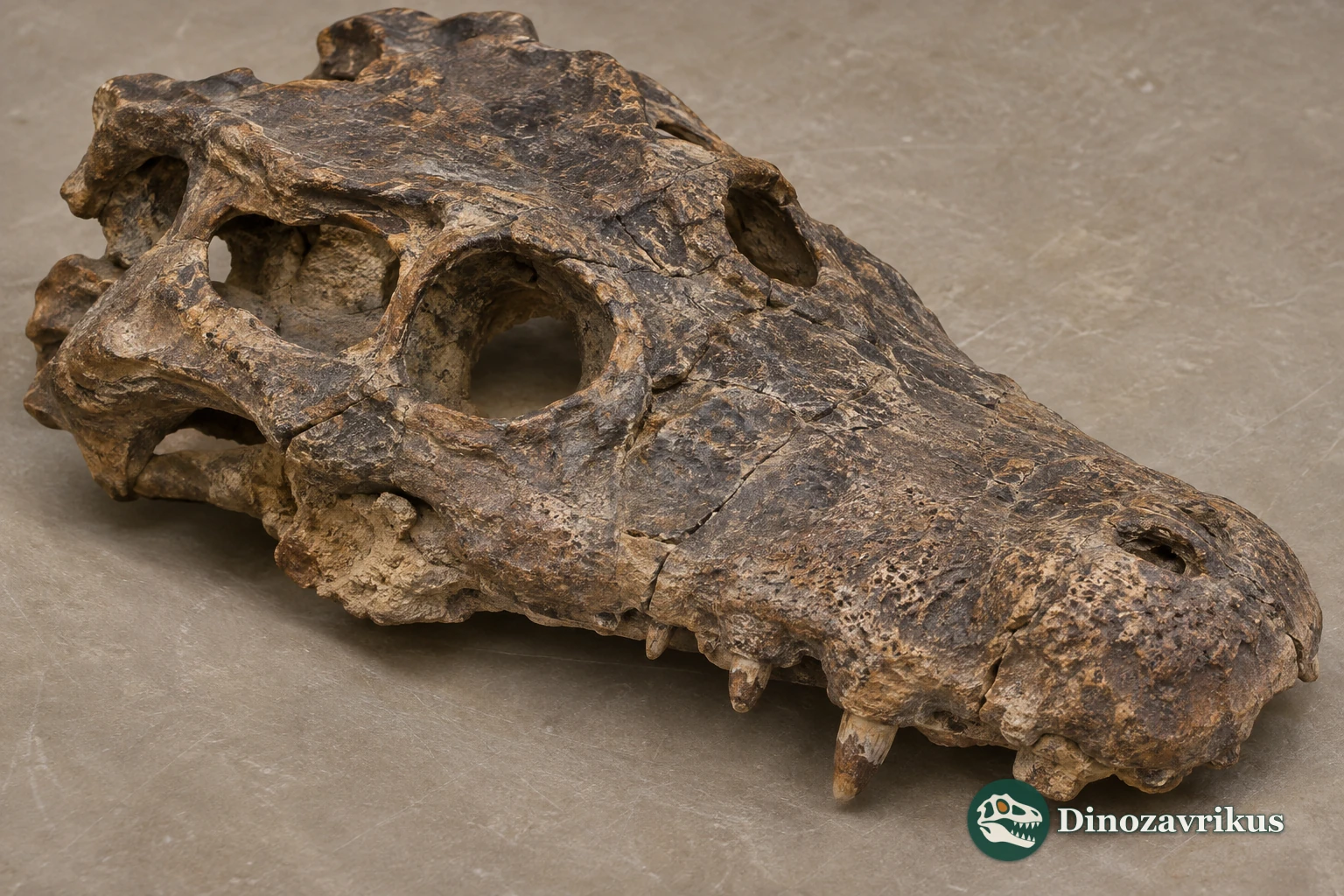
Brachyuranochampsa eversolei was an Eocene crocodyloid from Wyoming. Its skull preserves short palatine bones and an unusually shaped suture on the roof of the mouth. Deep pits between the upper teeth show where their lower counterparts fitted when the mouth closed.
Quick facts
| Type species | Brachyuranochampsa eversolei |
|---|---|
| Group | Crocodyloid |
| Age | Middle Eocene |
| Locality | Washakie Basin, Wyoming, USA |
| Principal evidence | Nearly complete skull without the lower jaw |
| Type skull length | About 39 cm with the tip restored |
What can the fossils tell us?
The shape of the suture with the upper jaw is preserved. Some bones of the palate were displaced in the rock and were repositioned during preparation.
The deepest reception pits lie between the seventh and eighth maxillary teeth. The absent lower jaw leaves its full tooth row unknown.
The estimated length with the tip restored is about 39 cm. The specimen does not preserve the trunk or tail.
Finding the Washakie skull
The Carnegie Museum's field party collected CM 9372 in 1941 from the middle Washakie beds in Sweetwater County, southern Wyoming. Rainer Zangerl prepared the skull and described the species in 1944. The name honours the Eversoles of Bitter Creek, who helped the expedition.
The skull was lying upside down in fine clay. The tip had been exposed and partly lost. The skull roof remained largely undistorted, while some bones of the palate were pressed against its inner surface. These were repositioned as far as the fossil allowed. Zangerl estimated a length of 39 cm from the occipital condyle to the tip of the snout.
Palate and tooth positions
The short palatines did not reach the front of the paired openings in the roof of the mouth. The suture between the palatine bones and the maxillae curved with its concave side facing forwards. Zangerl used that combination to distinguish the genus.
The fourth and fifth pairs of maxillary teeth were larger than the rest. The forward crowns were conical and the rear ones shorter and blunter. The deepest pits receiving lower teeth lay between the seventh and eighth pairs in the upper jaws. The lower jaw itself was absent.
How the names were separated
Charles Mook named Brachyuranochampsa zangerli in 1962 from a skull in the Bridger beds. In 2000 Christopher Brochu found no consistent differences between that skull and specimens assigned to “Crocodylus” affinis. He treated B. zangerli as a junior synonym of that species. The Washakie type remained a separate species in his analysis.
In Brochu’s tree, Brachyuranochampsa was on the crocodile branch, outside the living genus Crocodylus. The analysis compared it with other early crocodyloids, including Asiatosuchus, using characters of the skull and other available bones.
Frequently asked questions
When did Brachyuranochampsa live?
The type comes from the middle Washakie beds in Wyoming and dates to the middle Eocene.
How large was the type skull?
Zangerl estimated about 39 cm from the occipital condyle to the restored tip of the snout.
Do its teeth reveal its diet?
The front and back of the tooth row served different roles. The skull cannot identify specific prey.
What happened to the species named by Mook?
Christopher Brochu treated it as a junior synonym of “Crocodylus” affinis. The Washakie type species retained its separate name.