

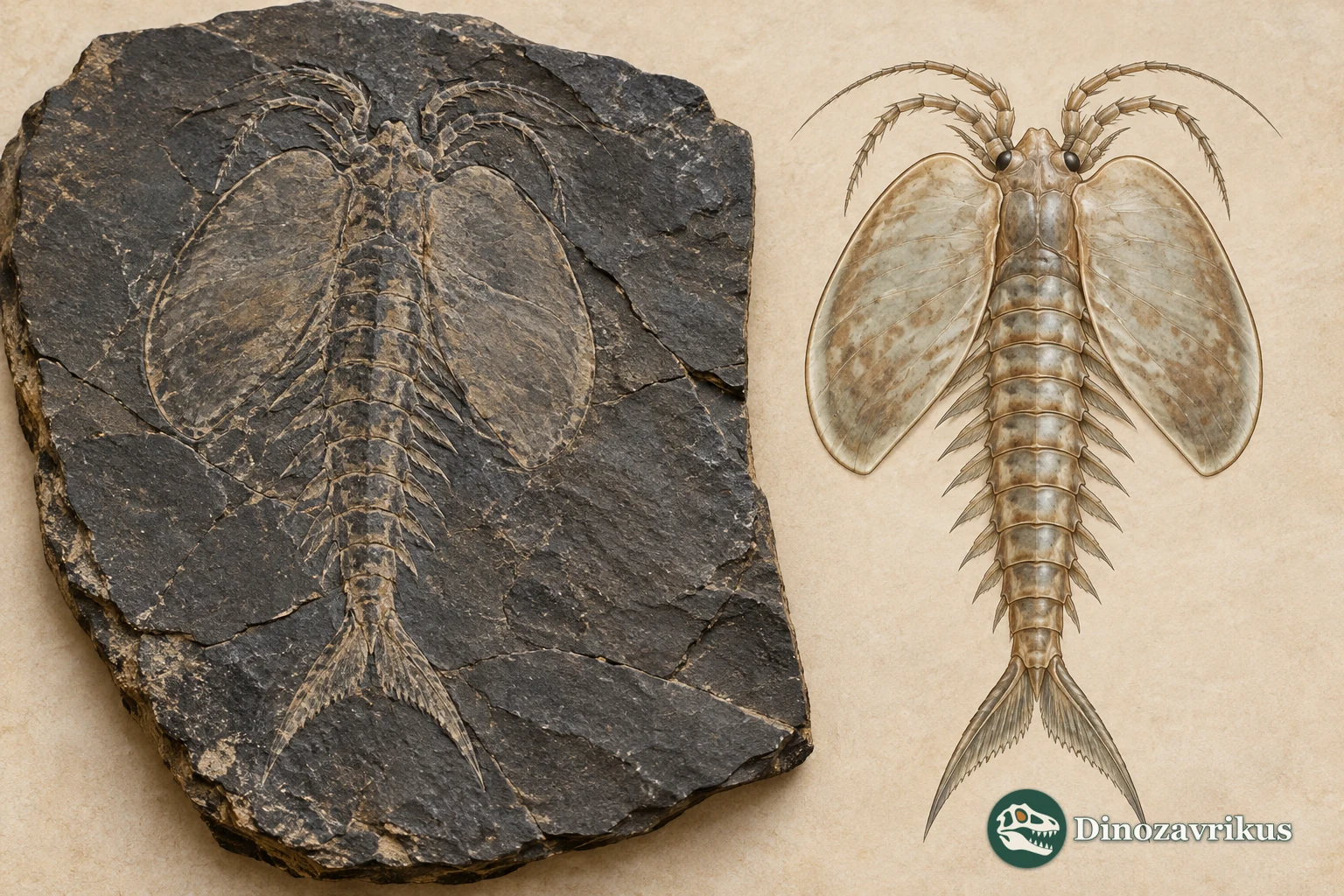
Branchiocaris pretiosa was a sizeable bivalved arthropod in the Middle Cambrian Burgess Shale of British Columbia. Its elongated segmented body sat within a pair of lateral valves and ended in a forked tailpiece. New specimens made the head and appendages easier to study than they were in the original material.
Charles Elmer Resser described the species in 1929 as Protocaris pretiosa. Derek Briggs established the genus Branchiocaris in a 1976 revision. In 2017, Cédric Aria and Jean-Bernard Caron compared new anatomical evidence from Branchiocaris with Tokummia while examining the early evolution of mandibles. The ancient arthropod catalogue includes both genera, but similar shells alone do not establish their exact evolutionary relationship.
Quick facts
| Scientific name | Branchiocaris pretiosa (Resser, 1929) |
|---|---|
| Group | Bivalved arthropod; Protocarididae |
| Age | Middle Cambrian |
| Type specimen | USNM 80483, Smithsonian National Museum of Natural History |
| Holotype length | 76 mm |
| Largest complete specimen | ROM 60751, about 154 mm |
| Key anatomy | Paired carapace, segmented trunk and forked tailpiece |
What can the fossils tell us?
Fossils preserve the outline of a broad bivalved carapace. Parts of the holotype valves were mechanically removed during preparation to expose underlying segments; that is a research procedure, not a fossil injury.
A ventral ROM specimen preserves swimming and head appendages. Different fossils expose different structures, so anatomical reconstructions combine multiple individuals.
The holotype is 76 mm long and the largest complete known specimen, ROM 60751, is 154 mm. That largest fossil is not a proven biological maximum.
The 2017 study discussed mandibulate characters in protocaridids. Their exact position within early arthropod lineages remains under study.
From Protocaris to a separate genus
Resser described the type species as Protocaris pretiosa from Burgess Shale material. In 1976, Derek Briggs revised its characters and established the genus Branchiocaris, with B. pretiosa as the type species. Such changes reflect comparison across museum collections: a broad resemblance can hide stable anatomical differences.
The holotype USNM 80483 is held by the Smithsonian National Museum of Natural History and measures 76 millimetres long. During mechanical preparation, portions of its carapace were removed to expose the segments underneath. This is a deliberate research technique that revealed the body beneath the preserved shell, not damage sustained during fossilisation.
Additional Royal Ontario Museum fossils expanded the evidence. Complete specimen ROM 34308, 90 mm long, was discovered as the counterpart to a fossil collected decades earlier; the other half is held by Harvard's Museum of Comparative Zoology. ROM 43188, 36 mm long, preserves the ventral side and parts of the appendages. The largest known complete specimen, ROM 60751, is about 154 mm long and preserves possible gut contents. That observation does not by itself establish diet; identifying the contents and their significance requires separate interpretation.
Carapace and segmented trunk
Broad paired valves covered a long body. The carapace has lobate corners and is clear on many shale impressions. Numerous segments and limbs lay behind it, while the rear ended in a forked tailpiece. This combination distinguishes protocaridids from trilobites and other Burgess Shale arthropods.
Some specimens preserve appendages and reveal the underside as well as the shell outline. Researchers compared this material with Tokummia, whose fossils show clear mandibulate features including mandibles and specialised anterior limbs. The comparison helps build a more coherent picture of early mandibulate diversity, but Branchiocaris is an extinct arthropod with its own character combination, not simply a “Cambrian shrimp.”
Movement and feeding: limits of reconstruction
The paired carapace and repeated limbs support the possibility that Branchiocaris could move through the water or above the seafloor. Protocaridids are often reconstructed as capable swimmers. But a fossil's burial position and shell shape are not direct recordings of movement. Speed, swimming frequency and the role of each limb pair remain uncertain.
The position of mouthparts and comparison with other mandibulates inform hypotheses about food processing. A specific diet cannot be assigned confidently from the carapace alone. Possible contents in one large ROM specimen are interesting but require careful identification; they do not substitute for a confirmed record of prey.
Branchiocaris in early arthropod evolution
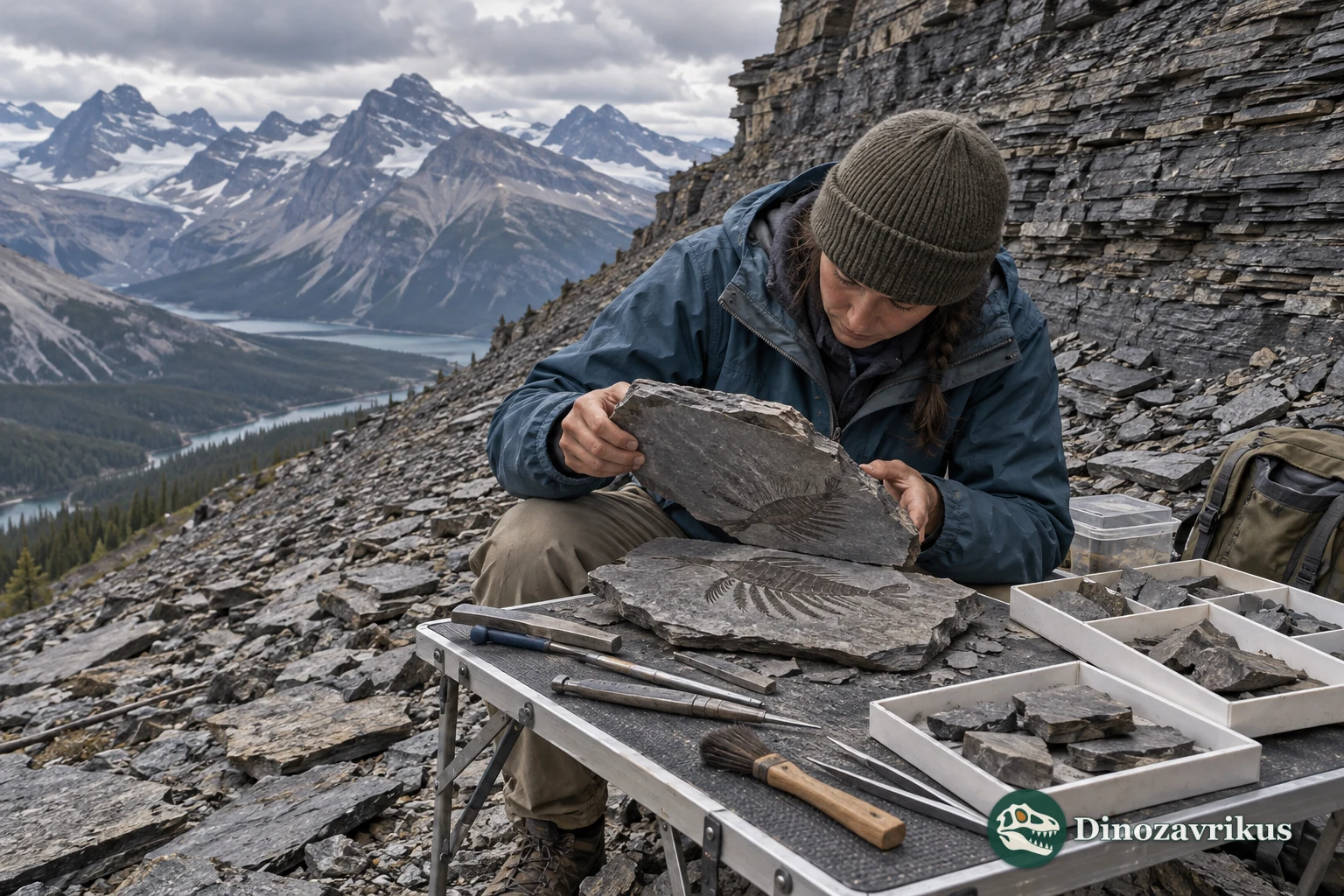
Aria and Caron's 2017 study compared Branchiocaris with Tokummia when evaluating traits of early mandibulates. The authors examined the anterior appendages and evidence for mandibles among protocaridids. Mandibulates include modern myriapods, insects and crustaceans. The work brought Cambrian bivalved arthropods into a wider discussion of how jaw-bearing appendages evolved.
The position of hymenocarines and their exact relationships within Mandibulata remain under investigation. Analyses can differ, particularly when structures are rarely preserved or their interpretation is uncertain. Branchiocaris alone cannot identify one specific step in the ancestry of modern crustaceans.
Branchiocaris lived in the Burgess Shale ecosystem alongside Odaraia, another animal with a broad bivalved carapace. Shared general features do not imply identical ecology. Useful comparisons examine appendages, segment count, tail anatomy and the particular rock layers that yielded each fossil. The wider ancient arthropod catalogue gathers these distinct lineages in one place.
Evidence, inference and reconstruction
| Direct evidence | Bivalved carapace, segmented body, forked tailpiece and appendages preserved across multiple specimens |
| Research inference | Possible swimming ability and mandibulate affinities discussed through comparative anatomy |
| Uncertain | Exact diet, locomotor performance and internal placement of protocaridids |
| Reconstruction | Colour, soft tissues and a specific swimming scene |
Frequently asked questions
When did Branchiocaris live?
Branchiocaris is known mainly from Middle Cambrian Burgess Shale deposits in British Columbia. Related material is also reported from Cambrian rocks in Utah.
Which fossil is the holotype?
The holotype of Branchiocaris pretiosa is USNM 80483 at the Smithsonian National Museum of Natural History. It measures about 76 mm long.
How large could Branchiocaris grow?
The largest known complete specimen, ROM 60751, is about 154 mm long. This is the largest complete fossil currently known, not a proven maximum for the animal.
Was Branchiocaris an ancestor of modern crustaceans?
That is not established. Research discusses protocaridid relationships to early mandibulates, but their precise position in the arthropod tree remains under study.